

What is an HX (heat exchanger) espresso machine
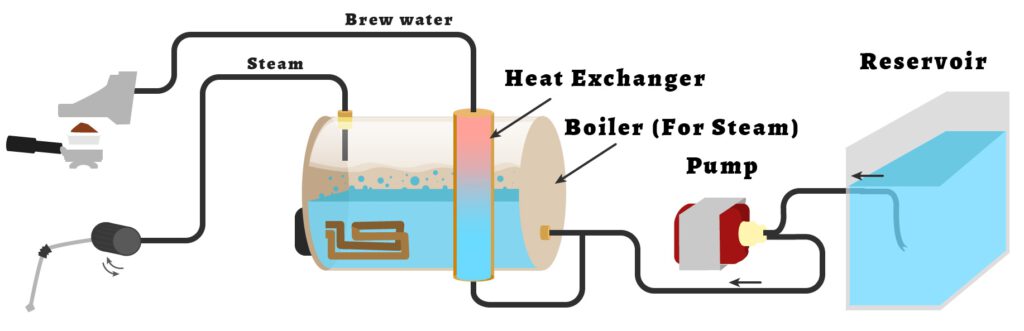
An HX espresso machine has one large boiler but with a heat exchanger. The water for espresso is not held in a separate tank: it flows through a thin tube running through the steam boiler. That is where it picks up the right temperature for brewing coffee.
It is a clever system, because it lets you steam milk and brew espresso at the same time, even though there is only one boiler. That is why HX machines are popular in cafés and increasingly in homes too.
How an HX machine and the thermosiphon work
The steam boiler in an HX machine usually heats up to about 120°C. The steam is used for steaming milk, but at the same time it heats the heat exchanger tube that fresh water for espresso passes through. The result? At the group head outlet you get water at around 90-96°C.
Most HX machines have an E61 group head with a thermosiphon. This is a water circuit that constantly heats the group head to keep the temperature stable. Thanks to it, even if the machine has been sitting unused for a while, the first shot of espresso can still be right… well, almost.

Cooling flush: why do it
If an HX machine sits for longer without brewing, the water in the heat exchanger tube can overheat. The first coffee could then be too bitter. That is why baristas do a cooling flush: they run some water through the empty group head to push out the overheated water and make room for fresh water at the ideal temperature.
Modern HX machines, such as the Lelit MaraX or ECM Technika V, already have PID systems that control the temperature and minimise overheating. In many situations the flush is then shorter, and sometimes not needed at all.
Advantages of HX espresso machines
-
You can brew and steam milk at the same time, so you can serve more people faster
-
Fresh water for espresso: it does not sit in a boiler but is drawn as needed
-
Compact size: an HX machine can usually be smaller than a dual boiler machine
-
Lower price than a dual boiler: a great compromise between capability and budget
-
Simpler construction: fewer parts, easier servicing
Disadvantages of HX coffee machines
-
Less temperature control, especially in older models without PID
-
The need for a cooling flush after the machine has been idle, to avoid overheating
-
Steam and brew water from one boiler: changing the settings can affect both circuits
-
In demanding applications, for example in specialty cafés, an HX machine can be a limitation
HX vs dual boiler: the key differences
HX
-
One steam boiler with a heat exchanger
-
Espresso water heated “on the fly”
-
No full temperature control
-
Cheaper, smaller, faster to heat up
-
A good compromise for cafés and homes
Dual boiler (DB)
-
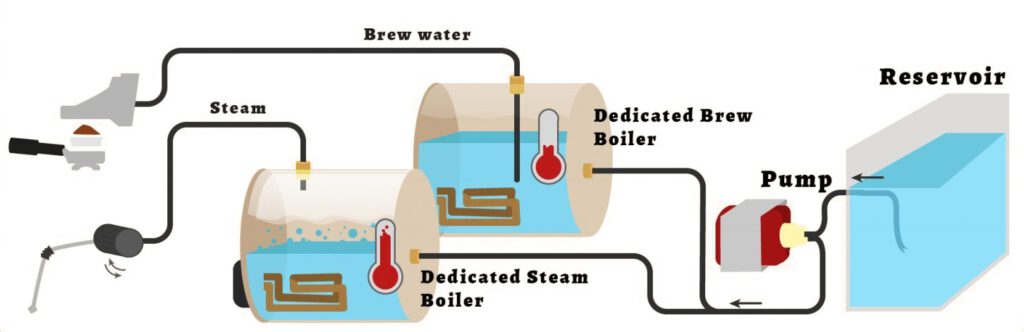
Two independent boilers: one for steam, one for coffee
-
Precise temperature control in each circuit
-
No need for a cooling flush
-
Larger, more expensive and more complex
-
Better for large cafés that need maximum stability
When an HX espresso machine makes sense
-
A small café, patisserie or ice cream parlour, where espressos and lattes are made continuously
-
Home enthusiasts who want quality close to professional machines
-
Owners of cafés with moderate traffic: an HX machine gives plenty of steam power and speed
-
When price, compact size and simple operation matter
When a dual boiler machine is the better choice
-
If you make several dozen coffees an hour and want 100% temperature stability
-
When you work with precise recipes, different coffee profiles and extraction experiments
-
In specialty cafés, where perfect repeatability and more control count
The most popular HX espresso machines
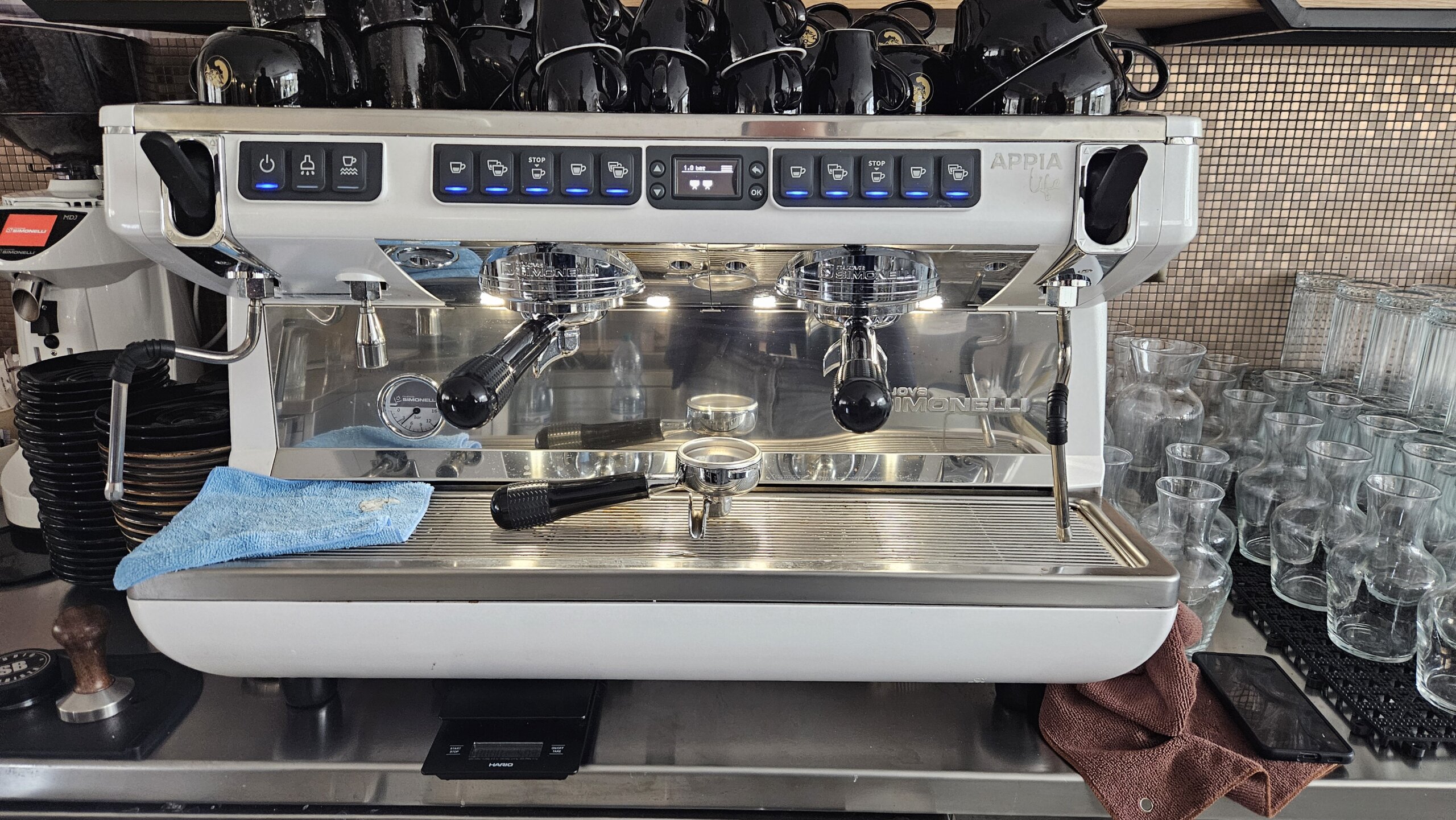
- Nuova Simonelli Appia Life Compact: a café classic, often found in hospitality
-
La Cimbali M39: ahead of its time in terms of features and still used successfully today; some machines are 15 years old
-
Astoria Gloria: a well-known design that is easy to repair
-
Faema E61: the first espresso machine to use an electric pump
FAQ: common questions about HX machines
Is an HX machine suitable for home use?
Yes, an HX espresso machine works very well at home if you want to brew espresso and steam milk at the same time. It is a compromise between price and capability.
Do you need to do a cooling flush on an HX machine?
On classic HX machines, yes, almost always. Modern models with PID, such as the Lelit MaraX, limit overheating, so the flush is shorter or unnecessary.
Is an HX machine worse than a dual boiler?
Not really. An HX machine is simpler, cheaper and sufficient for most users. A dual boiler gives full temperature control, but it is more expensive and larger.
