
Caffeine is by far the most well-known natural stimulant in coffee. A small, aromatic cup wakes up millions of people every day, sharpening concentration and lifting mood. Most people drink it mainly for the energy boost, but it is worth understanding what caffeine actually does in the body. That way you can enjoy your coffee with your eyes open: get the flavour, and keep any downsides to a minimum. Below, we look at what caffeine is, how it works, and which types of coffee contain the most of it. We also clear up some common myths (dehydration, high blood pressure) and cover the health benefits linked to moderate coffee drinking, from sharper thinking to protection against chronic disease.
What is caffeine, and how does it affect the body?
Caffeine is a small chemical that does a lot of heavy lifting. It occurs naturally in coffee, tea, cocoa and guarana, where it protects the plant from insects. On us, it works the opposite way: instead of repelling, it wakes us up, sharpens focus and gets us moving.
How does it do that? In simple terms, caffeine blocks adenosine receptors in the brain, adenosine being the compound responsible for that tired feeling. Block adenosine, and the brain never gets the signal to slow down. On top of that, dopamine, serotonin and adrenaline levels rise. The result: a better mood, sharper concentration, more energy and a faster metabolism. The heart works a little harder, circulation speeds up, and the digestive system gets a gentle nudge into action.
You will feel the first effects within 15-45 minutes, and caffeine sticks around a lot longer than that. Its half-life is roughly 4-5 hours, so a coffee at 5pm can still be keeping you up late in the evening. Everyone metabolises it differently, too: smokers break caffeine down faster, while pregnant women or people with liver problems process it more slowly. That is why some people can have an espresso at 10pm and fall straight asleep, while others are still tossing and turning after an afternoon cappuccino.
It pays to know your own body and time your coffee around your day, so the energy shows up when you actually need it, not right when you are trying to wind down.
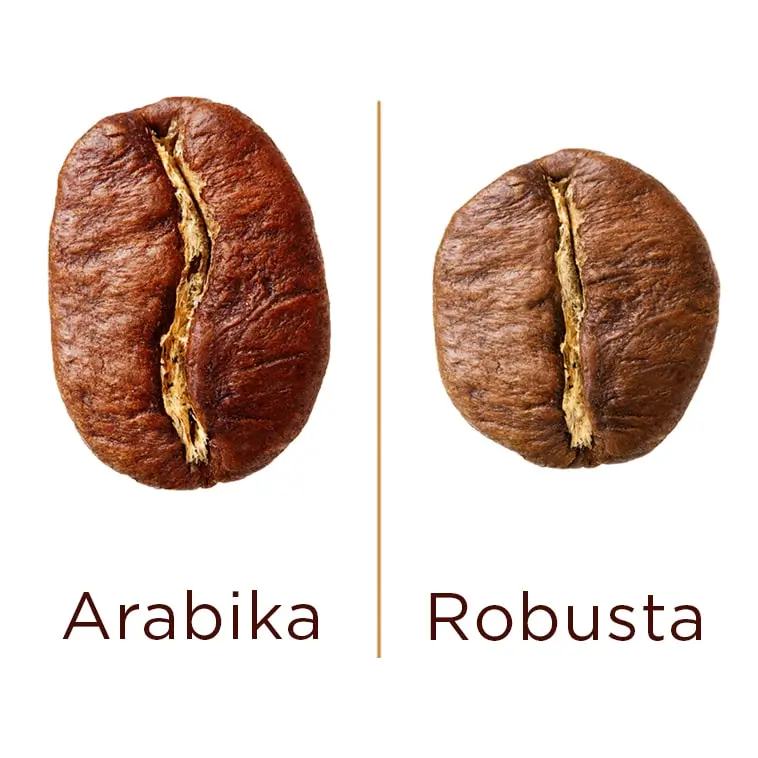
Caffeine content in coffee beans: Arabica vs Robusta
Not all coffee wakes you up the same amount. The biggest differences come down to species. The most popular coffee varieties are Arabica (Coffea arabica) and Robusta (Coffea canephora), and each has its own character.
Arabica is more subtle and aromatic, and usually contains around 1-1.7% caffeine. Robusta has a stronger, earthier profile and a much higher caffeine content, around 2-4%. In practice, that means Robusta beans give you a bigger energy hit, which is why they are often used in espresso blends. They are also behind a thicker, longer-lasting crema and that distinctive, punchy kick.
These figures can vary depending on the variety and how the coffee was grown. To put it in kitchen-spoon terms: around 7 g of Arabica delivers roughly 60-70 mg of caffeine, while the same amount of Robusta can give you up to twice that.
If you love the taste of coffee but want to skip the buzz, there is also decaf. It is still real coffee, just with the caffeine removed through a special process, so it keeps most of its aroma and character in the cup.
How roast level affects caffeine
Roast level does not have a big effect on the amount of caffeine in the bean, because caffeine holds up well under heat. It only starts breaking down at around 235-238°C, and bean temperatures during roasting usually stay in the 190-220°C range, so the loss is minimal, an estimated 0-5% even for very dark roasts.
What does change during roasting is moisture: beans lose water and get lighter.
- Light roast: around 13-15% weight loss
- Medium roast: around 15-17% weight loss
- Dark roast: up to 18-22% weight loss
That is why light-roasted beans are denser, while dark-roasted ones are more porous and take up more volume.
What this means in practice:
- Measuring by volume (with a spoon or scoop): a light roast can give you around 10-12% more caffeine per serving.
- Measuring by weight (18 g for an espresso, say): the difference in caffeine is close to zero, often under 1-2%.
The Scandinavian legend behind light roasting
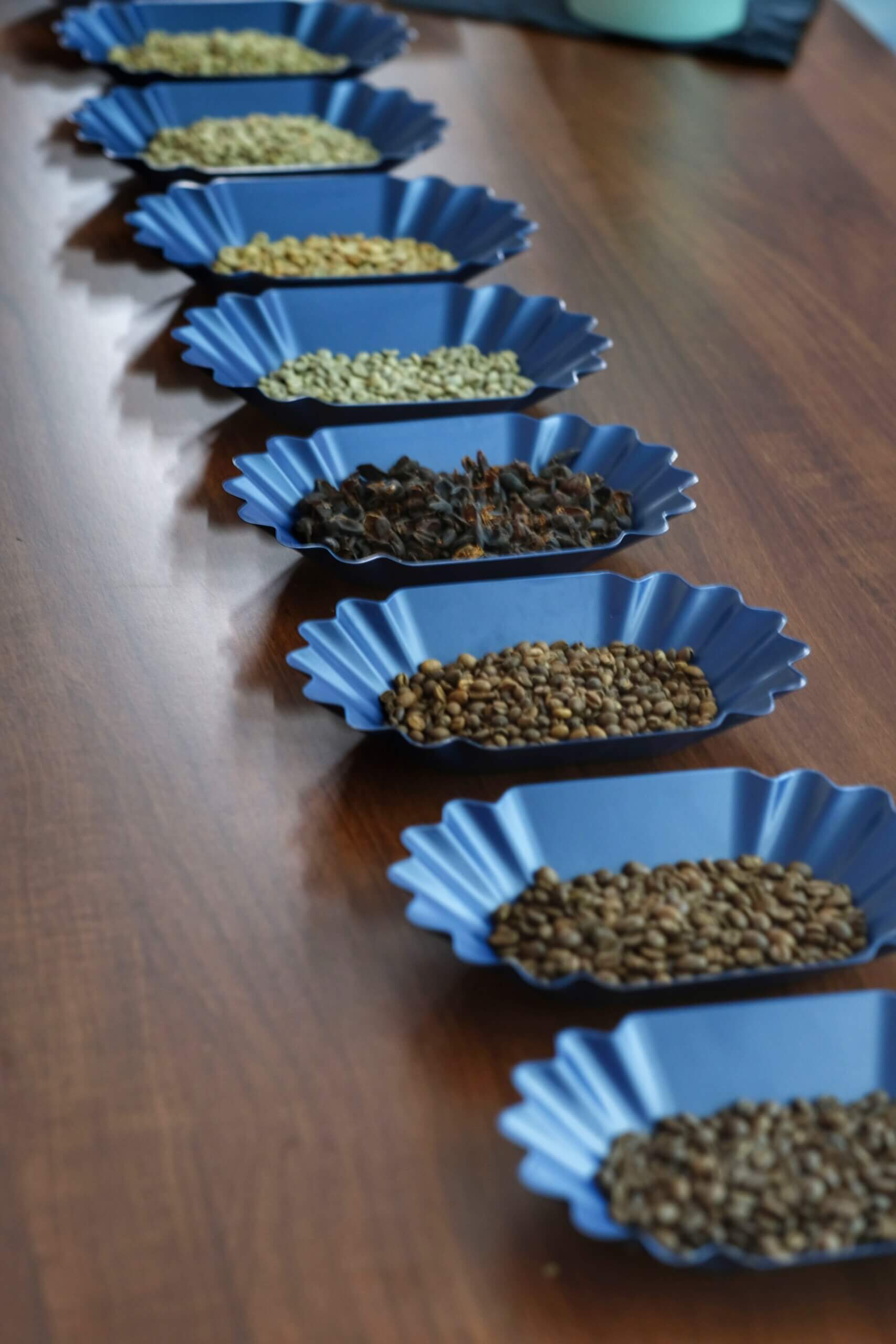
Light roasting is closely tied to the specialty coffee world today, but its popularity in Europe has an interesting Nordic backstory. Countries like Finland and Norway long favoured dark-roasted coffee, imported already roasted. Over time, roasters started bringing in green beans and roasting them locally to get a better sense of the coffee’s natural flavour. Experiments pushed towards very light profiles that bring out sweetness, fruitiness and acidity.
That is how the Nordic roasting aesthetic was born, later growing into the specialty coffee philosophy of showing the flavour of the bean, not the roast.
There is another theory that does the rounds in the industry too. Some say the first Scandinavian roasters kept their roasts light because they were worried about beans self-igniting at darker profiles. It is a good story, but it is not confirmed as the main reason for light roasting, more one of the colourful legends that surround Nordic coffee culture.
Brew method and caffeine content
How much caffeine ends up in your cup depends on more than just the beans. The brew method matters enormously. Caffeine is extracted from coffee gradually, so the longer the water is in contact with the grounds, the more of it ends up in the cup.
Espresso is short, intense, and has the highest caffeine concentration per millilitre. But because a shot is usually only 25-35 ml, it delivers around 30-65 mg of caffeine on average. A classic filter coffee, by comparison, at 200-250 ml, can contain as much as 120-160 mg. It is a similar story with French press or AeroPress, where the longer contact time between coffee and water means more caffeine in the cup.

So in short: espresso tastes the strongest and has the highest caffeine concentration, but a large filter coffee usually wakes you up more, simply because there is more of it.
The coffee-to-water ratio plays a part too: a higher dose or less water means a more intense extraction. Cold brew, steeped in cold water for many hours, can be a real caffeine monster, because the extraction time is extremely long, even though the flavour ends up smoother.
And the milk in a cappuccino or latte? It does not change the caffeine content at all, it just adds volume. A latte has exactly as much caffeine as the espresso shot it is built on, just spread out over a bigger cup.
Health benefits of moderate coffee drinking
Moderate coffee drinking, roughly 3-5 cups a day, is consistently linked to health benefits in research. Coffee is about more than caffeine: it is also full of powerful antioxidants and anti-inflammatory compounds that support the body in a number of ways.
For the brain, coffee may improve short-term memory, concentration and reflexes. Older adults who drink coffee regularly often show better mental sharpness and a slower decline in cognitive function. Regular coffee drinking is also linked to a significantly lower risk of neurodegenerative disease. Studies suggest that people who drink several cups a day may have a noticeably lower chance of developing Alzheimer’s or Parkinson’s disease.
Coffee also supports metabolism and the cardiovascular system. Numerous studies show that coffee drinkers are less likely to develop type 2 diabetes, and moderate consumption is linked to a lower risk of high blood pressure and cardiovascular disease. Polyphenols such as chlorogenic acid, along with improved insulin sensitivity, are among the main suspects behind this effect.

Coffee also appears to protect nerve and blood vessel cells from oxidative stress. In practice, that may translate into a lower risk of stroke and heart attack, as well as certain cancers, particularly colorectal and liver cancer.
One interesting pattern that keeps showing up in research is the so-called U-shaped effect: moderate coffee consumption comes out on top, while very low or very high intake seems to bring fewer benefits. In other words, the middle ground works best.
Of course, everyone’s body reacts differently. If you have high blood pressure, an arrhythmia or particular sensitivity to caffeine, listen to your body and talk to your doctor about how much coffee is right for you. The key is paying attention to how you actually feel, not chasing a specific number.
Coffee facts and myths
Coffee comes with plenty of long-running myths. Time to set the record straight.
Myth: “Coffee dehydrates you.”
Fact: Coffee is mostly water, and drinking it in moderation does not cause dehydration. Caffeine has a mild diuretic effect, but in people who drink coffee regularly, the body quickly adapts to it. Three to five cups a day will not disrupt your fluid balance, as long as you are drinking normal amounts of other fluids too. In short: an espresso is not a desert, drink it without worrying.
Myth: “Coffee is bad for your heart and raises blood pressure.”
Fact: In some people, coffee can raise blood pressure briefly, but over the long term, moderate coffee drinking does not increase the risk of heart disease. If anything, plenty of studies show that regular coffee drinkers have a lower risk of stroke, heart failure and cardiovascular disease. One technical detail worth knowing: filter coffee removes some of the compounds that can affect cholesterol levels, so if you are prone to high cholesterol, filter coffee can be a good choice.
Myth: “Coffee leaches calcium and causes osteoporosis.”
Fact: Moderate coffee drinking does not weaken bones. As long as your diet includes enough calcium and vitamin D, coffee is neutral for bone health. With very low calcium intake there can be a small effect, but that is a deficiency issue, not a coffee one. For most people eating a reasonably healthy diet, coffee poses no threat to their bones.
Myth: “Coffee is highly addictive.”
Fact: Caffeine can cause mild physical dependence, and stopping it can bring on headaches, drowsiness, low energy or irritability in some people. These symptoms usually pass within a few days. This is not addiction in the sense of nicotine or harder psychoactive substances. If you want to cut back on caffeine, it is best to do it gradually, for example by switching partly to decaf.
To sum up: coffee is a complex drink, full of bioactive compounds, antioxidants and aromatics, and its effects go well beyond the buzz of an espresso. As part of a healthy diet and in sensible amounts, coffee can genuinely support your body rather than work against it. The key is simple: moderation, and paying attention to how you feel.
FAQ: Caffeine and coffee
Does coffee really wake you up?
Yes. Caffeine blocks the adenosine receptors in the brain that are responsible for that sleepy feeling. That sharpens concentration, alertness and energy levels. It is physiology, not the placebo effect.
Which has more caffeine, espresso or filter coffee?
Espresso tastes the strongest and has the highest caffeine concentration per millilitre, but it is a small drink. A filter coffee (200-250 ml) usually contains more caffeine overall, so it tends to wake you up more.
Does a light roast have more caffeine than a dark roast?
Caffeine does not burn off during roasting. Any difference comes down to bean density: light-roasted beans are heavier, so by volume they contain slightly more caffeine. What matters is the weight of the beans, not the colour.
Arabica or Robusta: which is stronger?
Robusta. It usually has 2-4% caffeine, compared with around 1-1.7% for Arabica. That is why espresso blends often include some Robusta, for extra strength and a stable crema.
Does coffee dehydrate you?
No. Coffee is mostly water. In people who drink it regularly, the diuretic effect is minimal. Moderate consumption does not cause dehydration.
Is coffee bad for your heart?
Not for healthy people. Plenty of studies link moderate coffee drinking to a lower risk of heart disease and stroke. If you have an arrhythmia, keep an eye on how your body responds.
Can coffee affect your sleep?
It can. Caffeine lasts around 4-5 hours on average, longer for some people. If you struggle to sleep, it is best to have your last coffee between 2pm and 4pm.
Is coffee addictive?
Caffeine can cause mild dependence. Stopping it may bring on headaches and fatigue for 1-3 days. It is a mild, short-lived effect.
