









A coffee shop may be spending 44% of its net revenue on staff while the owner believes the figure is only 33%. The difference has nothing to do with pay rises or hiring more staff. It can come down to using the wrong sales figure and overlooking some of the employer’s costs. On paper, the coffee shop then looks far more profitable than it really is.
Colin Harmon, founder of the 3fe coffee shop chain in Dublin, describes this mistake in his book “What I Know About Running Coffee Shops”. He works through a simple financial example and explains why even a correctly calculated percentage should not be the sole basis for staffing decisions. Too many staff put pressure on the budget. Too few can limit sales and leave employees exhausted.
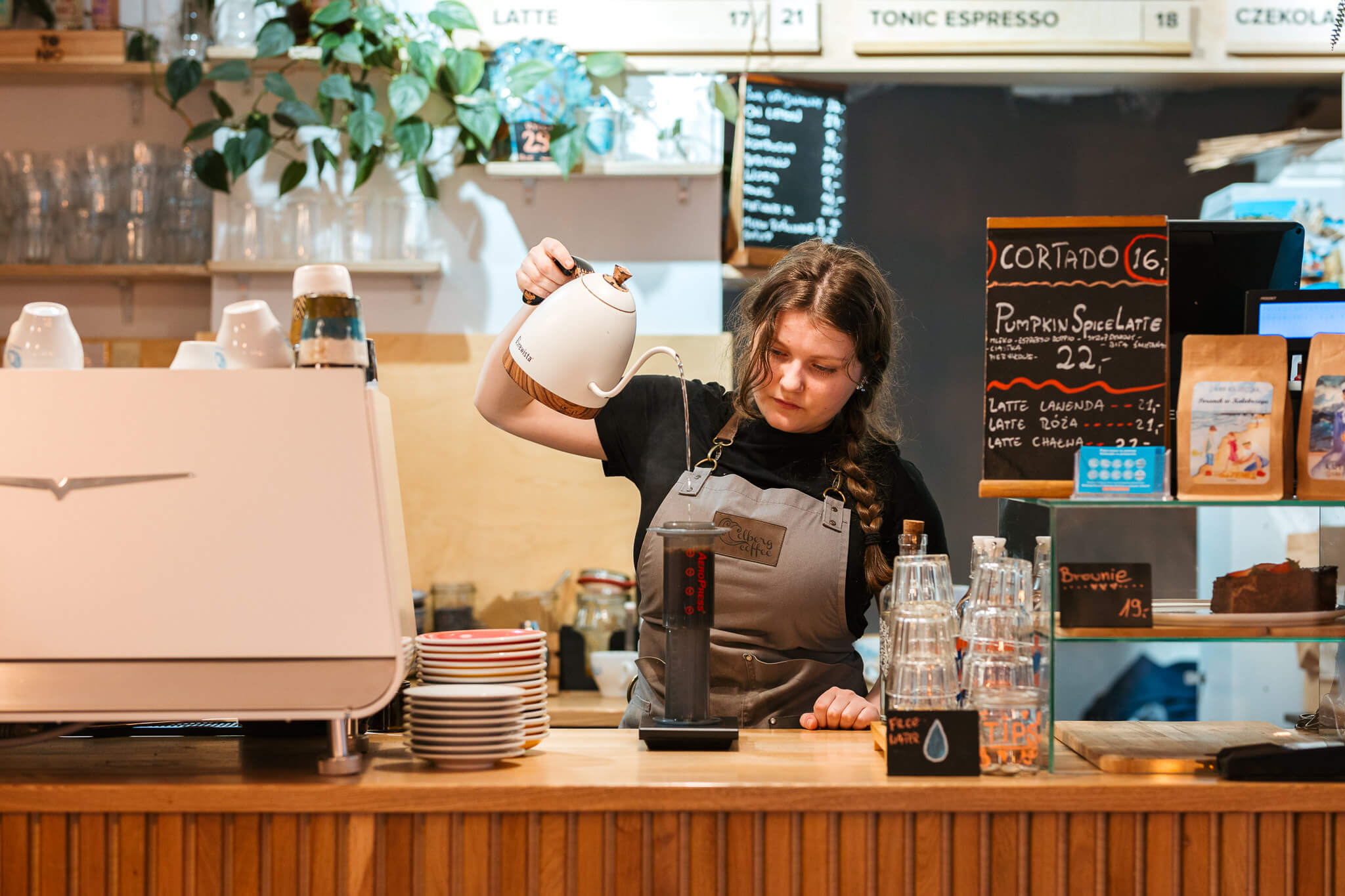
I run the Colbergcoffee roastery near Kołobrzeg. We also have a coffee shop in Kołobrzeg itself and supply other businesses with coffee and equipment. Organising work behind the bar is therefore a subject I take a particular interest in. Below, I look at the figures and experiences from the Dublin coffee shops described in the book, mainly from around 2017. The figures in euros are the author’s examples, not calculations for Polish coffee shops.
In this article, you will learn:
- How to calculate the full cost of employing baristas and why 33% can actually mean 44%.
- What staff cost percentage was considered reasonable at 3fe and why keeping it too low can also cause problems.
- How to plan rotas, holidays and work at the espresso machine to reduce unnecessary spending.
- How to track sales, wages and team productivity using a simple KPI spreadsheet.
How do you calculate staff costs in a coffee shop?
Let’s start with the formula. Staff cost percentage = total employment costs to the employer / net sales × 100%. The numerator should include wages and employer on-costs. The denominator is sales after deducting sales tax. Comparing these two figures shows what proportion of your revenue goes towards employing staff. Harmon recommends calculating this at least once a week, ideally every day as well..

| Item | Correct calculation | |
|---|---|---|
| Sales | EUR 12,000 including tax | EUR 10,000 excluding tax |
| Staff costss | EUR 4,000 in wages | EUR 4,400 including employer on-costs |
| Result | 33.3% | 44% |
These figures come from an Irish example and illustrate the method of calculation rather than the rates that apply in Poland. In Poland, employers must also account for social security contributions and other employment costs, while sales should be calculated excluding VAT. Check the applicable rates and which costs to include with your accountant. Overlooking these elements when analysing the costs of running a coffee shop can completely change your understanding of its profitability.
Coffee shop staff costs: 25%, 32% or 40%?
What percentage of revenue should go towards wages? In Harmon’s experience, most of the coffee shops he knew struggled to operate with staff costs below 25% of revenue, while many began making substantial losses above 40%. He acknowledges that there are exceptions. Rent, product costs, sales levels and the service model all play a significant role. These figures are neither universal hospitality benchmarks nor a target that Polish coffee shops should automatically adopt.
At 3fe in Dublin, around 32% was considered the right level. When staff costs fell to 27-31%, employees were often exhausted and irritable. Conflicts arose and some employees left their jobs. When the ratio exceeded 33%, Harmon sometimes noticed too many people on shift, a slower pace of work and problems with orders. A low staff cost percentage is therefore not necessarily a sign of a well-run coffee shop.
A good example is a coffee shop making 200 drinks a day with two members of staff. The owner wants to wait until sales reach 300 drinks before hiring a third person. The trouble is that those extra customers may never come. Faced with a long queue, they may decide not to buy anything, or they may not return after receiving poor service. Sometimes you need to invest in additional staff hours before sales can grow any further.
3fe had another rule. If staff costs remained below target for an entire quarter, for example at 29% instead of 32%, the money freed up was used to fund pay rises. The aim was to retain an efficient team without constantly overworking its members, rather than cutting wages at all costs. The staff cost percentage was discussed at weekly management meetings.
Rotas, holidays and cover: where does the money go?
An employee’s wages remain a cost even when they are on holiday. If a permanent member of staff continues to receive their salary while away and the coffee shop also has to pay for cover, the total cost increases. Harmon gives an example of having to cover around 40 hours of work a week. He describes situations where the rota seemed to work well for nine months, only for the coffee shop to find itself short of staff during its busiest period.
Under the Irish system described in the book, holiday entitlement for hourly paid staff was equivalent to 8% of their earnings. This figure does not apply to Polish employment contracts. The important lesson is to plan ahead. Harmon recommends reviewing outstanding holiday entitlement and the associated costs at the end of each quarter. This helps owners avoid facing a large, unbudgeted expense at the end of the year.
The rota needs to reflect actual customer demand without passing all the risk on to employees. Harmon criticises the practice of regularly sending staff home when trade is quiet and scheduling 3.5-hour shifts solely to cover the morning rush. He also discourages 12-hour shifts, working weeks of 60-70 hours and split shifts with a long unpaid break. He recommends honouring agreed working hours, ensuring staff take their breaks and, where possible, giving them two consecutive days off. Sickness and other unexpected absences also need to be factored into staffing plans.
Improving bar efficiency before hiring another barista
When orders start piling up, it is easy to assume that you need another member of staff or a bigger espresso machine. The problem may lie in how the workstation is organised. Harmon illustrates a drink preparation workflow in which completing every task in sequence takes 225 seconds. By overlapping tasks effectively, the time falls to 130 seconds, a reduction of around 42%. The aim is to make use of the moments when a task does not require the barista’s full attention, rather than rushing through every task.
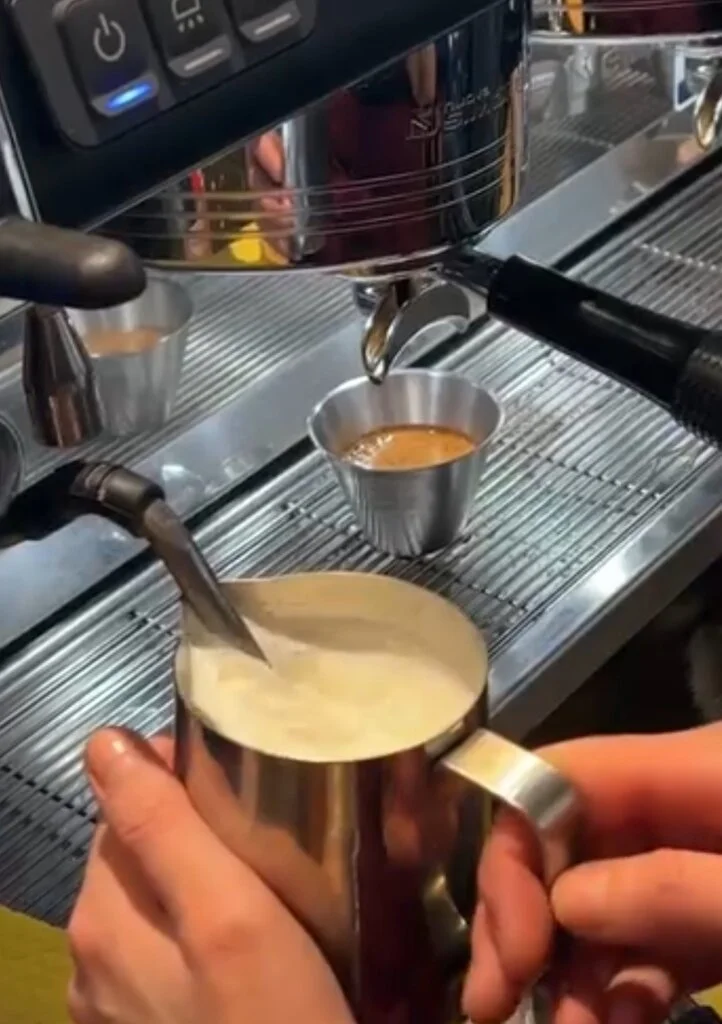
Harmon describes the capacity of a two-group espresso machine. At a special event, two baristas and an additional person providing break cover produced around 1,000 drinks in eight hours. That is an average of 125 drinks per hour. However, they were not handling the usual duties at the till or serving customers at tables. In a working coffee shop, Harmon estimates that around 700 drinks, or 800 at most, could be produced in a similar period. These figures reflect his own observations and are not a standard for every coffee shop.
A clear division of responsibilities matters in day-to-day operations. During busy periods, the barista should not have to keep leaving the espresso machine to serve customers at the till, deliver drinks to tables or replenish stock. When preparing milk-based drinks, it is important to separate milk steaming from pouring. In Harmon’s experience, the time it takes to steam enough milk for four cappuccinos is enough to pull the espresso shots for twelve. Without a proper division of tasks, a bottleneck develops that an extra group on the espresso machine will not resolve.
An interesting example comes from a competition for 3fe employees. Experienced baristas prepared ten drinks in around 15-16 minutes. A new member of staff who appeared to work more slowly completed the task in under 11 minutes by organising her tasks methodically. Before hiring more staff, it is worth reviewing how the team works. I cover more practical solutions in my guide to working more efficiently in a coffee shop.
Higher turnover, staff training and lower staff costs
The staff cost percentage depends on both wages and sales. If a coffee shop increases its sales while maintaining a similar number of staff hours, wages may account for a smaller proportion of revenue. Harmon illustrates this using retail bags of whole-bean coffee. Selling a bag of beans does not involve preparing a drink or occupying the espresso workstation. It can increase sales with relatively little additional work.
The book gives an example of a coffee shop using 30 kg of coffee a week, enough to prepare around 1,500 drinks. If customers buy one 250 g bag of coffee beans for every 15 drinks sold, that adds up to an extra 100 bags a week, totalling 25 kg of coffee. Assuming a margin of 20%, Harmon estimates an additional profit of around EUR 200 a week, or just over EUR 10,000 a year.
At Colbergcoffee, we run a roastery and supply coffee shops with coffee and equipment, so this part of the book is of particular interest to me. For a coffee shop owner, selling bags of coffee beans can provide a separate source of revenue. You need a well-planned product range and somewhere to display it so that customers can browse. If you are interested in a B2B partnership with a coffee roastery, you can also discuss the availability of coffee packaged for retail sale.
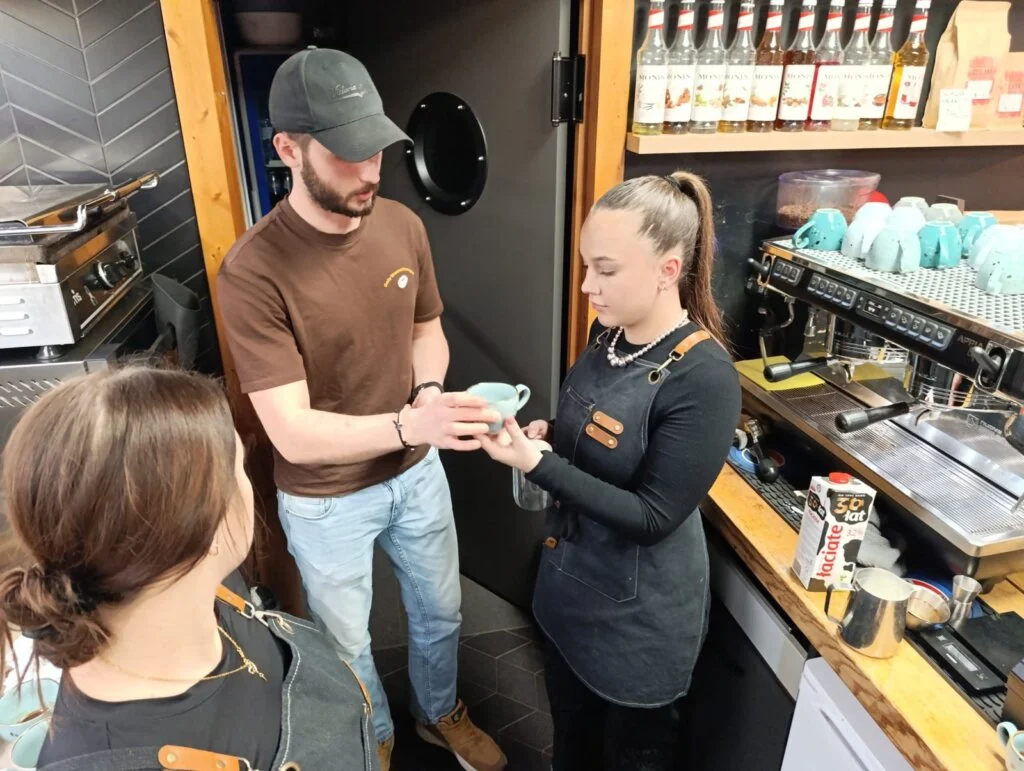
Retaining a good team is another important aspect of profitability. Harmon admits that he initially recruited on instinct, without a structured process. Over time, he began planning recruitment further in advance, writing job descriptions and allocating additional hours to training new staff. A new employee should not be expected to replace an experienced team member from day one. Harmon also highlights the cost of losing knowledge and skills when employees leave. I explore this subject further in my article on the mistakes new coffee shop owners make.
KPI spreadsheet: how to track staff costs every week
Finally, there is the simplest tool of all: a spreadsheet. At 3fe, Harmon recorded gross and net sales, the number of transactions, average transaction value, the numbers of drinks, bags of coffee and food items sold, wages and staff costs as a percentage of sales. He compared weekly results with historical data. He regretted not starting sooner.
Sample data from three weeks in January 2017 show why it is worth tracking several indicators at once. In the week of 2-8 January, net sales were EUR 8,667.56, wages were EUR 2,773.62 and staff costs accounted for 32%. The following week, net sales rose to EUR 8,895.49, wages to EUR 3,113.42 and the staff cost percentage to 35%. In the third week, net sales reached EUR 9,005.42, wages were EUR 3,241.95 and staff costs accounted for 36%.
At the same time, the number of transactions increased from 2,183 to 2,285 and then to 2,387. However, the average transaction value fell from EUR 4.41 to EUR 4.32 and then to EUR 4.19. Across the three weeks, the weekly averages were 2,285 transactions, EUR 4.31 per transaction and a staff cost percentage of 34.33%. Rising turnover alone did not tell the whole story. It was also necessary to examine the cost of achieving those sales.
Coffee shop owners can start by keeping similar records. Once a week, record sales excluding VAT, total employment costs, the number of transactions, average transaction value and the numbers of drinks and bags of coffee sold. Comparing sales on individual days can also help you plan staffing more effectively. If you are still working out how to open a coffee shop, a spreadsheet like this can be your first tool for testing financial assumptions.
Key takeaways
- Calculate staff costs as a percentage of sales excluding VAT, using the full cost of employment to the employer. The example of 4,000/12,000 = 33% becomes 4,400/10,000 = 44% once the figures are corrected.
- Do not treat 32% as a universal target. At 3fe, it was considered the right balance, while the indicative range of 25-40% was based on Harmon’s own experience.
- Plan ahead for holidays and staff cover. Harmon recommended reviewing outstanding holiday entitlement every quarter and avoiding rotas that consistently overwork employees.
- Before hiring another barista, review how work is organised. A clear division of responsibilities can improve productivity without buying another espresso machine.
- Monitor performance every week. Net sales, wages, the number of transactions and average transaction value can help you identify problems before they lead to substantial losses.
From a coffee shop owner’s perspective, the most important thing is finding the right balance. The cheapest rota does not always result in the most profitable coffee shop. If cutting costs leads to longer queues, poorer service and the loss of good employees, it is hard to call that a success. Overstaffing can also eat into the funds needed for growth. Calculate staff costs regularly, but always consider them alongside sales and the team’s actual workload.


How do you calculate staff costs in a coffee shop?
Divide the total employment costs to the employer by net sales, meaning sales excluding VAT, and multiply by 100%. Employment costs include wages and the relevant employer on-costs. Harmon recommends checking this ratio at least once a week. Consult your accountant about the specific accounting requirements in Poland.
What percentage of turnover should barista wages account for?
There is no single correct figure for every coffee shop. In the examples described by Harmon, many coffee shops struggled with staff costs below 25% or above 40%, while the target at 3fe was around 32%. These are historical observations from the Irish market, not recommended benchmarks for Polish coffee shops.
Why can staff costs of 33% actually mean 44%?
In the book’s example, the owner divides EUR 4,000 in wages by EUR 12,000 in sales including tax, giving a figure of around 33%. After deducting tax, net sales amount to EUR 10,000. Adding an illustrative 10% in employer on-costs brings total employment costs to EUR 4,400. The correct result in this example is 44%.
Does cutting staff costs always increase a coffee shop’s profit?
No. Understaffing can lead to queues, mistakes, exhausted employees and lost customers. Harmon describes a coffee shop making 200 drinks a day with two members of staff. Waiting until sales reach 300 drinks before hiring a third person may prevent further growth if the existing team cannot cope with increasing customer demand.
What data should you record in a coffee shop cost spreadsheet?
The essential figures are gross and net sales, total staff costs, the number of transactions, average transaction value and the numbers of drinks and products sold. You can also compare results across weeks, individual days and with figures from the previous year. Keeping these records helps you control spending and plan rotas based on actual sales.
How much profit does a coffee shop make after all costs?
There is no single amount or percentage that applies to every coffee shop. In his book, Harmon notes that many successful coffee shops had a net profit margin of around 5%. In a separate example breaking down the price of a EUR 3.50 drink, he shows a net profit of EUR 0.26, or around 8% of sales excluding tax. These are two different examples. To calculate the actual profit of your own coffee shop, you need to account for wages, product costs, rent and other expenses. It is also useful to calculate the cost of a cup of coffee separately, using your own business’s prices and costs.
Przeczytaj też

Café Staff Costs: How to Calculate Them and Why 33% Is Often 44%
A coffee shop owner calculates staff costs at 33%, but once taxes and employer on-costs
Nov

Geisha (Gesha) Coffee: Flavour, Origin and Record Prices
Geisha coffee originates in Ethiopia but gained worldwide recognition thanks to Panama's Hacienda La Esmeralda.
Nov
Kopi Luwak: The Coffee from Droppings I Don’t Recommend
Kopi Luwak costs a fortune, yet its supposedly exceptional quality remains questionable. Behind this famous
Nov
Paper, Metal or Cloth Coffee Filters: Which to Choose?
Paper retains most coffee oils and fine particles, metal lets more of them through, and
Nov

Christmas Coffee Recipes: 5 Ideas from a Barista
Five Christmas coffee recipes you can make at home, including drinks from our café's winter
Nov

Cyber Monday 2026: When Is It and How to Stock Up on Coffee
Cyber Monday 2026 falls on 30 November. Find out how it started, what we have
Nov
Jamaica Blue Mountain Coffee: Is the Legend Worth the Price?
For years, Jamaica Blue Mountain was regarded as one of the world's finest coffees, and
Nov
How much water do coffee grounds retain? Where does it go?
From 350 g of water, you get around 302 g of brewed coffee. We explain
Nov

This site is protected by reCAPTCHA. The Google Privacy Policy and Terms of Service apply.