








Jamaica Blue Mountain is one of the world’s most famous coffees, but its high price does not always guarantee exceptional flavour. For decades, it was regarded as a symbol of luxury in the coffee world. It was sold in distinctive wooden barrels, exported mainly to Japan and enjoyed a reputation as a premium product. But does it really taste better than other coffees?
I was particularly interested in the perspective offered by James Hoffmann, author of “The World Atlas of Coffee”. He describes Jamaica as a country that began producing clean, sweet coffee relatively early and successfully promoted it. However, he also notes that today’s Jamaica Blue Mountain rarely matches the complexity of the best coffees from other parts of the world.
At our Colbergcoffee roastery near Kołobrzeg, we work with coffees from various parts of the world. We do not currently stock Blue Mountain, but I want to take a closer look at its history, flavour and price. There is a far more interesting story behind the famous name than the simple label of “luxury coffee” suggests.
In this article, you will learn:
- How coffee reached Jamaica and why its production went through periods of both prosperity and crisis.
- What the Jamaica Blue Mountain name means and how it differs from Jamaica’s other altitude-based coffee designations.
- What Jamaican coffee tastes like and why it commands such a high price.
- Whether it can be considered the world’s most expensive coffee and what a comparison with Panamanian coffees reveals.
The history of Jamaica Blue Mountain began in 1728
It all started with a single plant. In 1728, Sir Nicholas Lawes, the then governor of Jamaica, received a coffee seedling from the governor of Martinique. He planted it in the Saint Andrew area. He had already experimented with growing various crops, and coffee became his next venture.
Coffee production had modest beginnings. In 1752, Jamaica exported just 27 tonnes of coffee. Cultivation only began to expand rapidly in the second half of the 18th century. It spread from Saint Andrew towards the Blue Mountains, where the island’s best-known coffee-growing region eventually emerged.
The pace of growth was remarkable. By 1800, Jamaica had 686 plantations in operation. In 1814, annual production reached around 15,000 tonnes. Some historical estimates put the figure even higher. Within a few decades, small-scale coffee cultivation had grown into a major sector of the colonial economy.
This growth was also tied to the history of slavery. The British slave trade was abolished in 1807, while slavery itself ended in Jamaica in 1838. Attempts were made to employ formerly enslaved people as wage labourers, but coffee plantations struggled to compete with other sectors of the economy for workers.
Labour shortages were probably the main reason for the subsequent decline in production. Other contributing factors included problems with land management and the loss of favourable trading terms previously granted by Britain. By 1850, around 180 plantations remained in Jamaica, and annual production had fallen to 1,500 tonnes.
By the end of the 19th century, production had partially recovered, reaching around 4,500 tonnes a year. However, serious problems with coffee quality had emerged. In 1891, regulations were introduced to improve knowledge of coffee cultivation and raise the quality of the harvest. Centralised coffee processing and grading facilities were also developed. Initially, these measures had limited success.
In 1944, the Central Coffee Clearing House was established, and coffee was intended to pass through it before export. In 1950, the Jamaican Coffee Board was formed. From then on, coffees from the Blue Mountains steadily gained a reputation as some of the finest in the world.
According to Hoffmann, this success needs to be understood in the context of the coffee market at the time. Jamaican producers consistently supplied clean, sweet and well-prepared coffees when comparable quality was not yet widely available. This gave Blue Mountain a competitive advantage, which subsequent marketing helped to reinforce. The reputation Jamaican coffee enjoys today is therefore rooted in the genuine achievements of earlier generations of producers.
Jamaica Blue Mountain – what does the name mean?
The Blue Mountains are a mountainous region of Jamaica associated with the island’s most famous coffee. However, not all coffee grown in Jamaica can be sold under the Jamaica Blue Mountain name. The designation applies to coffees grown within a specified altitude range and geographical area.
Jamaica Blue Mountain coffee must be grown between 900 and 1,500 m above sea level, within four parishes: Saint Andrew, Saint Thomas, Portland and Saint Mary. Jamaica also uses other designations to distinguish coffees according to the altitude at which they are grown.
| Designation | Growing altitude | What it means |
|---|---|---|
| Jamaica Blue Mountain | 900-1,500 m above sea level | Coffee from a designated area within four parishes in the Blue Mountains region. |
| Jamaica High Mountain | 450-900 m above sea level | A designation for coffees grown at lower altitudes than Blue Mountain coffee. |
| Jamaica Supreme | Below 450 m above sea levelsea levelOne of the designations for coffees grown at lower altitudes.ng farms. | |
| Jamaica Low Mountain | Below 450 m above sea level | The other designation for coffees grown at lower altitudes. |
This is the classification presented by Hoffmann. The Blue Mountain name therefore has a specific geographical meaning. Varieties grown in the region include Typica and Jamaica Blue Mountain, which is derived from Typica. This is a good example of why it is important to distinguish between geographical origin and coffee varieties. The same name can refer both to a well-known product and to a coffee plant belonging to a particular genetic lineage.
The region’s harvest takes place in June and July. Many smallholders deliver their coffee to shared processing facilities, where the beans are prepared for sale. This is why coffee packaging often carries the name of the processing facility rather than that of an individual farm. These facilities sometimes keep coffee from larger farms separate, but they generally buy from numerous small producers. Tracing an individual lot back to its origin is therefore not always straightforward.
From Jamaica’s mountains to the coffee plantations of Papua New Guinea
The story of Blue Mountain extends beyond Jamaica. Coffee trees were first planted in Papua New Guinea as early as the 1890s, although cultivation initially had little commercial significance. The breakthrough came in 1926, when 18 plantations were established using seeds from Jamaican Blue Mountain coffee plants. Production began to expand on a larger scale in 1928, and infrastructure development in the 1950s made coffee easier to transport.
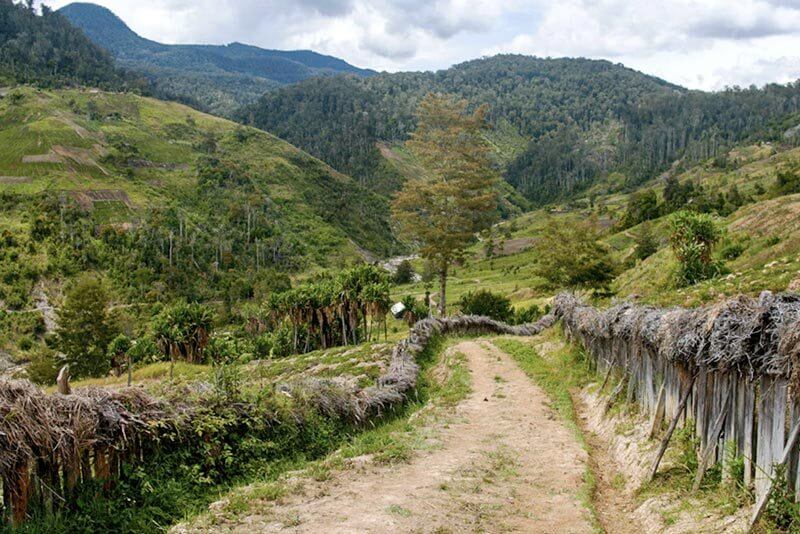
Today, coffee from Papua New Guinea has established its own place in the market. High-quality coffees from the country can offer sweetness, a buttery texture and complex flavours. This provides an interesting contrast to the mild flavour profile of Jamaican coffees. The historical link between their seed stocks does not mean that all coffees grown in Papua New Guinea today descend from a single variety or taste alike.
Why is Jamaica Blue Mountain so expensive?
The high price of Blue Mountain has its roots in history. Jamaican producers supplied clean, sweet and well-prepared coffees at a time when such consistent quality was difficult to find. Over time, the region earned a reputation for producing exceptional coffee beans. Its recognisable name and effective marketing reinforced that position, even as other countries began producing coffees with increasingly impressive sensory characteristics.
Packaging played an important role. Green Jamaica Blue Mountain coffee was exported in small wooden barrels rather than traditional jute sacks. This distinctive packaging set the product apart and made it more recognisable. The Japanese market was also significant, receiving most of the Blue Mountain crop for many years.
Production figures for 2013 show that Jamaica produced 27,000 bags of coffee, each weighing 60 kg, equivalent to around 1,620 tonnes. This figure covers the entire country, not just the Blue Mountain region. The high market value of this famous coffee also created opportunities for fraud. Products falsely labelled as Blue Mountain appeared on the market, making it even harder for buyers to establish the true origin of the beans.
According to Hoffmann, Blue Mountain is one of the greatest marketing successes in the history of coffee. Its reputation grew from an early advantage in quality and was subsequently reinforced by the region’s name recognition and effective marketing. For buyers, this means that part of the product’s value lies in its history and brand. However, this alone does not allow us to calculate how much of today’s price reflects the quality of the beans themselves.
What does Jamaica Blue Mountain taste like?
Blue Mountain coffee has a reputation for being exceptional, yet its flavour profile is surprisingly understated. A clean cup, sweetness and mildness are its defining characteristics. Rather than intense fruity or floral aromas, descriptions tend to emphasise its delicate character. This flavour profile can be very appealing, particularly to those who prefer less pronounced flavours.
Hoffmann describes Jamaican coffees as clean, sweet and very mild. However, he points out that they are rarely particularly complex, juicy or fruity. In his view, Jamaican coffees today struggle to compete with the finest beans from Central America, South America and East Africa. The main reasons are their lower complexity and the absence of distinctive characteristics typically associated with leading specialty coffees.
A clean flavour means there are no undesirable off-flavours that detract from the coffee. Sweetness is a pleasant sensory quality, while mildness describes the overall character of the brew. However, a delicate flavour should not be mistaken for poor quality. Good coffee can be subtle and balanced. The question is whether this is the flavour we are looking for, especially when paying an exceptionally high price.
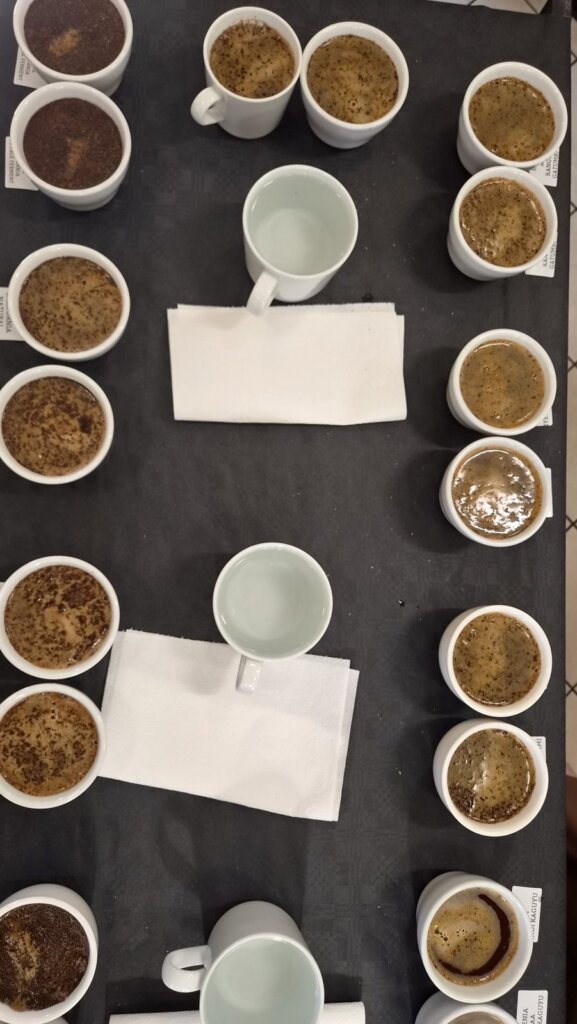
At our roastery, we use cupping as one of our methods for comparing different coffees. During a tasting, we assess aroma, sweetness, acidity, body and the overall character of the brew. This allows us to compare samples under similar conditions without relying solely on the reputation of their origin. This approach is particularly useful when tasting coffees whose famous names create high expectations before the first sip.
Is Jamaica Blue Mountain the most expensive coffee in the world?
Jamaica Blue Mountain is often mentioned in discussions about the world’s most expensive coffees. Its reputation and high prices make this association understandable. However, it is difficult to declare it the most expensive without comparing specific lots and the periods in which they were sold. A good example is Hacienda La Esmeralda in Panama, a coffee farm owned by the Peterson family, whose Geisha coffee has fetched record prices at auction.
The breakthrough came with the Best of Panama competition, organised by the Specialty Coffee Association of Panama. The finest lots were scored and subsequently offered for sale at an online auction. Hacienda La Esmeralda won the competition for four consecutive years, from 2004 to 2007, then again in 2009 and 2010, and in one category in 2013.
As early as 2004, coffee from this farm fetched $21 per pound. In 2010, the price reached $170 per pound, and in 2013, a small lot of naturally processed Geisha sold for $350.25 per pound. During the period covered in the book, this was a record price for coffee from a single farm. It should not, however, be taken as a current world record or a typical retail price.
Hoffmann compares this example with other expensive coffees, including Kopi Luwak and some Jamaica Blue Mountain coffees. He is highly critical of Kopi Luwak as a product built on sensationalism. By contrast, the record-breaking Geisha from Hacienda La Esmeralda stood out for its genuine sensory quality. It had an intense floral aroma, citrus notes and a light, tea-like body. Strong demand and marketing also influenced its price, but the coffee’s exceptional characteristics were the foundation of its success.
For these reasons, I would not call Jamaica Blue Mountain the world’s most expensive coffee. It is one of the best-known and most highly priced coffees, but these examples show that beans from other regions can also command exceptionally high prices. Moreover, auction prices for exceptional lots and regular retail prices reflect different types of transactions. Comparing them directly without further context could be misleading.
Is Blue Mountain coffee worth buying?
If you are interested in the history of coffee, Jamaica Blue Mountain has plenty to offer. Its story spans everything from a single seedling brought from Martinique in 1728 to the establishment of hundreds of plantations, the subsequent crisis and eventual worldwide fame. It is one of the more fascinating examples of a coffee-growing region whose name became recognised far beyond its country’s borders.
When it comes to flavour, however, it is worth knowing what to expect. A clean cup, sweetness and mildness may appeal to those who enjoy subtle, delicate coffees. Those who favour pronounced fruitiness, floral aromas and greater complexity may have different expectations. A high price alone does not guarantee a more intense or complex sensory experience.
When buying Blue Mountain, I would pay particular attention to the actual origin of the beans. Given that falsely labelled Blue Mountain coffees are available on the market, an attractive label is not enough. Information about the growing region, processing facility and individual lot can be useful. When buying blends, it is worth checking their composition, as the Blue Mountain name alone does not tell you how much Jamaican coffee the bag contains.
At our roastery, what matters most is the flavour of each individual lot. I look at its origin, green coffee quality, how it is roasted and how it tastes in the cup. Good whole bean coffee should, above all, suit the preferences of the person drinking it. You might buy Jamaica Blue Mountain out of curiosity or to explore its history. Whether it is worth buying again should ultimately depend on how much you enjoy tasting it.
Key takeaways
- The history of Jamaica Blue Mountain dates back to 1728. In 1800, Jamaica had 686 plantations in operation, and by 1814, annual production stood at around 15,000 tonnes.
- The Jamaica Blue Mountain designation applies to coffees grown between 900 and 1,500 m above sea level within a defined area of four parishes. Jamaica’s other coffee designations apply to coffees grown at lower altitudes.
- The typical Jamaican coffee has a clean, sweet and very mild flavour profile. The author emphasises that these coffees are rarely particularly complex, juicy or fruity.
- Blue Mountain’s fame stems from a historical advantage in quality and effective marketing. Distinctive wooden barrels, the region’s name recognition and many years of exports to Japan helped reinforce its reputation.
- Jamaica Blue Mountain has not been established as the world’s most expensive coffee. The example of Hacienda La Esmeralda shows that other coffees have also fetched record prices, sometimes thanks to exceptional sensory characteristics.
To me, this story illustrates just how important the reputation of a coffee’s origin can be. Blue Mountain has earned its place in the history of the coffee market, but its fame does not necessarily translate into an exceptional tasting experience every time. Ultimately, the judgement rests with the person drinking the coffee.
What is Jamaica Blue Mountain?
Jamaica Blue Mountain is a designation for coffee grown within a defined area of Jamaica’s Blue Mountains. It applies to coffee grown between 900 and 1,500 m above sea level in the parishes of Saint Andrew, Saint Thomas, Portland and Saint Mary. The region is known for its long history of coffee production and strong international reputation.
What does Jamaica Blue Mountain coffee taste like?
Typical Jamaican coffees are described as clean, sweet and very mild. They rarely offer pronounced complexity, juiciness or intense fruitiness. This is a general description and cannot replace tasting an individual lot.
How does Jamaica Blue Mountain differ from Jamaica High Mountain?
The main differences are growing altitude and geographical origin. Jamaica Blue Mountain covers coffees grown between 900 and 1,500 m above sea level within a designated area, while Jamaica High Mountain applies to coffees grown between 450 and 900 m above sea level. Coffees grown at lower altitudes may be sold under the Jamaica Supreme or Jamaica Low Mountain designations.
Why is Jamaica Blue Mountain so expensive?
Its high price is linked to its long-standing reputation, the region’s name recognition and effective marketing. Jamaican producers gained recognition early on by consistently producing clean, sweet coffees. Distinctive wooden barrels and strong trading relationships with Japan further reinforced Blue Mountain’s position as a premium product.
Is Jamaica Blue Mountain the most expensive coffee in the world?
There is no basis for declaring it the world’s most expensive coffee outright. In 2013, a small lot of naturally processed Geisha from Hacienda La Esmeralda in Panama fetched $350.25 per pound at auction. At the time, this was a record for coffee from a single farm. Results like this demonstrate that coffees from other regions can also command exceptionally high prices.
Is Jamaica Blue Mountain the best coffee in the world?
Reputation alone is not enough to establish this. Jamaican coffees can be clean, sweet and very enjoyable, but they often fall short of the finest specialty coffees in terms of complexity and aromatic intensity. The final judgement depends on the individual lot and the preferences of the person drinking it.
Przeczytaj też
Kopi Luwak: The Coffee from Droppings I Don’t Recommend
Kopi Luwak costs a fortune, yet its supposedly exceptional quality remains questionable. Behind this famous
Nov
Paper, Metal or Cloth Coffee Filters: Which to Choose?
Paper retains most coffee oils and fine particles, metal lets more of them through, and
Nov

Christmas Coffee Recipes: 5 Ideas from a Barista
Five Christmas coffee recipes you can make at home, including drinks from our café's winter
Nov

Cyber Monday 2026: When Is It and How to Stock Up on Coffee
Cyber Monday 2026 falls on 30 November. Find out how it started, what we have
Nov
Jamaica Blue Mountain Coffee: Is the Legend Worth the Price?
For years, Jamaica Blue Mountain was regarded as one of the world's finest coffees, and
Nov
How much water do coffee grounds retain? Where does it go?
From 350 g of water, you get around 302 g of brewed coffee. We explain
Nov
V60 Pouring Height: What Does Physics Say?
Does pouring from higher up always improve coffee agitation? Physics shows that there is a
Nov

Why Does Coffee Taste Different as It Cools?
Coffee left on your desk can taste completely different from how it tasted just after
Nov

This site is protected by reCAPTCHA. The Google Privacy Policy and Terms of Service apply.