













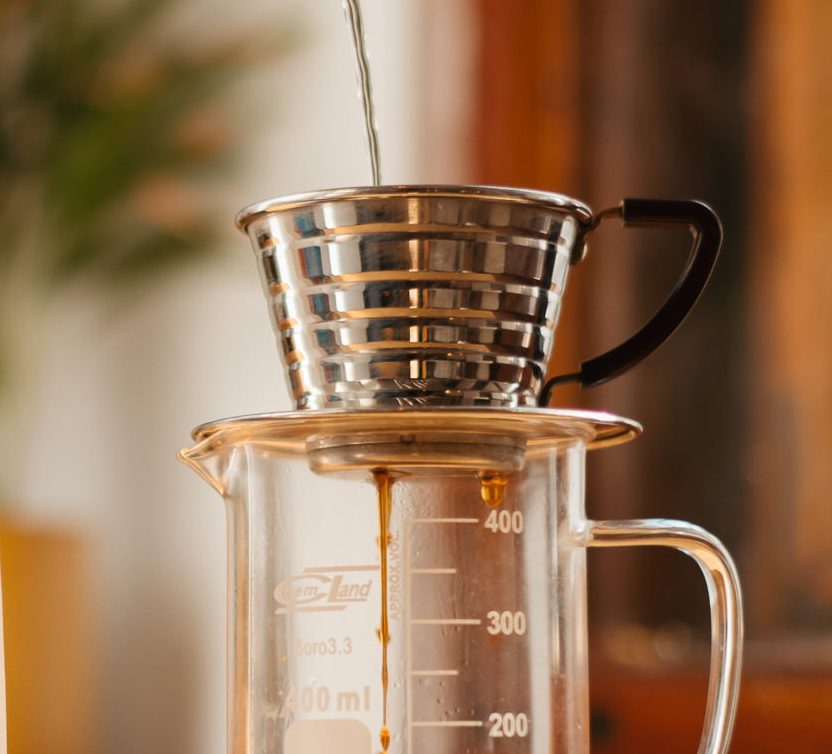
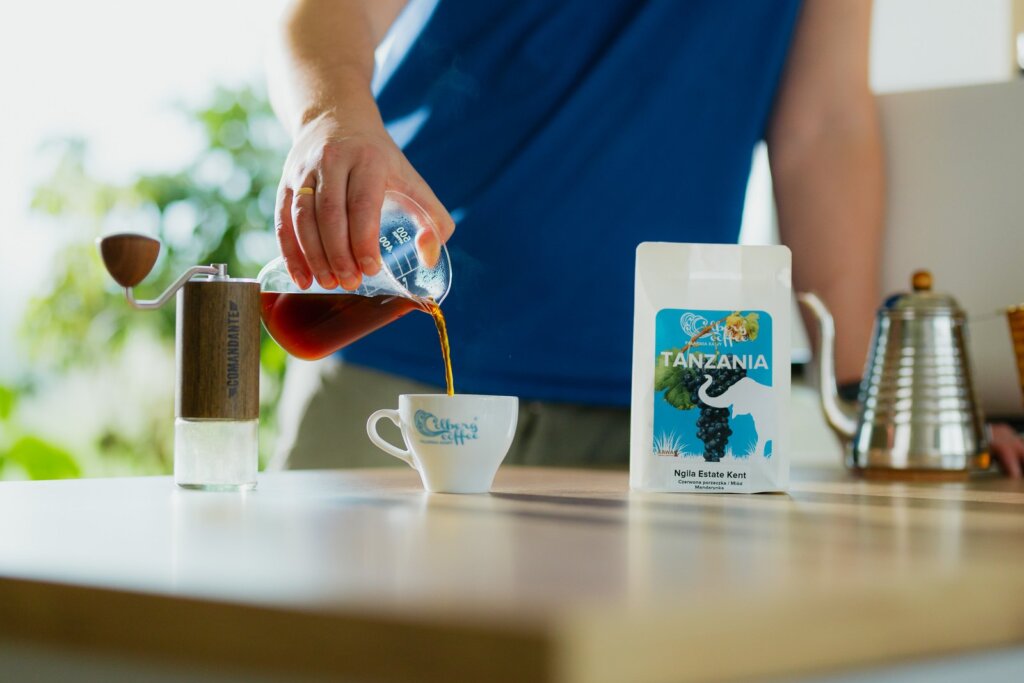
You pour 350 g of water into your dripper and end up with around 302 g of coffee in the server. Where did nearly 50 g go? Most of the difference comes from water retained by the coffee grounds. To understand how much water the grounds retain, we need to look at what happens inside the coffee bed during brewing.
In his book “The Physics of Filter Coffee”, Jonathan Gagné explains why coffee grounds retain water and how this affects extraction calculations. This is useful knowledge for anyone who brews filter coffee using scales. It helps you predict how much coffee you will get, calculate brew ratios correctly and avoid errors when measuring extraction.
In this article, you will learn:
- How much water each gram of ground coffee retains.
- Why 350 g of water does not produce 350 g of brewed coffee.
- How water retention affects brew ratio, strength and extraction yield.
- How to calculate water retention at home using scales.
How much water do coffee grounds retain after brewing?
Ground coffee retains a surprising amount of water. According to Gagné, once brewing is complete, the coffee bed typically contains more than twice the original dry coffee mass in water. This means that more than 2 g of water is retained for every gram of coffee. This includes both the water absorbed by the coffee particles and the liquid held between them.
This phenomenon is described using the liquid retained ratio (LRR). It is the ratio of the mass of water retained in the spent coffee bed to the initial mass of dry coffee. At an approximate ratio of 2.2, each gram of coffee retains around 2.2 g of water. This ratio can vary and should not be treated as a fixed value for every coffee and brewing method.
Let’s use 22 g of ground coffee and 350 g of water. By my calculations, at a retention ratio of 2.2, the grounds will retain around 48.4 g of water, since 22 × 2.2 = 48.4. Subtracting this from 350 g leaves approximately 301.6 g of brewed coffee. Rounded to the nearest gram, that gives 48 g of water in the grounds and 302 g of coffee in the server.
This calculation explains the difference between the amount of water poured into the dripper and the amount of brewed coffee you get. Since 2.2 is an approximate value, the best way to estimate actual water retention is to take your own measurements.
Where does the water retained by coffee grounds go?
During brewing, water penetrates the structure of the ground coffee. Some remains inside the particles, while some fills the tiny spaces between them. Even after the coffee stops dripping, the bed still holds a considerable amount of liquid. Together, these account for the total amount of water retained by the coffee grounds.
Surface tension is one of the factors that help retain liquid between coffee particles. Water can remain in these tiny spaces despite the pull of gravity. Gagné explains this in terms of interactions at the interfaces between water, coffee and air. This is why the coffee bed has not necessarily drained completely when water stops flowing through the dripper.
The liquid remaining between the coffee particles also contains dissolved coffee compounds. Some of the extracted compounds therefore never reach the server, which matters when calculating extraction yield accurately.
How much coffee will you get? A table for three brew sizes
You can estimate how much coffee you will get before you start brewing. We use the mass of dry coffee, the amount of water poured and an approximate retention ratio of 2.2. Multiply the coffee mass by 2.2 and subtract the resulting amount of retained water from the total amount of brewing water. The table below shows the results without adjusting for brew strength.
| Coffee and water | Water retained in the grounds | Brewed coffee in the server |
|---|---|---|
| 15 g coffee + 250 g water | Around 33 g of water retained in the grounds | Around 217 g of brewed coffee in the server |
| 22 g coffee + 350 g water | Around 48 g of water retained in the grounds | Around 302 g of brewed coffee in the server |
| 30 g coffee + 500 g water | Around 66 g of water retained in the grounds | Around 434 g of brewed coffee in the server |
At the same retention ratio, a larger dose of dry coffee retains more water. We have estimated that 15 g of coffee retains 33 g of water, while 30 g retains 66 g. This difference directly affects how much coffee ends up in the server. The table therefore helps you estimate the size of the brew you want to prepare.
Coffee-to-water ratio and the amount of brewed coffee
The brew ratio describes the relationship between the mass of water used for brewing and the initial mass of dry coffee. If we use 22 g of coffee and 350 g of water, the brew ratio is approximately 1:15.9. A recipe expressed in this way specifies the quantities of the ingredients used. It does not mean that you will end up with 350 g of brewed coffee in the server.
The amount of brewed coffee is smaller because some of the water remains in the grounds. As a result, the ratio of brewed coffee mass to dry coffee mass differs from the brew ratio. If we increase the coffee dose while keeping the amount of water and the retention ratio the same, more liquid will remain in the coffee bed. Two recipes using identical amounts of water can therefore produce different amounts of brewed coffee.
Gagné gives a simplified formula: LRR ≈ (mass of water poured – brew mass) / dry coffee mass. The exact formula also accounts for the concentration of dissolved compounds extracted from the coffee into the brew. It is expressed as LRR = [W – B × (1 – C)] / D, where W is the mass of water poured, B is the brew mass, C is the concentration expressed as a fraction and D is the dry coffee mass.
The book includes an example of a brew with a concentration of 1.40%, a brew ratio of 1:17 and a retention ratio of around 2.2. Gagné points out that under these conditions, the simplified formula can underestimate the result by approximately 10%.
Water retention, brew strength and extraction yield
Coffee strength is expressed as the concentration of total dissolved solids (TDS). This tells us what proportion of the brew’s mass consists of compounds extracted from the coffee. A concentration of 1.40% means that 100 g of brewed coffee contains approximately 1.4 g of dissolved solids. This can be measured using a specialist refractometer.
Extraction yield (EY) describes the proportion of the initial dry coffee mass that has been extracted. The simplest formula is: extraction yield = concentration × brew mass / dry coffee mass. The concentration must be expressed as a fraction, so 1.40% becomes 0.014, for example. This calculation makes it easier to compare brewing results.
Let’s return to our 22 g coffee dose and an approximate brew mass of 301.6 g. Suppose the refractometer gives a reading of 1.40%. The simplified extraction yield is then 0.014 × 301.6 / 22 × 100%, or approximately 19.2%. This is a worked example, not an actual measurement.
If we used the 350 g of brewing water in the same formula instead of the brew mass, we would get approximately 22.3%. That is a difference of 3.1 percentage points, even though the concentration and dry coffee mass remain unchanged. Using the wrong mass overestimates the extraction yield. This formula requires the mass of the brewed coffee collected in the server.
The simple formula does not account for dissolved compounds in the liquid retained by the coffee grounds. As a result, an extraction yield calculated from the coffee collected in the server may not reflect the total extraction yield. A more accurate mass balance must account for both the quantity and concentration of the solution remaining in the coffee bed.
In the “Brewing Basics” section of “The World Atlas of Coffee”, James Hoffmann describes how a refractometer and software can be used to calculate extraction. He refers to the 18-22% range as a widely accepted benchmark. However, he does not present these limits as essential for good flavour. The numerical result must be interpreted in the context of the measurement and calculation methods used.
Pour-over, immersion and cupping: differences in extraction
In pour-over brewing, fresh water flows through the coffee bed, carrying dissolved compounds away from the particles. This maintains a concentration gradient that promotes further extraction. During immersion brewing, the ground coffee remains submerged in water and the concentration of the entire mixture gradually increases. Over time, the rate at which additional compounds are released decreases.
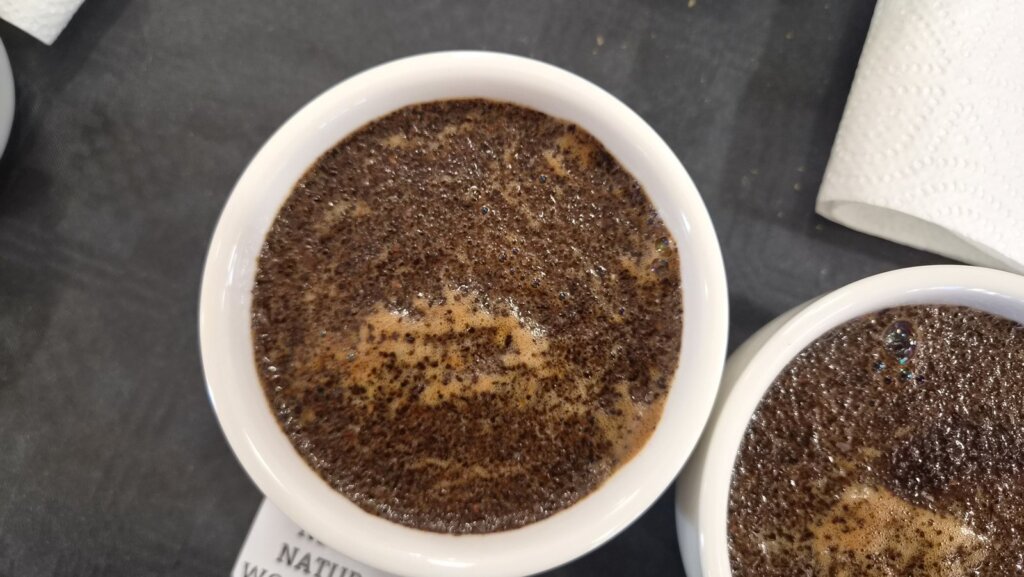
These brewing methods also differ in the concentration of the liquid retained by the grounds. Given sufficient immersion time, the solution between the coffee particles can reach a concentration close to that of the finished brew. In pour-over brewing, water flows through the coffee bed throughout the brewing process. The liquid remaining between the particles towards the end of brewing may have a different concentration from the coffee collected in the server.
Gagné describes an experiment using a Hario V60, a Weber Workshops EG-1 V2 grinder and SSP ultra-low-fines burrs. With this set-up, the coffee draining towards the end of brewing had around 70% of the average concentration of the finished brew. The final portion of liquid passing through the coffee bed was therefore considerably weaker. This finding applies to the specific equipment used and is not a universal value for the V60.
A more accurate formula for pour-over brewing accounts separately for the concentration of the finished brew and that of the liquid retained in the coffee bed. It also requires the mass of brewing water, the mass of dry coffee and the amount of water absorbed by the coffee particles. This allows us to account for dissolved compounds that remain in the grounds.
For immersion brewing, a separate parameter describes the water absorbed into the coffee particles. It is denoted by f_abs and has an approximate value of 1.0, depending on the coffee and grind size. This corresponds to roughly 1 g of water absorbed by the particles per gram of dry coffee. This parameter differs from total water retention, which also includes the liquid held between the coffee particles.
During cupping, the ground coffee remains in the bowl with the water. If we take only a portion of the brew and calculate extraction yield using its mass, the result will exclude the remaining extracted compounds. The book describes an example in which removing half of the slurry produces an apparently very low extraction yield. This does not mean that the actual level of extraction was so low.
Gagné also compared results obtained using an AeroPress and a V60. The initial calculations suggested that the AeroPress achieved a higher extraction yield. Applying the appropriate equations for each brewing method changed the interpretation of the results. Differences in liquid retention can therefore lead to misleading comparisons when the wrong calculation method is used.
In the “Cupping” chapter of “The Coffee Roaster’s Companion”, Scott Rao recommends using a refractometer to establish comparable levels of extraction. He gives an example of a 20% extraction yield for espresso, pour-over and cupping. This approach helps distinguish the characteristics of the coffee itself from differences in brewing methods.
How to calculate water retention at home
If you want to find out how much water your coffee grounds retain after brewing, all you need is a set of scales. You need to know the mass of dry coffee, the total mass of water poured into the dripper and the mass of the finished brew. The difference between the mass of water poured and the brew mass gives you an estimate of how much liquid has been retained. Divide this difference by the dry coffee mass to obtain the simplified retention ratio.
- Weigh the dry coffee before brewing and record its mass in grams.
- Weigh the total amount of water poured into the dripper.
- Once brewing is complete, weigh the brewed coffee, excluding the weight of the server.
- Subtract the brew mass from the water mass and divide the difference by the dry coffee mass.
If you use 22 g of dry coffee and get 301.6 g of brewed coffee from 350 g of water, the simplified retention ratio is (350 – 301.6) / 22 = 2.2. You can take these measurements without a refractometer. The result gives you an approximate retention ratio for that particular brew. A more accurate calculation also accounts for the concentration of dissolved solids in the brewed coffee.
Once you know the retention ratio, you can estimate how much water is needed to produce a particular amount of brewed coffee. If you want around 300 g of brewed coffee from 22 g of dry coffee, a retention ratio of 2.2 means allowing for approximately 48.4 g of retained water. Using the simplified calculation, you would need to pour around 348 g of water. This gives a brew ratio of approximately 1:15.8.
Key takeaways
- Coffee grounds typically retain more than twice their original dry mass in water. An approximate retention ratio of 2.2 means that 2.2 g of water is retained per gram of coffee.
- Some water remains inside the coffee particles, while some is held between them. Surface tension is one of the factors that contribute to liquid retention.
- The brew ratio is calculated using the dry coffee mass and the total amount of water used. The amount of brewed coffee is smaller because some liquid remains in the grounds.
- The simplified extraction yield formula uses brew mass, concentration and dry coffee mass. Using the mass of brewing water instead of the brew mass overestimates extraction yield.
- The liquid remaining in the coffee grounds also contains extracted compounds. More accurate comparisons between pour-over and immersion brewing require this portion of the extract to be taken into account.


How much water do coffee grounds retain after brewing?
Ground coffee typically retains more than 2 g of water per gram of its initial dry mass. At an approximate retention ratio of 2.2, a 15 g dose of coffee retains around 33 g of water. Actual water retention can be estimated from the mass of brewing water and the mass of the finished brew.
Why do you get less brewed coffee than the amount of water you pour?
Some water penetrates the coffee particles, while some remains in the spaces between them. As a result, the mass of coffee collected in the server is smaller than the mass of water used for brewing.
Is the coffee-to-water ratio calculated using the finished brew?
The brew ratio is based on the total amount of water used in the recipe and the mass of dry coffee. Brew mass is a separate measurement used, among other things, in the simplified extraction yield calculation.
Does water retention affect the calculated extraction yield?
Yes, because the retained liquid contains some of the dissolved compounds released from the coffee. The simple formula based on the coffee collected in the server excludes this portion of the extract. A more accurate calculation also accounts for the concentration of the solution remaining in the coffee bed.
Does the liquid retained by the grounds have the same concentration as the finished brew?
In pour-over brewing, concentrations can differ because fresh water flows through the coffee bed throughout the brewing process. In immersion brewing, given sufficient contact time, the concentration of the liquid between the coffee particles can approach that of the finished brew.
Can you calculate water retention without a refractometer?
Yes, you only need to know the mass of dry coffee, the mass of water poured and the mass of brewed coffee collected in the server. Subtract the brew mass from the water mass and divide the difference by the dry coffee mass. This gives you a simplified retention ratio that you can use when planning future brews.
Przeczytaj też
Kopi Luwak: The Coffee from Droppings I Don’t Recommend
Kopi Luwak costs a fortune, yet its supposedly exceptional quality remains questionable. Behind this famous
Nov
Paper, Metal or Cloth Coffee Filters: Which to Choose?
Paper retains most coffee oils and fine particles, metal lets more of them through, and
Nov

Christmas Coffee Recipes: 5 Ideas from a Barista
Five Christmas coffee recipes you can make at home, including drinks from our café's winter
Nov

Cyber Monday 2026: When Is It and How to Stock Up on Coffee
Cyber Monday 2026 falls on 30 November. Find out how it started, what we have
Nov
Jamaica Blue Mountain Coffee: Is the Legend Worth the Price?
For years, Jamaica Blue Mountain was regarded as one of the world's finest coffees, and
Nov
How much water do coffee grounds retain? Where does it go?
From 350 g of water, you get around 302 g of brewed coffee. We explain
Nov
V60 Pouring Height: What Does Physics Say?
Does pouring from higher up always improve coffee agitation? Physics shows that there is a
Nov

Why Does Coffee Taste Different as It Cools?
Coffee left on your desk can taste completely different from how it tasted just after
Nov

This site is protected by reCAPTCHA. The Google Privacy Policy and Terms of Service apply.