












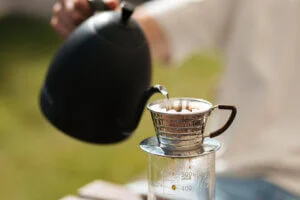
“Pour from higher up to agitate the coffee more effectively.” This advice sounds logical, but physics tells a different story. Water gains speed as it falls from a greater height, but eventually the stream breaks up into droplets and agitates the coffee bed less effectively. So how high should you pour when brewing with a V60 to make the most of the water’s energy?
We turn to Jonathan Gagné’s book “The Physics of Filter Coffee” for answers, particularly Chapter 6 on kettles and agitation. Gagné analyses the behaviour of the water stream, compares kettles and explains how pouring affects extraction. It turns out that pouring height needs to be considered alongside flow rate and the properties of the ground coffee.
In this article, you will learn:
- Why pouring from higher up does not always produce stronger agitation.
- How to find the right kettle height by ear.
- What measurements of Fellow and Brewista kettles revealed and how to interpret flow rates in g/s.
- How to reduce fines migration and the risk of filter clogging.
What happens to the stream when you raise the kettle?
Water leaves the spout at a certain speed and accelerates under gravity as it falls. The further it travels before reaching the water surface in the dripper, the faster it can become. Pouring from higher up therefore increases the energy of the stream as it hits the surface.

Gagné uses a 10 cm drop as an example. Water falling from rest over this distance would reach a speed of approximately 1.4 m/s under gravity. When pouring from a kettle, however, the water already has an initial velocity, so the increase in speed also depends on how it leaves the spout.
Greater speed does not always lead to better agitation because the stream changes shape as it falls. Initially, it is smooth and coherent. Irregularities then develop until the stream eventually breaks up into droplets. The point at which this happens determines how the water interacts with the coffee.
The distance over which the stream remains coherent before it starts to break up into droplets is known as the breakup length. It depends on the flow rate and spout design. Two kettles held at the same height can therefore produce very different patterns of water movement within the dripper.
Why is pouring from higher up not always better?
When you pour from very close to the surface, the smooth stream penetrates deep into the coffee slurry. It creates strong downward currents but relatively little turbulence. It can even form a crater in the coffee bed. Water moving deep into the slurry does not necessarily mean that all the particles are being vigorously agitated.
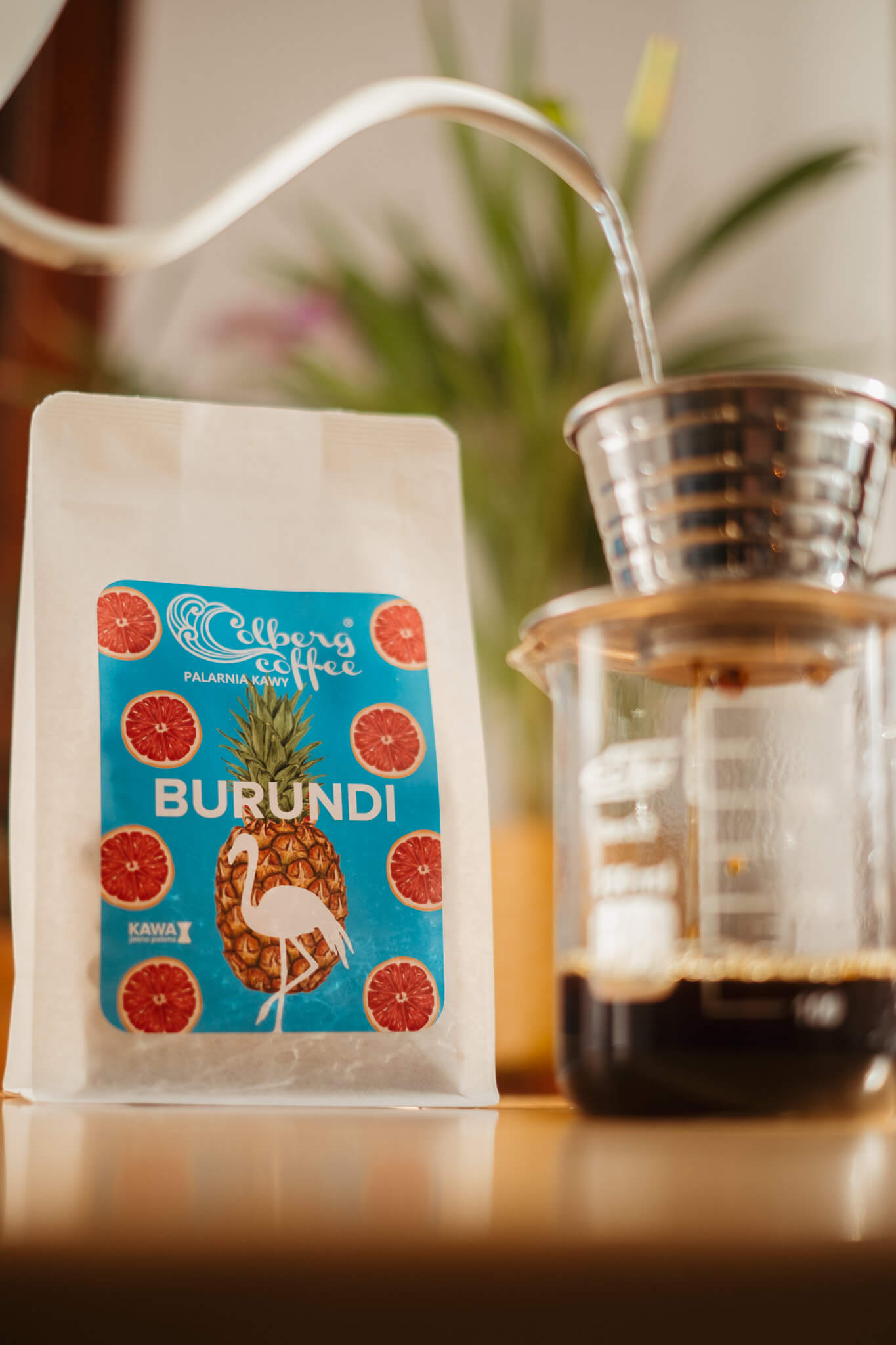
As the pouring height increases, the stream becomes less regular. When it hits the surface, it can carry air bubbles beneath it, creating turbulence that mixes the water and coffee. Under the right conditions, this turbulence extends deeper into the slurry than it does when pouring close to the surface.
If you raise the kettle too high, however, the stream breaks up into droplets before reaching the surface. Agitation then becomes shallower and can weaken considerably. The strongest agitation deep within the slurry therefore occurs at a particular height, depending on the kettle and flow rate.
Gagné recommends pouring from just below the height at which the stream begins to break up. The water then reaches the surface as an almost continuous stream, while the developing irregularities promote deep agitation. This height encourages vigorous agitation, although not every coffee benefits from it.
A 2011 study by Qu and colleagues yielded interesting results. At a pouring height of approximately 14 cm, air bubbles penetrated to a depth of around 16.4 cm. At greater pouring heights, the penetration depth decreased again. The experiment involved a stream of water entering still water, without a coffee bed.
Pouring height therefore allows you to control both the force of impact and the nature of the agitation. Pouring close to the surface can create deep currents, pouring from a suitably greater height can generate stronger turbulence, and pouring from very high up mainly disturbs the surface. These are three distinct ways in which the water interacts with the coffee.
Agitation, extraction and coffee fines
Agitation refers to the movement and mixing of the coffee slurry caused, among other things, by the incoming stream of water. Turbulence improves water movement between particles and speeds up the removal of dissolved compounds from their surfaces. This can result in faster and more even extraction within the agitated portion of the coffee bed.
During manual pour-over brewing, agitation generally affects the upper layers of the coffee bed most strongly. The lower layers remain considerably less disturbed. Visible movement at the surface therefore does not mean that the same level of agitation occurs throughout the entire bed.
The Melodrip illustrates the importance of agitation. The device divides the water into numerous small streams or droplets, reducing agitation of the coffee. With all other brewing variables kept constant, the average extraction yield can decrease considerably. This can be partly offset by grinding finer or increasing the number of pours, although both adjustments also affect the brewing process.
Strong agitation also has its drawbacks. Ground coffee contains very small particles known as fines, which are easily carried by the water. Fines migration can increase resistance to flow, reduce clarity in the cup and clog the filter. These problems become more pronounced when the coffee contains a large proportion of fines or is subjected to particularly vigorous agitation.
Uneven water flow through the coffee bed is known as channelling. Some areas offer less resistance, allowing more water to flow through them. As a result, different parts of the coffee bed may be extracted to different degrees. Vigorous agitation combined with channelling can further disrupt the brewing process.
Gagné notes that vigorous agitation works particularly well with a relatively uniform grind and a filter capable of retaining a larger quantity of fines without excessively restricting flow. For coffees that produce a lot of fines, a gentler pouring technique may be preferable.
What did measurements of Fellow and Brewista kettles reveal?
A gooseneck kettle makes it easier to control the flow rate and direction of the pour. However, the diameter and shape of the spout tip also matter. A smoother spout can maintain a coherent stream over a greater distance. A wider spout generally achieves its maximum breakup length at a higher flow rate.
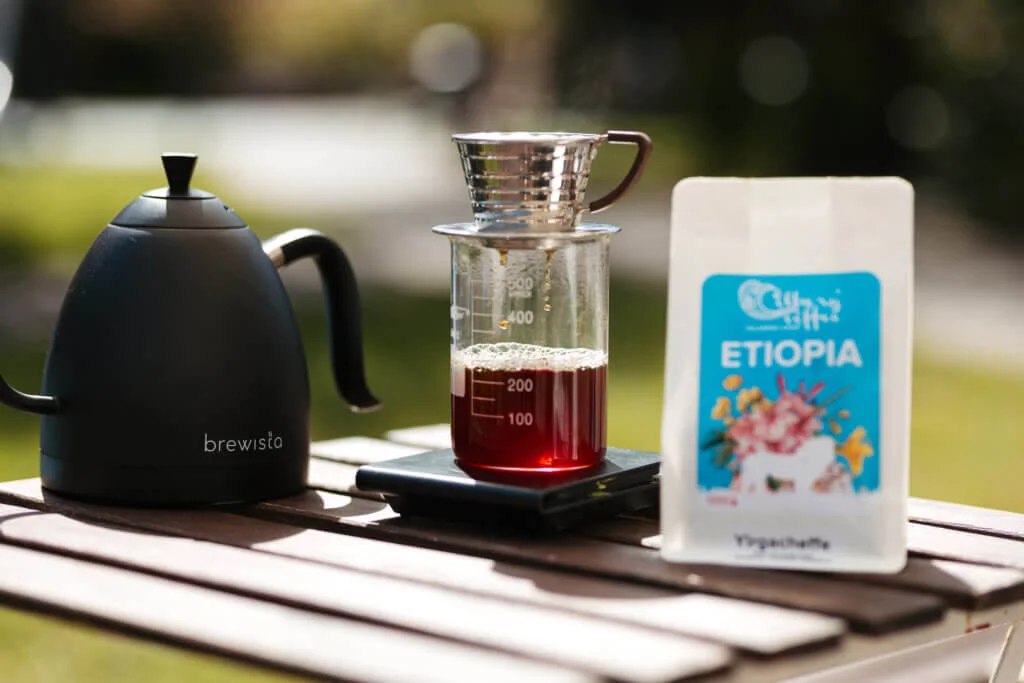
Gagné compared the 0.6 L Fellow Stagg EKG and the 0.6 L Brewista Artisan, also testing the Brewista with a flow restrictor that reduced the diameter at the base of the spout from 5.5 to 4.0 mm. The measurements were taken using water at room temperature. He examined the relationship between flow rate and maximum breakup length. The approximate values below are taken from the graph on page 131.
| Kettle | Maximum breakup length | Corresponding flow rate |
|---|---|---|
| Fellow Stagg EKG | Approximately 26-27 cm | 8 g/s |
| Brewista Artisan | Approximately 24-25 cm | 7-8 g/s |
| Brewista Artisan with flow restrictor | Approximately 21 cm | 6-7 g/s |
These figures represent the maximum breakup lengths recorded during the experiment, not recommended pouring heights for brewing coffee. The results demonstrate how significantly kettle design affects the behaviour of the water stream. Each configuration achieved its maximum breakup length at a particular flow rate.
The overall flow rate ranges also differed. The Fellow Stagg EKG offered a range of 1-18 g/s, the Brewista Artisan 2-35 g/s, and the Brewista with a flow restrictor 2-15 g/s. The restrictor reduced both the maximum flow rate and the breakup length. Restrictors fitted at the very tip of the spout can also considerably reduce the breakup length.
When choosing a pouring technique, kettle height is only part of the equation. The ability to maintain a steady flow rate also matters. A narrower spout makes slow, precise pouring easier, but changes in flow rate also affect the point at which the stream breaks up.
How high should you pour with a V60? Find out by ear
The simplest way to determine the pouring height requires no ruler. Gagné suggests watching for the point at which the stream begins to break up and listening to the sound of the water. This method helps you find a height that promotes deep agitation with a particular kettle and flow rate.
- Choose a comfortable flow rate that you can maintain reasonably steadily.
- Start pouring from just above the water surface. The stream should be smooth and coherent.
- Gradually raise the kettle while maintaining roughly the same flow rate. Listen to the sound of the water hitting the surface.
- When you hear a slight splashing sound, lower the spout a little. This allows you to find the height just before the stream begins to break up.
The book also includes a map of pouring heights and flow rates for a V60 brew using 22 g of coffee and a Fellow Stagg EKG kettle. It covers heights of approximately 11-25 cm and flow rates of 2-14 g/s. The map identifies a range of favourable combinations where the stream provides suitable agitation.
On the simplified graph, Gagné’s starting point is approximately 5 g/s at a height of 18-19 cm. This is his default pouring strategy for the specified setup of 22 g of coffee, a V60 and a Fellow Stagg EKG kettle. A flow rate of 5 g/s means adding approximately 50 g of water over 10 seconds.
How should you pour water into a V60 once you have established the pouring height? The water should cover the surface of the coffee fairly evenly. You can guide the stream in a spiral or a flower-shaped pattern. Keep your movements consistent and avoid sudden changes in direction that disrupt the stream.
A forceful pour can create a crater in the coffee bed. Gently swirling the dripper, a technique known as a spin, or distributing the stream appropriately across the surface can help. Both approaches allow you to level the coffee bed without further vigorous agitation.
What to do when coffee clogs the filter
When water begins to drain increasingly slowly, fines migration may be one of the causes. Fines displaced during agitation increase the hydraulic resistance of the coffee bed and can accumulate against the filter. The more fines the ground coffee contains, the more important the intensity of agitation becomes.
On page 142, Gagné shows how he adapts his technique for coffees that produce more fines. Alongside the favourable pouring region, his map identifies areas associated with crater formation, filter clogging and under-extraction. For coffees prone to clogging, he uses a lower flow rate and pouring height to reduce agitation.
There is no need to eliminate agitation altogether. A gentler pour reduces particle movement while allowing water to continue flowing through the coffee and extracting soluble compounds. With a more uniform grind, you can pour more forcefully to achieve stronger agitation.
Pouring height therefore also has an indirect effect on drawdown time. Vigorous agitation can increase fines migration, while accumulated fines can slow the drainage of water. This is why a longer brewing time is not necessarily caused by an excessively fine grind setting alone.
Temperature is another consideration when water is divided into numerous very thin streams. A greater surface area exposed to air relative to the volume of water promotes faster heat loss. This is an additional factor discussed in relation to devices that distribute water across multiple streams.
Key takeaways
How high should you pour when brewing with a V60? The ideal pouring height depends on your kettle, flow rate and the amount of fines in the coffee. If you want deep agitation, listening to the sound of the water and pouring from just below the breakup height can help. For coffees prone to clogging the filter, it is better to reduce the intensity of agitation.
- Pouring from higher up increases the speed of the falling water, but agitation can become shallower once the stream breaks up into droplets.
- The deepest agitation occurs at a particular combination of pouring height and flow rate. Maximum agitation is not always necessary.
- Spout design and diameter affect the breakup length. Switching kettles may require adjusting your pouring technique.
- For coffees that produce a lot of fines, a lower pouring height and flow rate can reduce fines migration and filter clogging.
- Distributing water evenly, using smooth pouring movements and levelling out any craters can help you control the brewing process.

What is the best pouring height when brewing with a V60?
The ideal height depends on the kettle, flow rate and properties of the coffee. For deep agitation, it is best to pour from just below the height at which the stream begins to break up. For coffees prone to clogging the filter, a gentler pouring technique may work better.
Does pouring from higher up increase extraction?
It can increase agitation, which speeds up extraction and improves extraction uniformity within the agitated portion of the coffee bed. Beyond a certain height, however, the stream begins to break up into droplets and agitation may weaken.
How many grams of water per second should you pour into a V60?
One example given in the book is a flow rate of approximately 5 g/s at a pouring height of 18-19 cm. The appropriate flow rate depends on the kettle and the desired intensity of agitation. A flow rate of 5 g/s is equivalent to pouring 50 g of water over 10 seconds.
Why does water sometimes drain very slowly through a V60?
One possible cause is fines migration. These small coffee particles increase resistance to flow and can clog the filter. Vigorous agitation encourages them to migrate. Reducing the flow rate and pouring height can help minimise this problem.
Does a gooseneck kettle help when brewing with a V60?
It makes it easier to control the direction and flow rate of the pour while maintaining a steady stream. The shape and diameter of the spout affect the breakup length. Different kettle models may therefore require different pouring heights.
Do you need to level the coffee bed after pouring?
The water stream can create craters in the coffee bed, particularly when pouring more forcefully. Gently swirling the dripper helps level them out. You can also distribute the water appropriately across the surface while avoiding sudden movements.
Przeczytaj też

Kopi Luwak: The Coffee from Droppings I Don’t Recommend
Kopi Luwak costs a fortune, yet its supposedly exceptional quality remains questionable. Behind this famous
Nov
Paper, Metal or Cloth Coffee Filters: Which to Choose?
Paper retains most coffee oils and fine particles, metal lets more of them through, and
Nov

Christmas Coffee Recipes: 5 Ideas from a Barista
Five Christmas coffee recipes you can make at home, including drinks from our café's winter
Nov

Cyber Monday 2026: When Is It and How to Stock Up on Coffee
Cyber Monday 2026 falls on 30 November. Find out how it started, what we have
Nov
Jamaica Blue Mountain Coffee: Is the Legend Worth the Price?
For years, Jamaica Blue Mountain was regarded as one of the world's finest coffees, and
Nov

How much water do coffee grounds retain? Where does it go?
From 350 g of water, you get around 302 g of brewed coffee. We explain
Nov
V60 Pouring Height: What Does Physics Say?
Does pouring from higher up always improve coffee agitation? Physics shows that there is a
Nov

Why Does Coffee Taste Different as It Cools?
Coffee left on your desk can taste completely different from how it tasted just after
Nov

This site is protected by reCAPTCHA. The Google Privacy Policy and Terms of Service apply.