












A burr grinder is the foundation of good coffee, at home and in a café. It crushes the beans between two burrs whose distance you set yourself, so the grind is far more consistent than from a blade grinder and extraction is easier to control. The remaining question is which burrs to choose: flat or conical. Here is how they differ and how that can show up in the cup.
Burr grinder or blade grinder?
A blade grinder works like a blender. A spinning blade smashes the beans into a mix of fine dust and big chunks, which makes even extraction difficult. The coffee can end up bitter, astringent or flat.
A burr grinder breaks the coffee down between flat or conical burrs. By changing the gap between them you control grind size and get a repeatable result. That is why a burr grinder is the right choice for espresso and for filter methods. Grind size and taste are covered in How grind size affects the taste of coffee.
How flat burrs work
Flat burrs are two parallel rings with their teeth facing each other. One stays still, the other spins. Beans drop into the centre and centrifugal force pushes them outwards, where they are ground finer and finer until they leave at the edge of the burrs.
Flat burrs often grind more evenly and produce less very fine dust, although a lot depends on the burr geometry. That can favour a clean cup with well-defined flavour notes. You will find flat burrs in many café grinders, usually between 64 and 98 mm across. A larger diameter can raise output and help carry heat away when the grinder works hard.
Retention, the coffee that stays inside the grinder after grinding, is also worth checking. It depends mostly on the design of the whole grinder, not just the burr type. Manufacturers reduce it with burr orientation, a short path to the spout and features that help clear leftover grounds.
How conical burrs work
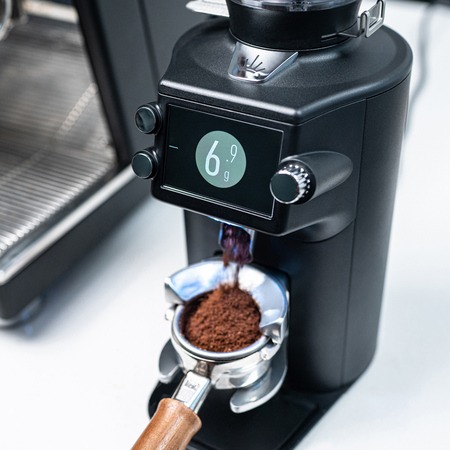
In a conical grinder the inner burr is cone-shaped and turns inside an outer ring. Beans fall in by gravity and are broken down in stages, from larger pieces at the top to fine particles at the bottom of the cone.
Conical burrs tend to produce a wider spread of particle sizes and more fines, though models differ a lot. In the cup that can mean more body and a rounder taste, with a little less clarity. Conical burrs are found in most hand grinders, many home electric grinders and some professional models.
Flat or conical burrs: comparison
| Flat burrs | Conical burrs | |
|---|---|---|
| Design | two parallel rings | a cone inside a ring |
| Particle distribution | often more even | usually wider, more fines |
| Taste | can favour clarity | can give more body |
| Where you find them | many café grinders and home grinders for espresso and filter | most hand grinders, many home electric and some professional grinders |
There is no single winner. Good grinders with either burr type can give excellent results, and the specific model and brew method matter more. When choosing, look at grind quality, adjustment range, output, retention and noise.
Steel or ceramic burrs?
Electric grinders mostly use steel burrs, hardened or surface-treated. Ceramic burrs appear mainly in simpler hand grinders. Ceramic resists corrosion and wear but is more brittle than steel. Grind quality depends above all on geometry, manufacturing, alignment and burr condition, not on the material alone.
All burrs wear out eventually. Worn burrs can create more fines, grind more slowly and load the motor more. Many manufacturers give an approximate burr life in kilograms of coffee. In a café it pays to track how much you grind and how the grind looks, because the change is gradual and easy to miss. Common faults are covered in Coffee grinder troubleshooting.
Which burr grinder should you choose?
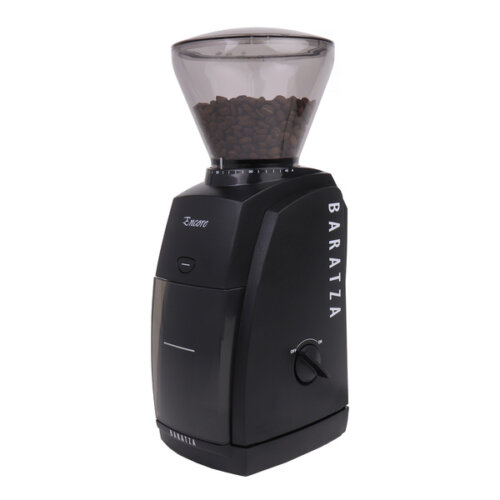
Home, filter coffee. The electric Baratza Encore with steel conical burrs is a solid choice. It handles pour-over, Chemex, AeroPress and French press.
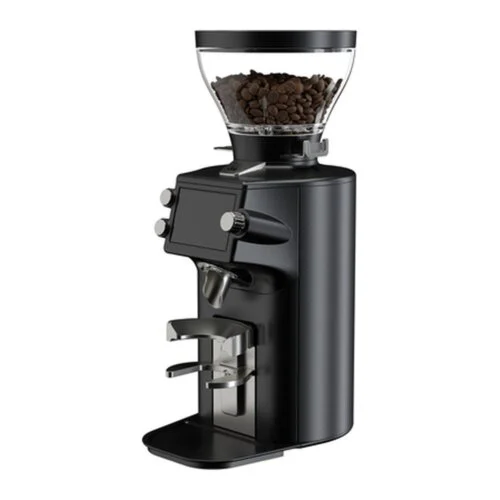
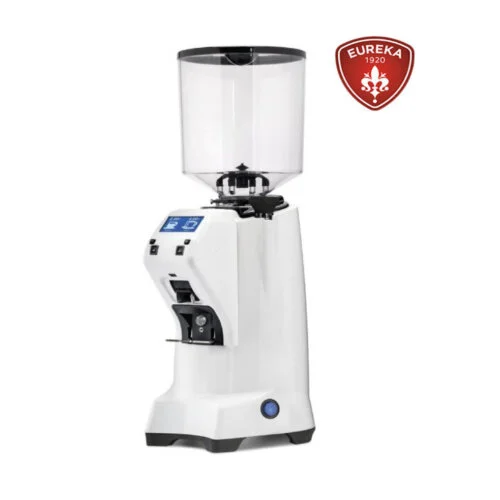
Home, espresso. Espresso needs adjustment that allows very small changes in grind size. A good compact example is the Mahlkönig E64 WS with 64 mm flat burrs, electronic adjustment and grind-by-weight. If you have more space or brew a lot, consider the larger commercial Eureka Olympus 75 NEO with 75 mm flat burrs and stepless adjustment.
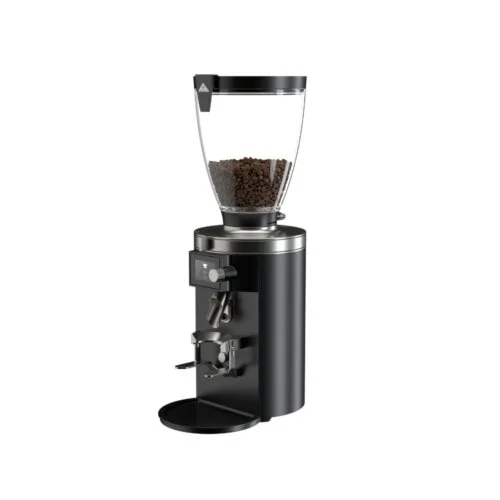
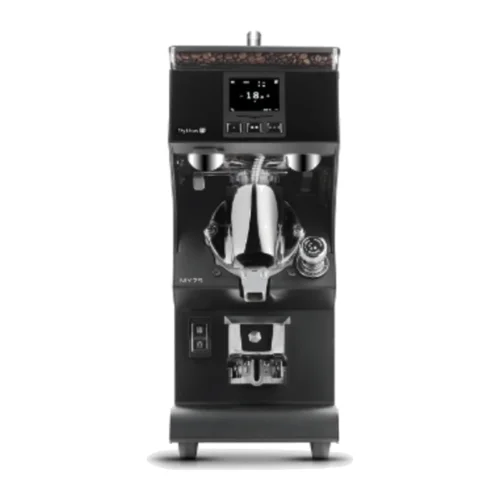
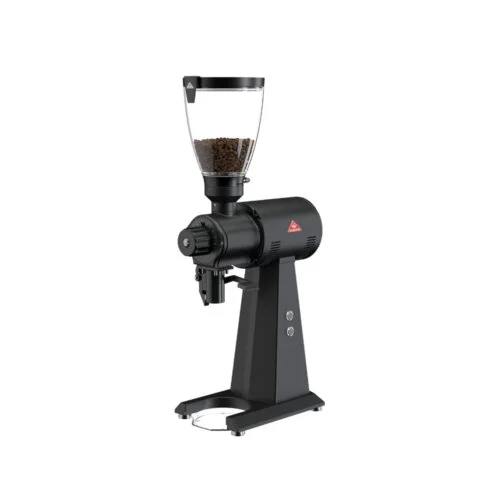
Café. With heavy traffic you need output, temperature stability and a consistent dose. Flat-burr grinders in the 65-85 mm range work well, for example the Mahlkönig E65S with 65 mm burrs, the Eureka Atom in 65 and 75 mm versions or the Victoria Arduino Mythos MY75 with 75 mm burrs. For batch brew and filter coffee in a café, the Mahlkönig EK43 with 98 mm flat burrs is a classic.
See the full range in our coffee grinders category. If you run a café, read How to dial in a coffee grinder in a café as well.
What is the difference between a burr and a blade grinder?
A blade grinder smashes the beans with a spinning blade, so the grind is uneven. A burr grinder breaks the coffee down between two burrs whose gap you can adjust. The result is a repeatable grind and easier control over extraction.
Which is better: flat or conical burrs?
Neither is better in every situation. Flat burrs often grind more evenly, though a lot depends on their geometry. Conical burrs are popular in hand and home grinders. Grind quality, precise adjustment and how you use the grinder matter most.
Which burr grinder for espresso at home?
You need a grinder with precise adjustment that lets you make very small changes. It can have flat or conical burrs. A compact home example is the Mahlkönig E64 WS, while the Eureka Olympus 75 NEO is a larger commercial machine.
Is a hand grinder good for espresso?
Some hand grinders adjust finely enough for espresso, but most simple models suit filter methods better. If you make espresso every day, an electric grinder will be more convenient.
When should I replace grinder burrs?
It depends on the model and how much coffee you grind. Many manufacturers give an approximate burr life in kilograms. More fines, slower grinding and a change in taste at the same settings can mean worn burrs, but also dirty or misaligned ones.
Are ceramic burrs better than steel?
Ceramic burrs resist corrosion and wear but are more brittle. Steel burrs can be made very sharp and dominate in electric grinders. Geometry, manufacturing, alignment and condition matter more than the material itself.
Przeczytaj też

Irish coffee: recipe, ratio and how to float the cream
The classic Irish coffee recipe: IBA proportions, how to keep the cream from sinking, which
Oct

Espresso macchiato: what it is and how to make one
An espresso macchiato is espresso with a little milk foam. Here is how it differs
Oct

Cortado: what it is, the ratio and how to make one
A cortado is espresso with a little warm milk. Here is the usual ratio, how
Oct
Burr grinders: flat or conical burrs?
How a burr grinder differs from a blade grinder, and what flat and conical burrs
Oct
La Marzocco Linea Mini, Linea Micra or Eagle One Prima? Choosing a home espresso machine
Three single-group home espresso machines compared: La Marzocco Linea Micra, Linea Mini R and Victoria
Oct

Sour espresso: why it happens and how to fix it
Why does espresso taste sour? Under-extraction, grind, temperature, water and the beans themselves. What to
Oct

New coffees at the roastery: Kenya Inoi Kaguyu and Ethiopia Kurume Natural
Two new specialty coffees from Africa: fruity Kenya Inoi Kaguyu and floral Ethiopia Kurume Natural.
Oct

Coffee as a Christmas gift: which one to choose? 2026 guide
Coffee as a Christmas gift: how to match it to the person and their brewing
Oct
