

A coffee tamper goes by a few names, ubijak, ubijaczka, tamper, but it’s always the same tool. A metal base presses ground coffee down in the portafilter’s filter basket, closes up large air gaps and leaves an even bed ready for extraction.
A good tamper has to match the basket’s diameter. What matters most while you work is even distribution of the coffee, keeping the base level, and applying consistent pressure.
Why you tamp coffee in the portafilter
Ground coffee sits loosely in the basket once you dose it in, and its density can be uneven. Water at nine bar takes the path of least resistance, and that’s how channelling starts.
Uneven flow means uneven extraction. Part of the puck stays under-extracted while more water rushes through elsewhere, and the result can be an espresso that’s sour and bitter at the same time.
Tamping won’t fix coffee that’s badly distributed. It locks in whatever arrangement is already in the basket, so distribution has to happen before you reach for the tamper.
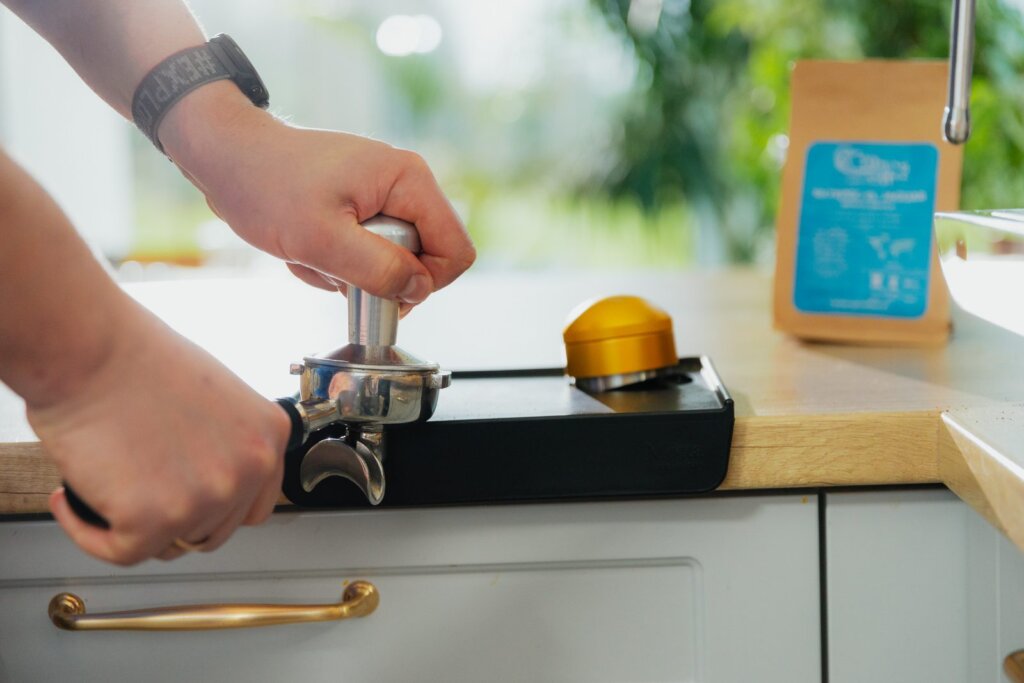
What size tamper should you choose
Size decides whether a tamper works properly in the basket. Everything else about it is mostly a matter of comfort.
The tamper needs to be a touch smaller than the basket’s inside diameter. Too small a base leaves a ring of under-tamped coffee round the edge. Too large, and it won’t fit the basket, or it will rub against the walls.
The nominal group size isn’t the exact tamper diameter. A basket sold as “58 mm” actually measures a bit more than 58.0 mm inside, so a well-fitted tamper is 58.4-58.5 mm. Buying a 58.0 mm tamper for a 58 mm basket is a common mistake.
| Your machine | Basket | Look for a tamper |
|---|---|---|
| La Marzocco, Nuova Simonelli, Victoria Arduino, Rocket, Profitec, Rancilio, Gaggia Classic, Lelit Bianca and MaraX, Sage Dual Boiler | 58 mm | 58.4-58.5 mm |
| Unic, Lelit Anna PL41 | 57 mm | 57.3 mm |
| Sage Barista Express, Barista Pro, Bambino | 54 mm | approx. 53.3 mm |
| La Spaziale | 53 mm | 53 mm |
| DeLonghi Dedica, La Specialista | 51 mm | 51 mm |
Can’t find your machine in the table? Measure the basket’s inside diameter with callipers and subtract half a millimetre. You’ll find the full table, including bean-to-cup machines, in our coffee tampers category.
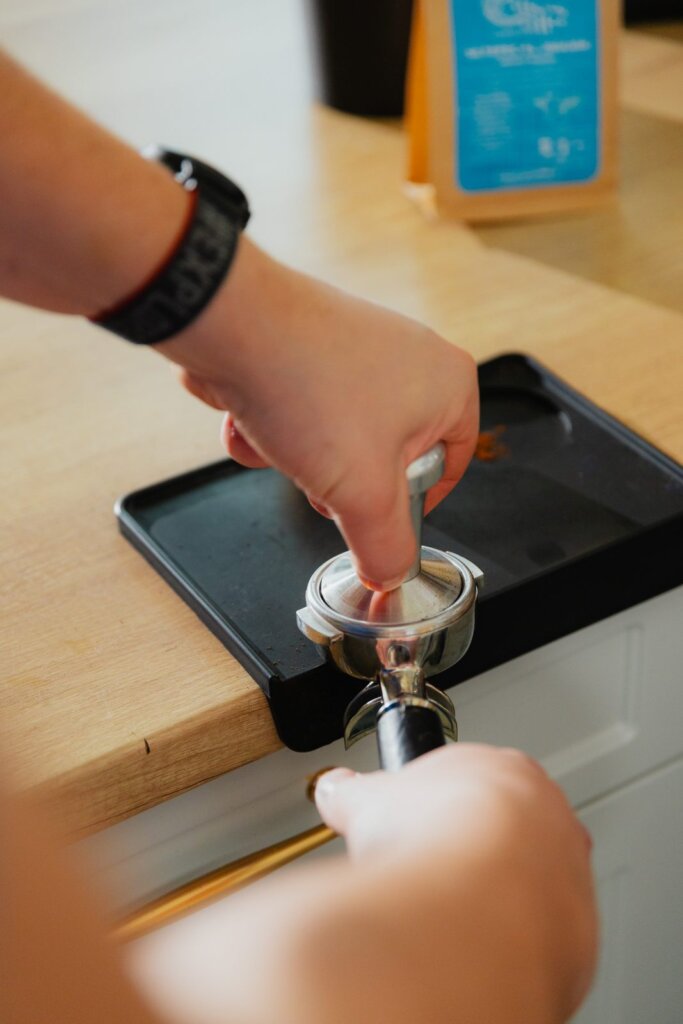
How to tamp coffee correctly
The single most important rule: tamp level. A tilted base leaves a puck of uneven thickness, and water finds it easier to push through the thinner side.
Level the coffee before you tamp. Spread it with a finger, a gentle shake of the portafilter, or a distribution tool. Aim for even density right across the basket.
Rest the portafilter on something stable. Set it on a tamping mat or a properly fitted stand. Don’t tamp while holding the portafilter in mid-air.
Press straight down. Keep your elbow above your wrist, with your forearm in line with the tamper handle. Looking down from above, check the base sits level against the edge of the basket.
Don’t twist the tamper. The finishing twist some people call a “polish” doesn’t improve extraction. With uneven pressure it can actually disturb the surface of the puck.
Don’t tap the portafilter after tamping. The knock can pull the coffee away from the basket wall and open up a gap that invites channelling.
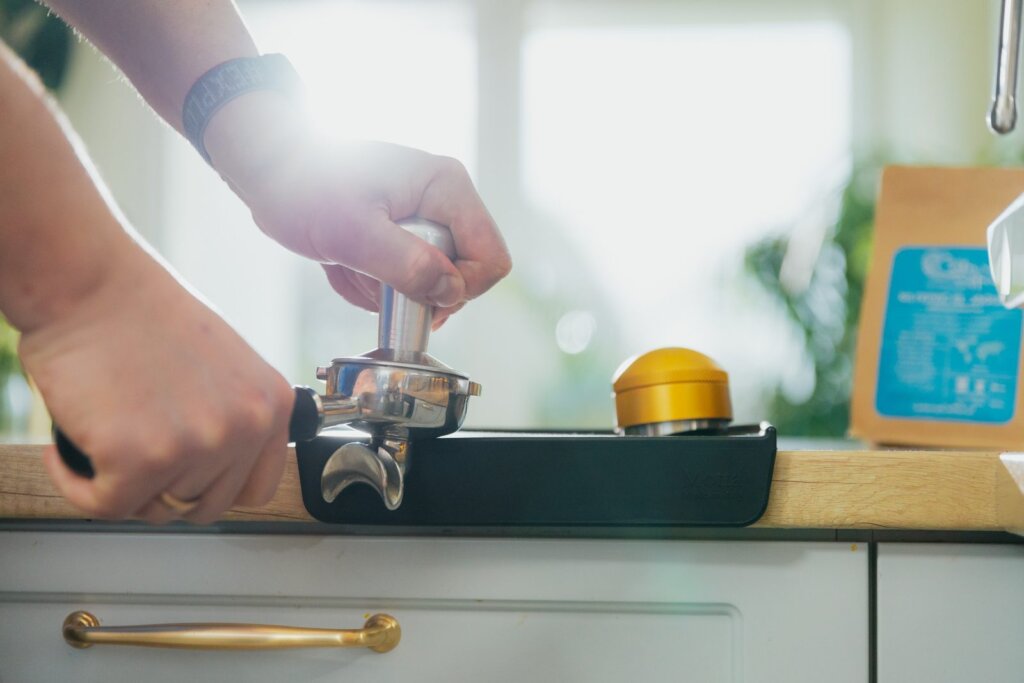
How much force do you actually need to tamp with
The figure you’ll often hear quoted is thirty pounds, around fourteen kilograms. It’s a reasonable reference point, but it isn’t a requirement for good extraction.
A controlled test by Socratic Coffee compared 5, 10, 15 and 20 kg of tamping pressure across forty shots, measuring total dissolved solids with two refractometers. It found no difference in extraction.
Separate measurements of puck compression show that eighty percent of the compaction happens at around three pounds of pressure already. Pushing harder beyond that has no proven benefit for extraction.
Apply the same pressure for every shot and keep the tamper level. Consistent technique means you can dial in the grinder without adding another variable into the mix.
Calibrated, spring-loaded tampers click once you’ve reached a set force. They help you learn a repeatable motion, but they don’t replace proper distribution or a level tamp.
Weight, base shape and handle
Weight. A heavier tamper does some of the work through its own weight, so your wrist has less to do. Over a few coffees a day the difference is small, but over several dozen it becomes noticeable.
Flat or convex base. A flat base is predictable and the best place to start. Convex, C-flat and ripple bases press the coffee harder at the edge and reduce channelling for some people, but they need a repeatable motion to work well. It’s a different way of working, not an automatic upgrade in extraction.
Handle. Wood feels warmer in the hand, while steel and aluminium are easier to keep clean. At home it mostly comes down to comfort and looks.
Stainless steel is the standard base material. Differences between steel grades don’t show up in the taste of the espresso.
Three common tamping mistakes
The wrong tamper size. Too small a base leaves the coffee at the edges under-tamped, too large and it can jam in the basket. Check the diameter before you buy.
Tamping without levelling first. A tamper doesn’t spread coffee across the basket. If you’re getting clumps or uneven density, use a WDT tool or a properly set coffee distributor before you tamp.
Trying to control flow with tamping pressure. If your espresso runs too fast or too slow, check your grind size and dose first. Once the large air gaps are gone, pressing harder has no proven effect on extraction.
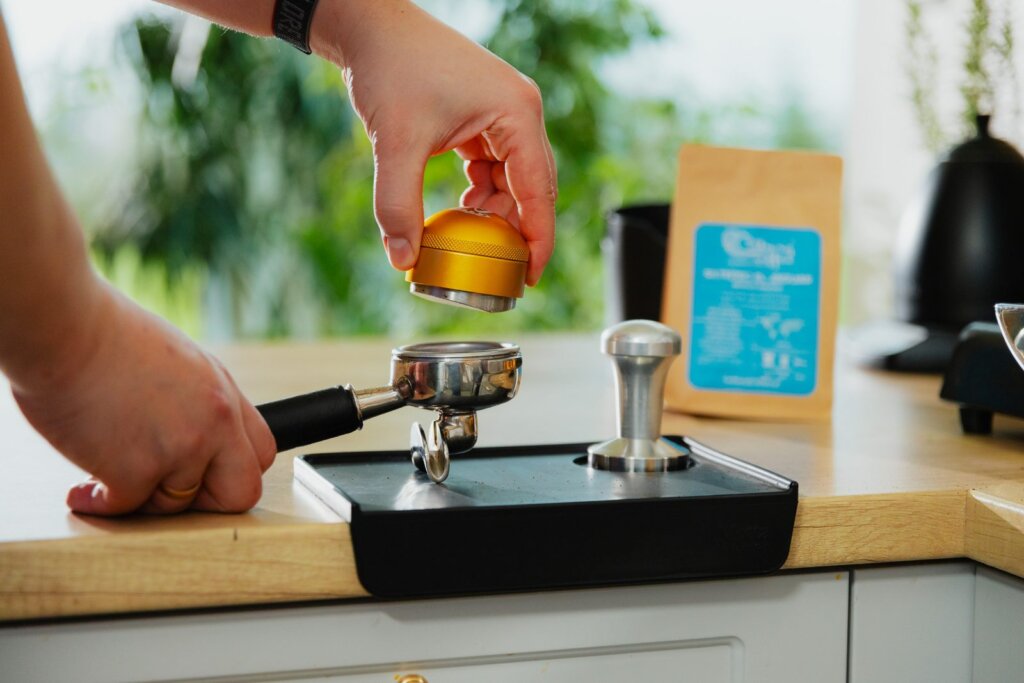
When an automatic tamper makes sense
A hand tamper is enough at home and in a small venue. An automatic one earns its keep when several people share the same machine and everyone tamps a bit differently. It also helps keep the pace up and the pressure consistent.
Automatic tamping also takes the strain off your wrists. Several hundred repetitions a day is a documented repetitive strain risk for baristas.
We’ve covered the differences between automatic models in our guide, which Puqpress model suits your café. You’ll find both hand and automatic tampers in our tampers category.
FAQ: coffee tampers
Which tamper should I choose for the Sage Barista Express?
The Sage Barista Express has a basket sold as 54 mm. Look for a tamper around 53.3 mm in diameter, which will sit in the basket without rubbing against the walls.
Which tamper fits the DeLonghi Dedica best?
A 51 mm tamper fits the DeLonghi Dedica. Before you buy, check the diameter of the basket you’re actually using too, especially if it’s been swapped for one from another maker.
Which tamper should I buy for a 58 mm group?
For a basket sold as 58 mm, look for a tamper at 58.4-58.5 mm. A 58.0 mm tamper will still work, but it leaves more of a gap round the edge of the basket.
How much force should you use to tamp coffee?
You don’t need to hit exactly thirty pounds, around fourteen kilograms. A study comparing 5, 10, 15 and 20 kg of pressure found no difference in extraction. Press with the same force every time and keep the tamper level.
What’s the difference between a tamper and a coffee distributor?
A distributor spreads ground coffee across the basket, while a tamper presses it down and closes up large air gaps. Distribution happens before tamping. Neither tool automatically replaces the other.
Does a calibrated tamper make better espresso?
A calibrated tamper helps you repeat the same pressure every time, but it doesn’t guarantee better extraction on its own. You still need to distribute the coffee evenly and keep the base level. It’s a tool for controlling technique, not a fix for bad grinding.
