

In Poland, an automatic tamper typically costs around 4,000 to 5,000 złoty, and it usually stays behind the bar for several years. Before you buy one, there are three things to check: tamper diameter, grinder compatibility and weekly coffee volume. Here’s a breakdown of the actual differences between models.
Don’t buy an automatic tamper to improve your espresso’s flavour. Pressure studies don’t back that up. What Puqpress actually solves are different problems: it reduces the variation between baristas, speeds up work at the bar and takes repetitive strain off your wrists. If none of those problems affect you, a manual tamper still does the job.
Start by answering three questions
What espresso machine and baskets are you using? That determines the tamper diameter, and it’s the easiest place to get it wrong.
What grinder do you have? That decides whether you can choose one of the under-grinder models.
How many kilograms of coffee do you use per week? The manufacturer rates workload in kilograms per week. The number of coffees per day can be misleading, since it depends on dose size and how many days the venue is open.
Tamper size: don’t go by the group name alone
In the trade, people often just say “58 group,” but that doesn’t always mean the same tamper diameter. Manual tampers for 58 mm baskets actually measure 58.4 to 58.5 mm. Puqpress doesn’t use those sizes. It offers five diameters, 53.0 / 54.3 / 57.3 / 58.0 / 58.3 mm, and assigns them to specific espresso machine brands.
That means a standard manual tamper size chart isn’t enough when ordering a Puqpress. You need to use the manufacturer’s own table:
| Machine brand | Puqpress tamper |
|---|---|
| La Marzocco, Synesso, Kees van der Westen, Carimali | 58.3 mm |
| Nuova Simonelli, Victoria Arduino, Cimbali, Faema, Astoria, Wega, Rancilio, Sanremo, ECM, Bezzera, Expobar, Conti | 58.0 mm |
| Unic | 57.3 mm |
| Dalla Corte, San Marco | 54.3 mm |
| La Spaziale | 53.0 mm |
La Marzocco needs 58.3 mm, while Victoria Arduino and Nuova Simonelli need 58.0 mm. Both are casually called a “58 group,” but the tampers are not interchangeable.
There’s one important exception: if you use VST baskets, it’s 58.3 mm regardless of your machine brand. A venue running Nuova Simonelli with VST baskets should order 58.3 mm, not 58.0 mm.
If your equipment isn’t on the list, measure the internal diameter of your baskets and confirm the size before ordering.
Freestanding or mounted under the grinder
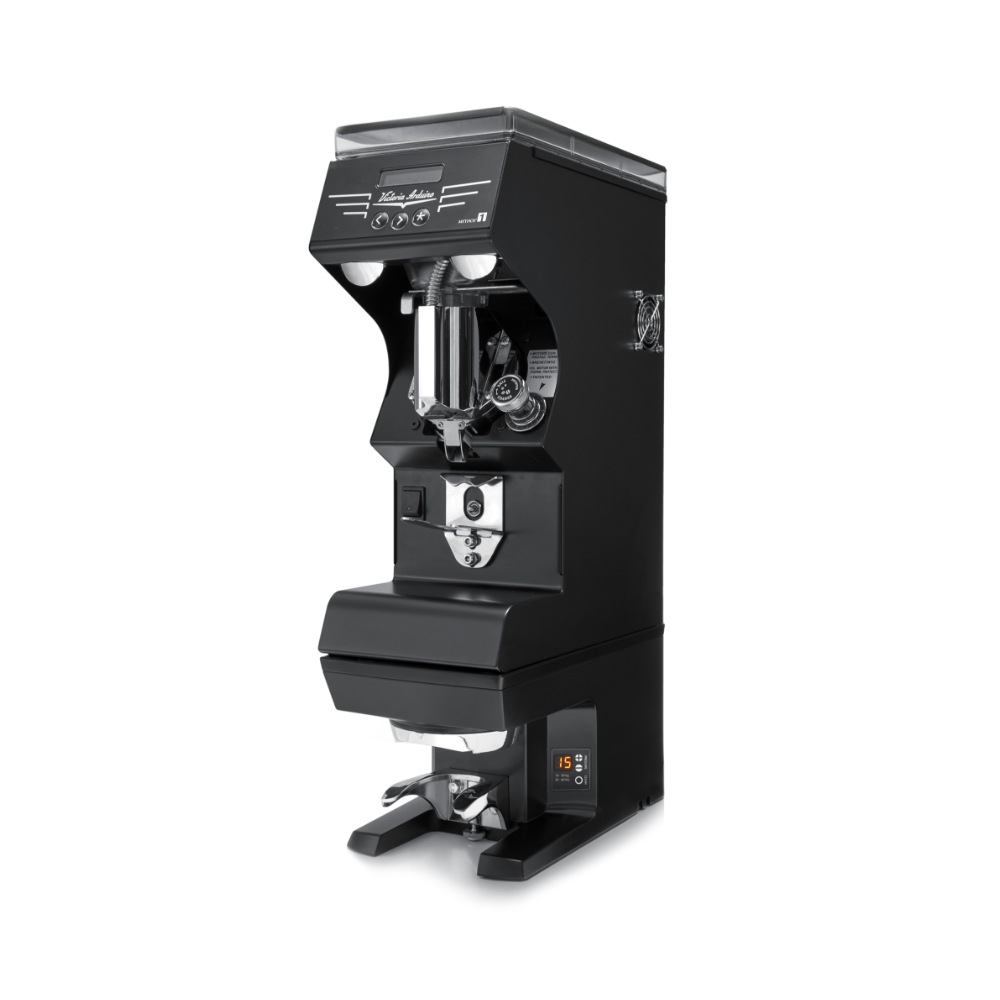
The M series mounts underneath the grinder and needs no separate counter space. The barista puts the portafilter under the grinder, then uses the tamper positioned right beneath it. The catch: the model has to match your specific grinder.
| Model | Fits which grinder | Pressure | Notes |
|---|---|---|---|
| M2 | Victoria Arduino Mythos 1 and 2 | 5-30 kg | 5 profiles, no cycle limit |
| M3 | Mahlkönig E65S and E65S GbW | 5-30 kg | 5 profiles, no cycle limit |
| M4 | Fiorenzato F64 and F83 | 10-30 kg | 3 profiles, 200,000-cycle warranty |
| M5 | Mahlkönig E80 and E80 GbW | 5-30 kg | 5 profiles, no cycle limit |
| M6 | Victoria Arduino MY75 and MY85 | 5-30 kg | 5 profiles, no cycle limit |
The M4 has a lower spec than the rest of the M series. Its pressure range starts at 10 kg, it has three profiles instead of five, and the warranty covers 200,000 cycles. It’s also the cheapest model in the series. If you’re a high-volume venue, factor these differences in before buying.
The manufacturer also offers extra mounting brackets for selected grinders outside the standard list: Mazzer, Macap, Ceado, Nuova Simonelli MDJ, Mazzer Robur and Kold. Bracket availability needs to be confirmed for your specific Puqpress model and grinder.
Mini, Q and Pro: weekly volume is what matters most
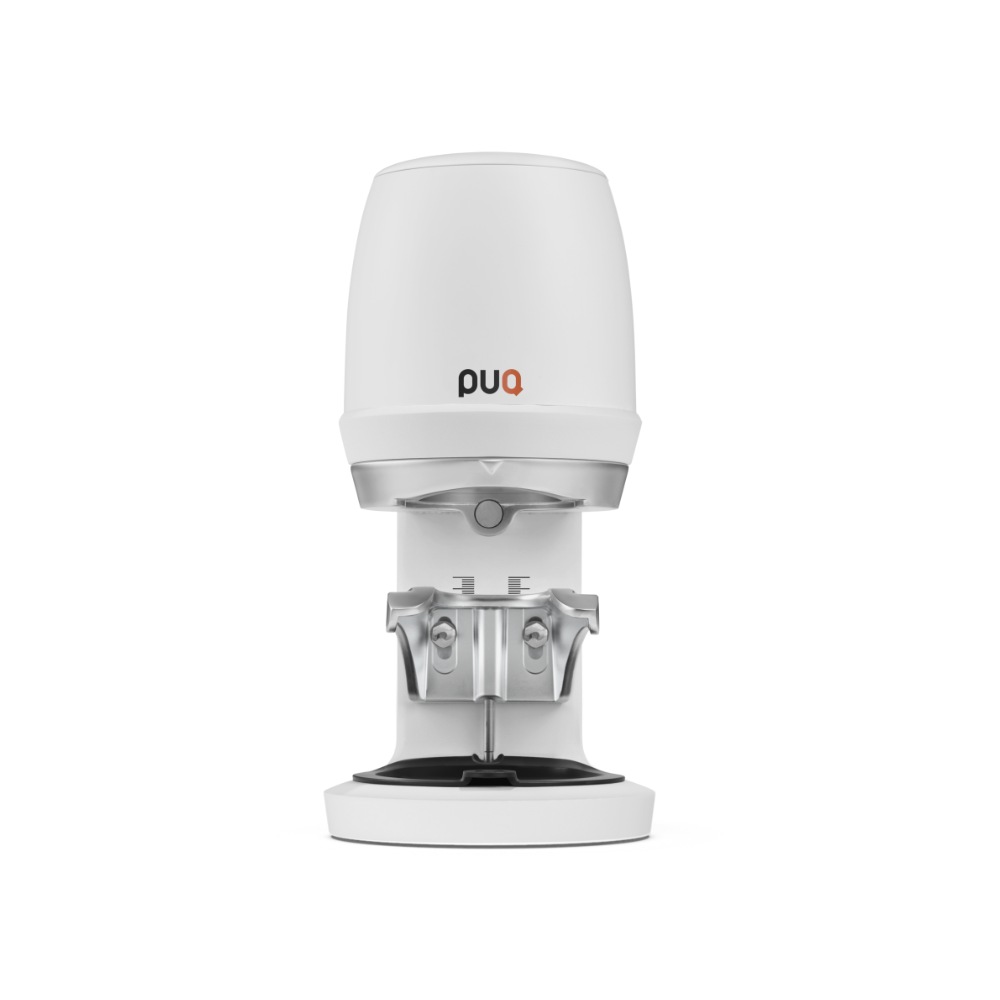
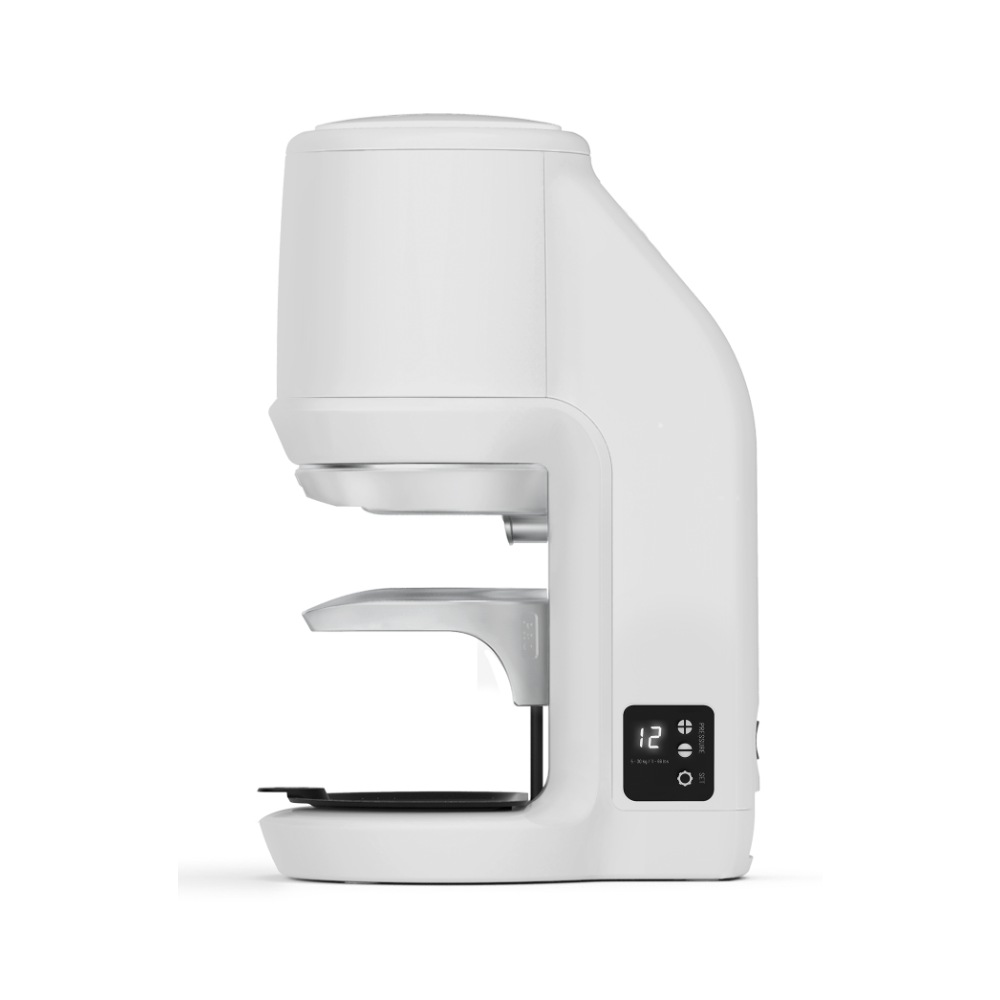
The freestanding models sit on the counter and can go next to any grinder. They look similar, but differ in rated workload, pressure range, profiles and available diameters.
| Mini | Q | Pro | |
|---|---|---|---|
| Workload | up to 7 kg of coffee per week | up to 25 kg per week | no limit |
| Pressure | 10-30 kg | 5-30 kg | 5-30 kg |
| Profiles | 3 | 5 | 5 plus a second set of 5 |
| Tamper sizes | 53 to 58.3 mm | 53 to 58.3 mm | 57.3 / 58.0 / 58.3 mm |
| Dimensions | 136 x 186 x 273 mm | 141 x 195 x 286 mm | 144 x 196 x 301 mm |
| Weight | 3.4 kg | 3.5 kg | 4.3 kg |
Seven kilograms a week works out to roughly four hundred coffees. The Mini suits a small venue, an office or a roastery. Don’t choose it based on daily order numbers alone. Work out your full weekly coffee usage instead.
The Pro only covers the upper end of the size range: 57.3, 58.0 and 58.3 mm. If you’re running Dalla Corte, San Marco or La Spaziale, go for the Q instead, because the Pro doesn’t come in the right diameter.
The Pro has a profile-switching button on the front of the unit. That’s useful if you’re running two coffees side by side and want different settings for each without digging into a menu mid-service.
A tamping cycle takes 1.3 to 1.5 seconds on the fastest profile, and around 2.5 seconds on the slowest. All models draw 76 W, a small load compared to the machine and grinder on the same circuit.
What Puqpress doesn’t do
Puqpress doesn’t distribute the coffee in the basket, and it doesn’t replace WDT (the Weiss Distribution Technique: breaking up clumps and levelling the grounds with fine needles right before tamping). Its job is tamping. Two-strike profiles smooth the surface of the puck, but they don’t replace distribution done beforehand.
If you’re fighting channelling and uneven extraction, add a separate tool. The simplest option is a 58 mm coffee distributor, which levels the coffee in the basket before tamping. The same rule applies here as with the tamper: the diameter has to match your portafilter.
If channelling or uneven extraction is your problem, an automatic tamper on its own won’t fix it. You need to sort out your grind and distribution in the basket first.
What you’re actually paying for
It’s a common claim online that higher, more consistent tamping pressure improves extraction. The measurements available don’t back that up.
In a controlled experiment by Socratic Coffee, pressures of 5, 10, 15 and 20 kg were compared. Forty shots were pulled and TDS was measured with two refractometers. Under those conditions, there was no measurable difference in TDS or extraction yield. A separate puck compression test found that 80% of compaction happened at just three pounds of pressure. So there’s no basis for promising better flavour purely because an automatic tamper presses with a specific force.
Three other, operational benefits are what actually justify buying one.
A consistent procedure. Every barista runs the same programmed profile. It removes one variable from the team’s workflow, but it doesn’t replace the grinder adjustments you still need to make through the day.
Pace behind the bar. The fastest cycle takes 1.3 seconds, during which the barista doesn’t need to tamp by hand. At three hundred coffees a day, the effect on workflow is noticeable, but the manufacturer doesn’t publish exactly how much time the whole process saves. You’ll need to judge that against your own station and workflow.
Less strain on the wrists. Wrist overuse injuries are a documented occupational issue for baristas. Removing a few hundred manual repetitions a day cuts a worker’s exposure to that movement.
The manufacturer doesn’t publish a pressure tolerance or deviation figure for tamp level. You can set a specific value and profile, but there’s no basis for promising precision down to the last few grams of pressure.
What to choose in practice
Using up to 7 kg of coffee a week: Mini. This is the model for a small venue, an office, or a low-volume station.
Using 7 to 25 kg a week: Q. It has five profiles, a pressure range of 5 to 30 kg, and covers every diameter from 53 to 58.3 mm.
Over 25 kg a week, or you need to switch quickly between two sets of profiles: Pro, as long as your machine falls into the 57.3, 58.0 or 58.3 mm sizes. In practice that’s everywhere except Dalla Corte, San Marco and La Spaziale.
You have a compatible grinder and want to cut down on separate units on the counter: the M series, in the model matched to your grinder.
You’ll find every model in our range. If you’re not sure about the tamper diameter or grinder compatibility, get in touch before ordering. Checking two specs takes a minute. Returning the wrong unit takes a lot longer.
FAQ: the Puqpress automatic tamper
What tamper size do I need for La Marzocco?
58.3 mm. The same size applies to Synesso, Kees van der Westen and Carimali. Watch out for a common mistake: Victoria Arduino and Nuova Simonelli use 58.0 mm, even though they’re also called a “58 group.” If you use VST baskets, it’s 58.3 mm regardless of machine brand.
What’s the difference between the Puqpress Mini and Q?
Mainly the workload: the Mini is rated for 7 kg of coffee a week, the Q for 25 kg. The Q also has a wider pressure range (5 to 30 kg versus 10 to 30 kg) and five profiles instead of three. The Mini suits a small venue or office, the Q a café with normal footfall.
Which Puqpress fits my grinder?
The under-grinder versions are tied to specific grinders: M2 for Victoria Arduino Mythos, M3 for Mahlkönig E65S, M4 for Fiorenzato F64 and F83, M5 for Mahlkönig E80, M6 for Victoria Arduino MY75, MY85, MYG75 and MYG85. Extension brackets are also available for Mazzer, Macap, Ceado and Nuova Simonelli MDJ. The freestanding versions, the Mini, Q and Pro, fit any grinder.
Does an automatic tamper improve the taste of the coffee?
There’s no evidence for that. A controlled experiment by Socratic Coffee found no meaningful difference in TDS or extraction yield across pressures from 5 to 20 kg. It didn’t test flavour directly, or compare the automatic tamper against manual tamping. What an automatic tamper actually gives you is consistency between baristas, pace at the bar and less wrist strain, not better extraction.
Does the Puqpress distribute coffee in the basket?
No. It only tamps. It doesn’t replace a distribution tool or WDT (the Weiss Distribution Technique: levelling the grounds with needles before tamping). Two-strike profiles smooth the surface of the puck, but they don’t distribute the coffee beforehand. If you’re fighting channelling, you need a separate tool, such as a portafilter distributor.
How long does a single tamp take?
From 1.3 to 1.5 seconds on the fastest profile, up to around 2.5 seconds on slower, multi-strike profiles. During that time, the barista has both hands free, which matters more during a rush than the raw seconds suggest.
