

The coffee market in 2024 and 2025: record exports, climate pressure and rising prices
2024 brought a lot of change to the global coffee market: record export volumes, volatile prices and growing concern about the climate. The most recent report from the International Coffee Organization (ICO) points to the largest annual rise in coffee exports on record in 2023, which shows how quickly the picture is shifting on both the supply and the demand side.
Record growth in coffee exports
Coffee producing countries posted record exports last year, which suggests producers are using price volatility to steady their own finances. Exporting more may be a response to an unpredictable market and an attempt to secure revenue in difficult conditions.
You may also like:
Coffee roasting: what actually happens during the roast
Climate as the main risk factor
Weather has an enormous effect on coffee supply, which feeds straight through to price and availability. Brazil, the largest producer in the world, is dealing with unpredictable conditions such as frosts and unexpected rainfall, which disrupt the growing cycle. Colombia and producing countries in Africa face similar problems, where climate variability affects harvest size and forecasts of future availability. Investors react to those risks, which produces large swings in the futures market.
Demand for better quality robusta
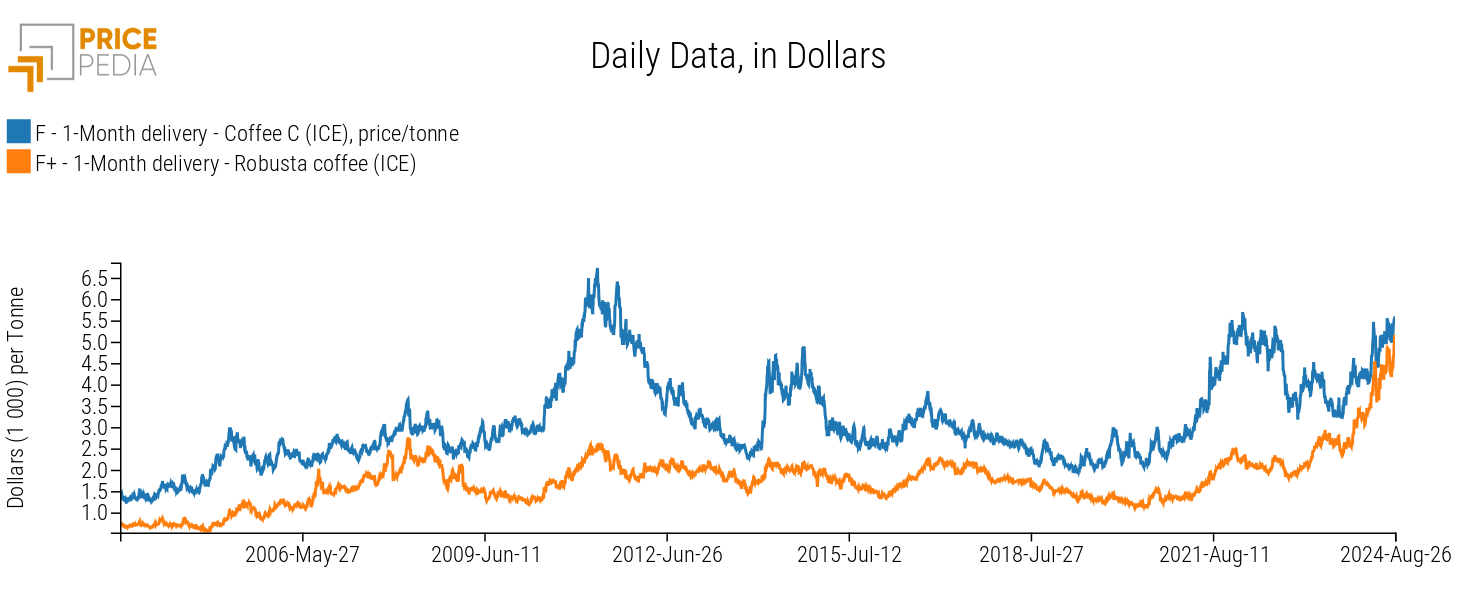
One of the most significant trends on the market is rising demand for robusta, which now sits at the same price as arabica. For years robusta quality was underrated and producers had little incentive to invest in better processing. That has changed. As blends have grown in popularity, farmers have started paying closer attention to robusta quality: careful picking, drying and fewer defects in the bean.
As a result the price of robusta, traditionally lower than arabica, has reached a comparable level, which is a new problem for roasters. The convergence is not only about better quality: it also comes from higher demand for blends, where robusta plays a key role in adding body and bitterness.
For our small-batch roastery this means adjusting final prices. Higher robusta costs feed directly into the price of blends, which is not easy for customers to accept. It puts the responsibility on us to explain why prices change and to make the case that better robusta costs more but delivers better flavour and more intensity in the cup.
Our guide to picking a coffee that suits you:
How to choose a good coffee and what to look for
Growing conditions: arabica against robusta
Arabica and robusta differ in more than flavour. They also differ in how they are grown. Arabica grows at higher altitudes, from 800 to 2,400 m a.s.l., which makes production more demanding. Robusta grows lower down, from sea level to 800 m a.s.l., which makes it easier to farm and, despite the rising quality, keeps its price lower.

Stock levels and market balance
Global coffee stocks, particularly in Europe and North America, the two key importing markets, are fluctuating, which reflects the tension between strong demand and production problems at the exporting end. The European Coffee Federation (ECF) has warned about falling stocks, which could reach dangerously low levels and put the stability of the supply chain at risk.
What comes next: opportunity and risk
The future of the coffee market is an open question, balanced between opportunity and risk. If climate change intensifies, expect further price rises, affecting both what consumers pay and the margins of everyone involved, from smallholders to large roasters. Growing interest in higher quality robusta may also narrow the price gap between robusta and arabica.
Right now, good quality robusta and entry-level specialty coffee from Brazil are priced at a similar level, which has taken the trade by surprise.
What is coming in 2025?
Forecasting the coffee market for 2025 is difficult, because the current situation is genuinely unstable. There are two paths open. One is opportunity, where prices steady and production rises to the benefit of the whole trade. The other is a market that becomes even less predictable because of difficult weather, bringing further disruption.
The coffee market is going through a period of serious change. Record exports, volatile weather and growing interest in robusta quality are challenges for everyone in the sector. How producers and distributors handle them remains to be seen. What is certain is that consumers can expect more change in the price of the coffee they buy.
