

Coffee in a French press is the simplest way to get a good brew without electricity or paper filters. You add coarsely ground coffee, pour over hot water, wait four minutes and push the plunger down. Everything else comes down to four numbers: 15 g of coffee per 250 ml of water, a coarse grind, water at 92-96°C and 4 minutes of brewing.
Below you’ll find a step-by-step recipe, a ratio table for every size of brewer, a variation on James Hoffmann’s method, and a list of the mistakes that most often ruin the cup. This is how we test-brew the coffees we roast near Kołobrzeg.
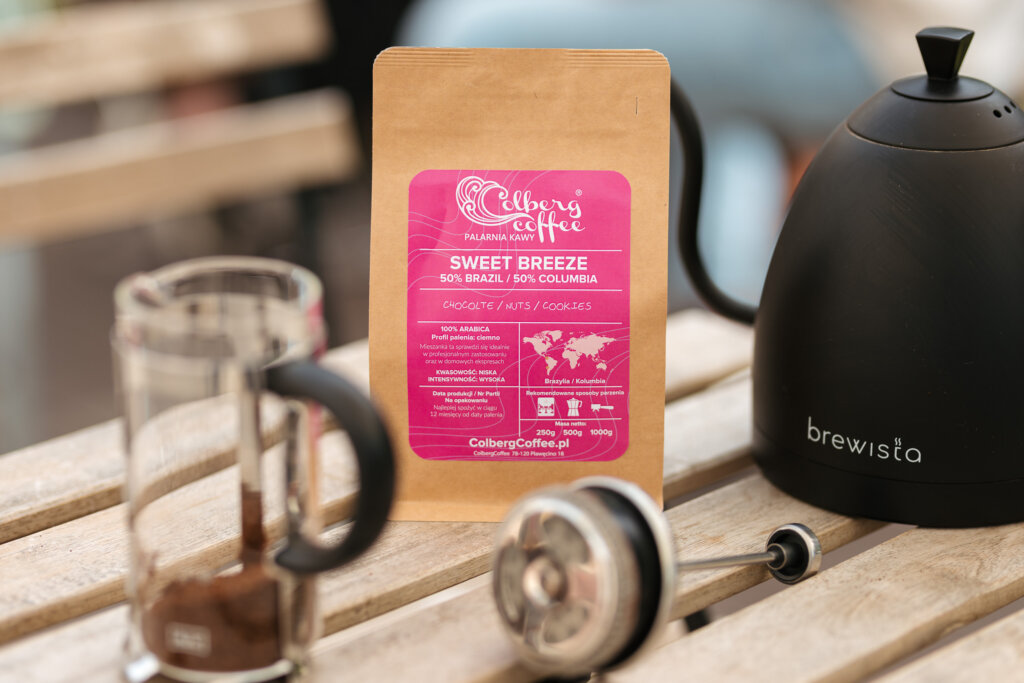
How to brew coffee in a French press, step by step
1. Warm the jug. Pour in a little hot water, swirl it around and tip it out. Cold glass can pull several degrees out of the brew in the first minute, which is exactly when most of the extraction happens.
2. Weigh and grind the coffee. Weigh out 15 g of coffee per 250 ml of water. Grind coarse, noticeably coarser than for a pour-over. Grinding it ahead of time instead of right before brewing is where you lose the most aroma.
3. Pour in all the water at once. Aim for 92-96°C, water that has rested a moment after boiling. Pour it in one go, the full amount, rather than in stages.
4. Stir straight away. One turn with a spoon is enough to wet all the coffee evenly. Put the lid on and leave the plunger pulled right up. Don’t press it down yet.
5. Wait 4 minutes. Near the end of the brew, skim off the crust and foam floating on the surface with a spoon. The cup comes out cleaner, with less sediment.
6. Press the plunger down slowly. All the way to the bottom, without forcing it. Strong resistance means the grind was too fine.
7. Pour the coffee out straight away. This is the most important step, and the one most people skip. Coffee left in the jug under the plunger keeps brewing and turns bitter within a few minutes.
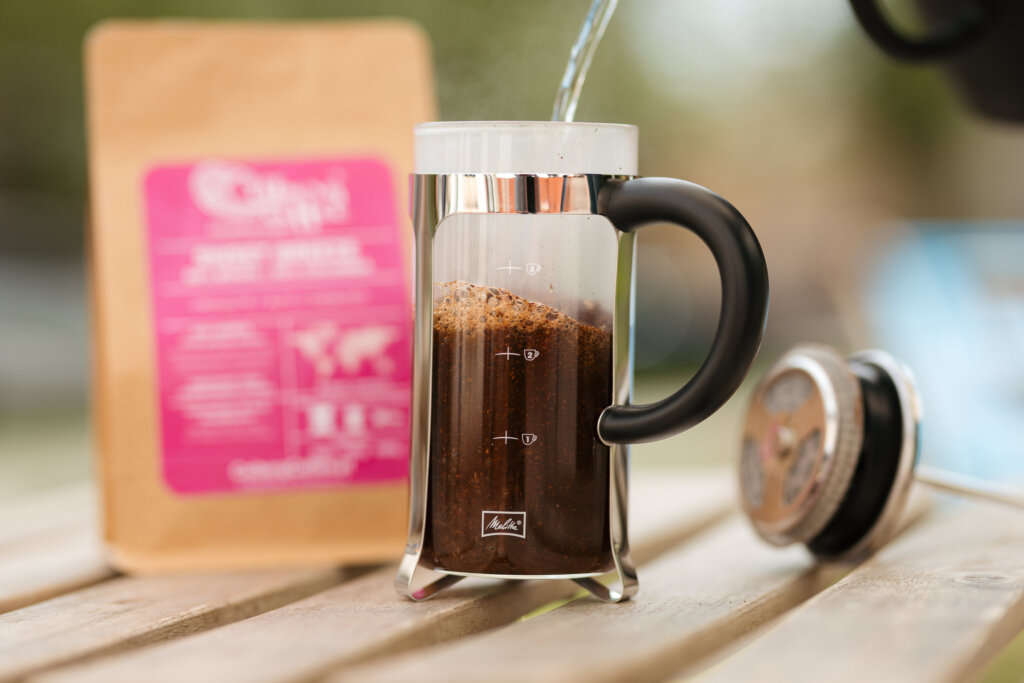
Coffee-to-water ratio for a French press
The starting point is 60 g of coffee per litre of water. That’s where we begin every test brew, then adjust from there for a specific coffee. If the brew comes out too strong, drop to 55 g per litre. If it’s too watery, go up to 65 g.
One note on capacity. Manufacturers quote the volume right up to the rim of the jug, but in practice you pour in around 10 percent less, since the plunger and the space under the lid take up room. That’s why the table below shows both the nominal capacity and the amount of water that actually fits.
| Brewer capacity | Water | Coffee | Cups |
|---|---|---|---|
| 350 ml (3 cups) | 300 ml | 18 g | 1 large or 2 small |
| 500 ml (4 cups) | 450 ml | 27 g | 2 |
| 800 ml (6 cups) | 700 ml | 42 g | 3 |
| 1 l (8 cups) | 900 ml | 54 g | 4 |
A kitchen scale is worth more here than any piece of gear that costs a small fortune. A tablespoon of coffee can be anywhere from 5 to 9 g depending on the grind and the density of the bean, so measuring by spoon can throw the ratio off by tens of percent.
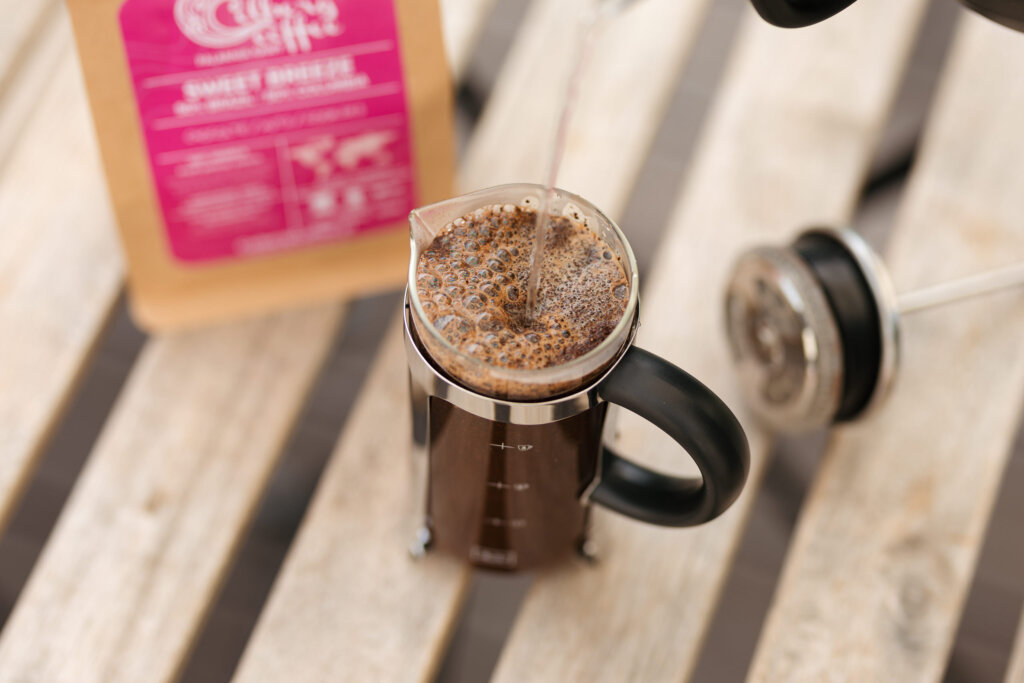
What grind size to use for a French press
Coarse. The particles should look like coarse sugar or coarse beach sand, not flour. It’s the coarsest grind of all the popular home brewing methods.
The reason is mechanical. The metal filter has holes measured in tens of microns, and anything finer passes straight into the cup. Too fine a grind causes three problems at once: the plunger meets resistance, the brew turns cloudy, and the taste turns bitter, because the fine particles extract much faster than the rest.
A burr grinder has the edge over a blade grinder here, not because it costs more, but because it gives a consistent particle size. A blade grinder produces large chunks and dust at the same time, and in a French press that dust goes straight into your cup. If you’re still deciding on a grind size for your method, we’ve covered it in a separate article: how to grind coffee for every brewing method.
Ground coffee bought off the shelf is almost always ground for filter or espresso, which means too fine. If you don’t have a grinder, ask for a coarser grind when you buy it and say outright that you’re brewing in a French press.
What coffee to use in a French press
A French press forgives more than a pour-over, because the long immersion evens out differences in grind. Coffee from any roast profile works, though each profile gives a different result.
Medium and darker roasts come out the most predictable. The brew’s full body lifts the sweetness and nutty, chocolatey notes, and the metal filter lets through the oils that carry them.
Light roasts work too, despite what you often hear. They just need hotter water, closer to 96°C, and sometimes a longer brew, 5 minutes instead of 4. That way the acidity comes through as fruitiness rather than sourness.
In the photos we’re brewing Tanzania Ngila Estate AA, a medium roast with notes of blackcurrant, black tea and jasmine. In a French press those notes come through with an especially full body. We’ve written more about choosing beans here: coffee for a French press.
The Hoffmann method: French press without pressing the plunger
James Hoffmann popularised a version where the plunger barely does any work. Instead of pushing the grounds down, you let them settle on their own. The brew comes out noticeably cleaner, with almost no cloudiness and barely any sediment at the bottom of the cup.
The process is the same up to the four-minute mark. Then, instead of pressing the plunger, you stir the brew a few times to break up the crust on the surface. The grounds then start sinking to the bottom. Skim off the foam and anything still floating with a spoon. Leave the jug for another 5 to 8 minutes.
At the end, dip the plunger just below the surface, without pressing it to the bottom, and pour the coffee out slowly, without tipping the jug all the way. The last centimetre, along with the grounds, stays in the jug.
It takes around ten minutes instead of four, and it’s worth it for light-roast specialty coffees, where a clean cup matters more than speed. For your morning coffee before work, the classic four minutes will do.
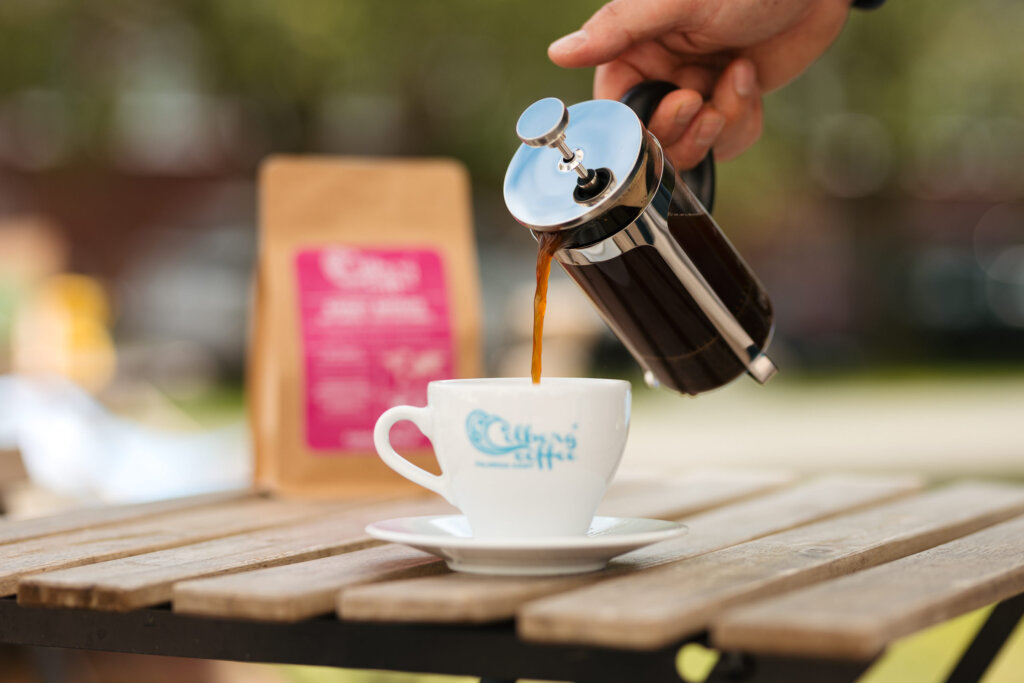
How a French press works, and where the full body comes from
A French press is an immersion method. The coffee sits fully submerged in water for the whole brew, unlike a pour-over, where water flows through the bed and out the other side. That gives it a different extraction dynamic, and makes it less sensitive to your pouring technique.
The second difference is the filter. Paper traps fine particles and most of the coffee oils, including cafestol and kahweol. A metal filter lets both through. That’s why a French press brew has a denser, more buttery body and a more pronounced aroma, and why there’s always a bit of sediment left at the bottom of the cup.
This isn’t a flaw to fix, it’s a feature of the method. If the sediment bothers you, you have two options: grind coarser, or use the no-press variation described above. Filtering the brew through paper at the end defeats the whole point of using a French press.
The most common mistakes when brewing in a French press
Leaving the coffee in the jug after brewing. Mistake number one. Extraction doesn’t stop the moment you press the plunger down. A second cup poured ten minutes later will taste bitter, even if the first one was fine. Pour out the whole batch straight away, and if you drink slowly, use a smaller brewer.
Grinding too fine. The plunger meets resistance, a layer of grounds ends up in the cup, and the brew turns cloudy and bitter.
Pouring boiling water straight from the kettle. Water straight off the boil is 100°C and scorches the coffee, especially a light roast. Just wait 30 to 60 seconds after it boils.
Not stirring after pouring. Some of the coffee stays dry on the surface and doesn’t extract at all. The brew comes out weak and uneven from the same dose.
Pressing the plunger down too fast. It stirs the grounds back up and ruins clarity. Pressing down should take a good ten seconds, not two.
Measuring by spoon instead of by weight. The cheapest mistake to fix, and the most underrated.
Which French press to choose
With this method, the gear matters less than it does for a pour-over or espresso. Three things count: a capacity that matches how much you actually drink, the material of the jug, and the quality of the filter.
Capacity. Choose it for a single brew, not for headroom. A one-litre brewer used half full performs worse, since the brew cools faster and sits on the grounds for longer.
Material. Borosilicate glass lets you see what’s happening inside and is neutral in flavour, but loses heat faster and can be broken. Stainless steel holds its temperature and survives a drop, but you’re brewing blind.
Filter. It should sit flush against the walls all the way round. A filter that doesn’t seal lets grounds slip past the sides, and no grind size fixes that. A plunger that comes apart into separate layers is much easier to clean properly.
| Model | Capacity | Material | Best for |
|---|---|---|---|
| Melitta Coffee Maker Premium | 350 ml | borosilicate glass, steel | getting started with the method, microwave-safe jug |
| Bialetti Preziosa | 350 ml | glass, stainless steel | one or two cups a day |
| Bialetti Preziosa | 1 l | borosilicate glass, 18/10 steel | breakfast for the whole table |
| Steel French press | 350 ml | stainless steel | office, travel, keeps heat |
| Barista & Co Plunge Pot | 300 ml | glass, steel | coffee, cold brew and milk frothing |
You’ll find all these models in the French press category in our shop.
French press versus AeroPress, pour-over or moka pot
French press versus pour-over. A pour-over gives a clear, light brew with more pronounced acidity. A French press gives something denser and heavier. Pour-over needs paper filters and an even pour, a French press needs nothing but a spoon.
French press versus AeroPress. An AeroPress brews faster, makes a single serving and is practically indestructible, so it wins for travel. A French press makes four cups at once and doesn’t use any filters. We’ve covered it separately: AeroPress, step by step.
French press versus moka pot. A moka pot forces water under pressure through finely ground coffee and gives a strong brew closer to espresso. That’s a different flavour category, not a better or worse one. If you want to compare all the home brewing methods side by side, we’ve put them together here: the best coffee brewing methods at home.
What else you can brew in a French press
Cold brew. Same coffee, same grind, just cold water and 12 to 16 hours in the fridge. Use a stronger ratio, around 80 g per litre, since the brew is usually diluted afterwards with water or milk.
Loose-leaf tea and cascara. The filter holds back the leaves, and the plunger lets you stop the brew at exactly the point you want. With green tea, remember to use a lower water temperature.
Milk frothing. Pour warm milk in to about a third of the jug’s height and pump the plunger for 30 to 60 seconds. You’ll get a dense, light foam for a milky coffee. It won’t work for latte art, since it’s not microfoam, but it’s more than good enough for a cappuccino at home.
How to clean and look after a French press
After brewing, tip out the grounds and rinse the jug and plunger under running water straight away, before any coffee residue dries onto the filter. Grounds don’t go down the sink, put them in the bin or a plant pot instead.
Most plungers can be taken apart into several filter layers held together with a spring that presses the filter against the walls. It’s worth washing them separately once a week. Coffee particles and old fat build up between the layers, and that fat is exactly what causes a rancid taste in the next brew.
Whether a French press is dishwasher-safe depends on the specific model, not just the material. Some glass jugs are dishwasher-safe according to the manufacturer, while some steel finishes are the opposite. The Barista & Co Plunge Pot we sell is hand-wash only, according to the manufacturer. Check your model’s instructions before putting the brewer in the dishwasher.
Every few months, degrease it with a proper coffee equipment cleaner. Water and washing-up liquid alone won’t shift the oils that build up on the filter.
Where the French press comes from
The first patent for an early ancestor of this brewer was filed in France by Mayer and Delforge in 1852. The filter was made of fabric and didn’t seal tightly against the walls, so some grounds still made it into the brew. An improved version, closer to today’s design, was patented in 1929 by the Italians Attilio Calimani and Giulio Moneta.
Large-scale production was taken up by the French companies Melior and Martin, and the biggest push behind its worldwide popularity came from the Danish company Bodum with its 1974 Chambord model. Most manufacturers still copy that shape today.
In Polish you’ll also come across the terms prasa francuska and praska francuska, both meaning “French press”. It’s the same method and the same device, just a different name.
How much coffee should you put in a French press?
Start with 60 g of coffee per litre of water, or about 15 g per 250 ml. For a 350 ml brewer, weigh out 18 g of coffee and pour in 300 ml of water. It’s a solid starting point that you can adjust later to your own taste.
What grind size should you use for a French press?
Coarse, noticeably coarser than for a pour-over or espresso machine. The particles should look like coarse sugar. Too fine a grind clogs the metal filter and gives a cloudy, bitter brew.
How long do you brew coffee in a French press?
Usually around 4 minutes from pouring the water to pressing the plunger. Near the end, it’s worth skimming the crust and foam off the surface with a spoon. Light roasts may need 5 minutes.
What water temperature should you use for a French press?
Ideally 92-96°C, water left to sit for 30 to 60 seconds after boiling. Water straight off the boil scorches the coffee and pulls out bitterness.
Why does French press coffee come out cloudy with sediment?
The metal filter lets through more fine coffee particles and oils than a paper filter. That gives the brew a fuller body, but there’s always a bit of sediment left at the bottom of the cup. A coarser grind cuts it down significantly.
Is a French press the same thing as a “prasa francuska”?
Yes. In Polish, prasa francuska, praska francuska and zaparzacz tłokowy are all names for the same device. In practice, the English name “French press” is the one most commonly used.
Does light-roast coffee work in a French press?
Yes. It just needs water closer to 96°C and sometimes an extra minute compared to a medium roast. At those settings, the acidity comes through as fruitiness rather than sourness.
Can you wash a French press in the dishwasher?
It depends on the specific model, not just the material. Some glass jugs are dishwasher-safe according to their manufacturers, while some steel finishes need hand-washing. Check the instructions for your brewer.
