Ristretto, espresso and lungo are the same coffee and the same dose in the portafilter. Only one thing separates them: how much liquid you let out of it. You stop ristretto early, pull espresso to the classic point, and let lungo run on.
Most guides describe these three drinks in millilitres and leave it there. Below is the full set of parameters: dose in grams, ratio, extraction time and grind size for each one. There’s also a table that sorts out lungo, americano, caffè crema and long black, plus a section on cortado, because that question comes up with all of these drinks.
Ristretto, espresso and lungo: the parameters
The figures below are for a double shot, the standard 18 g basket, because that’s how most cafés brew today and it’s the easiest to repeat at home. The output is given in grams, since weighing is more accurate than judging the level in the cup by eye.
| Parameter | Ristretto | Espresso | Lungo |
|---|---|---|---|
| Dose | 18 g | 18 g | 18 g |
| Output | 18-27 g | 36 g | 54-72 g |
| Ratio | 1:1 to 1:1.5 | 1:2 | 1:3 to 1:4 |
| Extraction time | 20-25 s | 25-30 s | 35-50 s |
| Grind | finer | base setting | coarser |
| Character | dense, sweet, low acidity | balanced | lighter, more bitter |
If you’re brewing a single shot from a 9 g basket, just halve all the weights. The ratio and timings stay the same.
What is ristretto
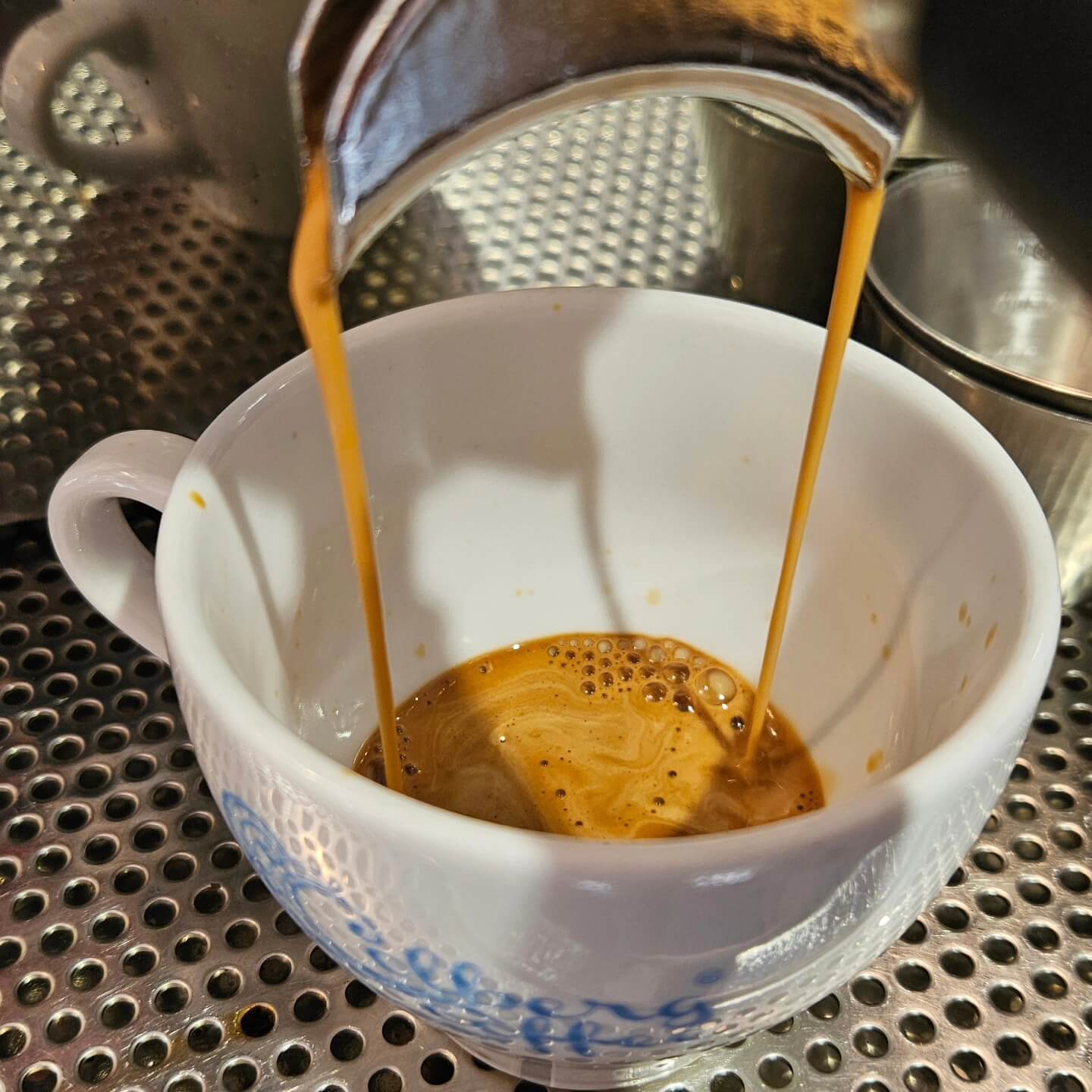
Ristretto, Italian for restricted, is espresso stopped halfway through. From 18 g of coffee you let out 18 to 27 g of liquid instead of 36 g, cutting the extraction before it starts pulling out the compounds responsible for bitterness.
The result is counterintuitive. Ristretto tastes stronger but contains less caffeine than espresso pulled from the same dose. Stronger, because it’s denser and has a higher concentration of dissolved solids. Less caffeine, because shorter contact with water simply extracts less of it overall.
In the cup you get concentrated sweetness, a pronounced body and very low acidity. It’s a good choice with darker roasts and with beans that come out too sharp as espresso. Ristretto is drunk in one go, from a small cup, no top-ups.
Important: ristretto isn’t espresso cut short on the same grind setting. Done that way it comes out sour and under-extracted. To get it right you need to grind finer, more on that below.
What is lungo
Lungo, meaning long, is the opposite of ristretto. From the same 18 g dose you let out 54 to 72 g of liquid, running the extraction for 35 to 50 seconds.
The drink is bigger, lighter in body and has more caffeine than espresso, because more water simply extracts more of it. Flavour-wise it’s trickier: the last phase of extraction pulls mostly bitter, astringent compounds out of the coffee.
A typical cup volume is 60 to 90 ml. Capsule systems call a 110 ml serving lungo, which is closer to an americano than a classic lungo from a portafilter machine. Worth keeping in mind when comparing recipes.
Why lungo usually turns out bitter
This is the most common problem with lungo and it has one cause: you’re running more water through a bed that’s set up for espresso. Extraction goes further than it should and pulls the worst out of the coffee.
There’s one fix, and it’s about changing the grind, not the time. Grind coarser. A coarser grind offers less resistance, so a bigger volume passes through the bed without pushing contact time to the limit. From 18 g in 45 seconds you’ll then pull 60 g of liquid that isn’t bitter.
The second adjustment is temperature. If your machine lets you control it, go 1 to 2 degrees lower than for espresso. Bitterness during a long extraction rises along with temperature. We covered this separately in our piece on brew time and extraction.
The third factor is the bean. Coffee roasted for espresso tends to be darker, and the darker the roast, the sooner bitterness shows up in a longer extraction.
How to set the grinder for ristretto and lungo
The rule is simple and follows directly from how much water needs to pass through the bed in roughly the same time.
For ristretto, grind finer. More resistance slows the flow, so less water passes through the coffee in 20 to 25 seconds. Start from your espresso setting and move one or two clicks towards finer. If the time jumps past 30 seconds, back off half a step.
For lungo, grind coarser. Less resistance lets more water through. Move two or three clicks towards coarser and aim for 60 g of liquid in 40 to 45 seconds.
In practice this means you can’t get a good ristretto and a good lungo from one grinder without changing the setting. If you drink both at home, set the grinder for the one you drink more often and treat the other as occasional. We go into more detail on choosing grind size in our guide to grinding coffee for every method.
Lungo, americano, caffè crema and long black
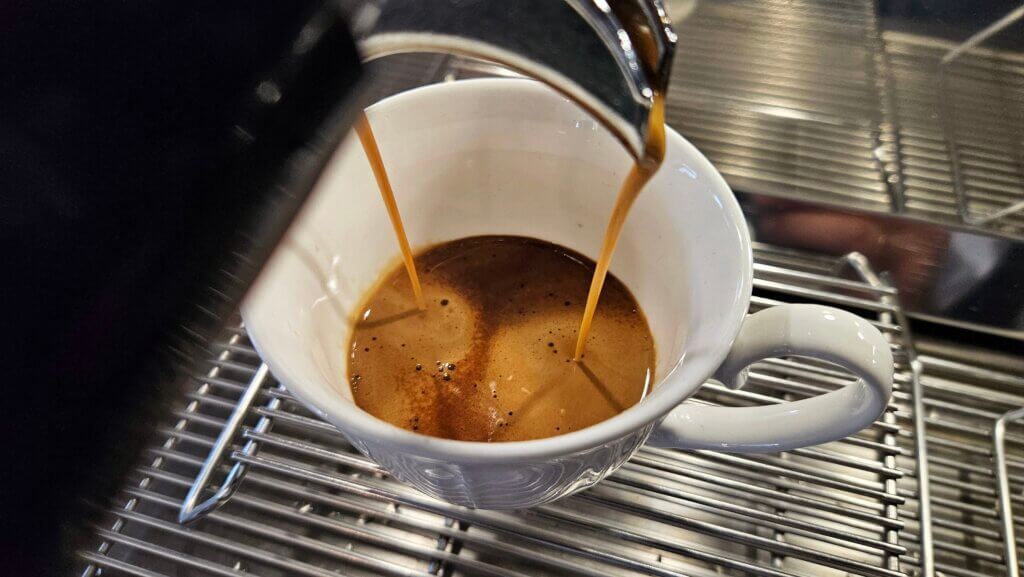
Four big black coffees that get mixed up constantly. The difference comes down to whether the water passes through the coffee or is added to it afterwards.
| Drink | How it’s made | Volume | Character |
|---|---|---|---|
| Lungo | all the water passes through the coffee | 60-90 ml | intense, easy to over-extract into bitterness |
| Americano | espresso diluted with hot water | 120-180 ml | mild, no added bitterness |
| Long black | espresso poured onto hot water | 100-150 ml | like americano but keeps the crema |
| Caffè crema | a very long extraction from a coarser grind | 120-180 ml | light body, thick foam |
A practical note on bean-to-cup machines: the button labelled caffè crema usually pours something that’s technically a lungo. That’s where a lot of the confusion in descriptions comes from. If you want a closer look at americano, we covered it in a separate post: what is an americano.
How much caffeine is in ristretto, espresso and lungo
Contrary to what intuition suggests, ristretto, the strongest tasting of the three, has the least caffeine. The dose of coffee is the same, so what decides it is how much water passed through it.
Caffeine dissolves readily and comes out of the coffee relatively early, though not all at once. The longer water flows through it, the more caffeine ends up in the cup. So from the same 18 g dose you get the least caffeine in ristretto, more in espresso, and the most in lungo.
Concentration is a different matter. Per millilitre, ristretto is by far the strongest, because it packs the same coffee into roughly half the volume. That’s why it feels the most stimulating, even though the full serving contains the least caffeine.
Cortado: espresso cut with milk
Cortado takes its name from the Spanish cortar, to cut. The milk is there to cut the sharpness of the espresso, not dilute it, which is why the ratio is even: 1:1, roughly 25 to 30 ml of espresso and the same amount of milk, served in a small glass of 130 to 150 ml.
The key detail is the milk. For cortado you only steam it to heat it, without frothing. It should be smooth and warm, with minimal microfoam and no visible layer on top. That’s what sets it apart from a cappuccino more than the ratio itself.
The drink comes from Spain and is particularly associated with the Basque Country. There are plenty of local variants: tallat in Catalonia, ebaki in Basque, noisette in France, Cuban cortadito made with condensed milk, and the Australian piccolo latte.
Cortado versus macchiato, flat white and cappuccino
| Drink | Espresso to milk | Volume | Foam |
|---|---|---|---|
| Macchiato | 1:0.5 | 60-80 ml | a dash of foam |
| Cortado | 1:1 | 130-150 ml | virtually none |
| Flat white | 1:3 to 1:4 | 150-170 ml | thin microfoam |
| Cappuccino | about 1:5 | 150-180 ml | a distinct layer |
What about the Gibraltar
The Gibraltar is in practice a cortado, just served in a specific glass: the Libbey Gibraltar, holding around 135 ml. The name comes from that glass and caught on in San Francisco. It’s usually made with a double espresso, so about 60 ml of coffee and 75 ml of milk. Where people do distinguish between the two, it’s on the glass and the dose.
We wrote more about milk drinks, and where one ends and the next begins, in our comparison of latte and cappuccino.
Which coffee for ristretto and lungo
For ristretto, medium and darker roasts with pronounced sweetness and a dense body work well. A short extraction accentuates whatever is sweet and heavy, so the coffee needs to have that to begin with. Light roasts often come out sour as ristretto, because they don’t get the chance to fully extract.
For lungo it’s the other way round. A long extraction forgives less and quickly pulls bitterness out of a dark roast, so it’s better to reach for beans roasted medium or lighter, with enough acidity left to balance the bigger volume.
From our own roasts, Brazil Mogiana works well for ristretto, and Tanzania Ngila Estate AA for lungo and cortado. If you want to understand where the density we call body comes from, we’ve covered it here: coffee body.
Ristretto, espresso and lungo: FAQ
What’s the difference between ristretto and espresso?
The dose is identical, they differ in how much liquid comes out. From 18 g of coffee, ristretto is 18 to 27 g in 20 to 25 seconds, espresso is 36 g in 25 to 30 seconds. Ristretto is denser, sweeter and less acidic.
How many millilitres is a lungo?
A classic lungo from a portafilter machine is 60 to 90 ml, or 54 to 72 g of liquid from a double 18 g dose. Capsule systems call a 110 ml serving lungo, which is already closer to an americano.
Does ristretto have more caffeine than espresso?
No. From the same dose, ristretto has the least caffeine, because less water passed through the bed. It is the strongest per millilitre, though, which is why it feels more stimulating.
What’s the difference between lungo and americano?
In a lungo all the water passes through the coffee, in an americano espresso is diluted with hot water added separately. That makes lungo more intense and easier to tip into bitterness, and americano milder.
Why is my lungo bitter?
Because you’re running more water through a bed set up for espresso. Grind two or three clicks coarser and aim for 60 g of liquid in 40 to 45 seconds. Dropping the temperature by 1 to 2 degrees helps too.
Is caffè crema the same as lungo?
Not in theory, but often in practice. Caffè crema is a long extraction from a coarser grind, and the button with that name on bean-to-cup machines usually pours a drink that’s technically a lungo.
What is a cortado?
Espresso cut with an equal amount of milk, at a 1:1 ratio, usually 25 to 30 ml of coffee and the same amount of milk in a 130 to 150 ml glass. The milk is only steamed to heat it, with no frothed layer on top.
What’s the difference between cortado and a Gibraltar?
Practically nothing, apart from the glass. A Gibraltar is a cortado served in a Libbey Gibraltar glass holding around 135 ml, usually made with a double espresso, so 60 ml of coffee and 75 ml of milk.
