












If you start with 1 kg of green coffee, you will typically end up with 760 to 880 g after roasting. What accounts for the difference? In his 2014 book The Coffee Roaster’s Companion, Scott Rao states that coffee beans lose 12% to 24% of their weight during roasting, with slightly lower losses possible in the lightest roasts. At the same time, the beans increase considerably in volume. I’ll explain what the beans lose during roasting, why they expand and why every batch is weighed.
In this article, you’ll learn:
- how much roasted coffee 1 kg of green coffee yields at different roast levels,
- why coffee beans increase in volume despite losing weight,
- how roasters measure weight loss and why bean colour alone is not enough to assess a roast.
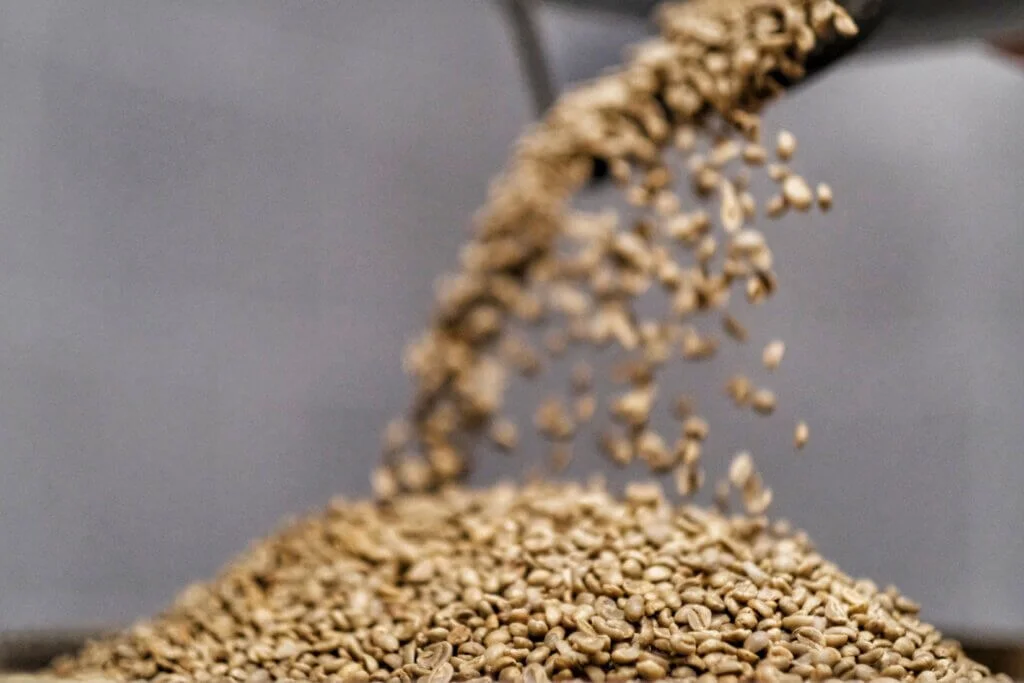
How much weight does coffee lose during roasting?
Weight loss depends primarily on the initial moisture content of the green coffee, the roast level and the degree of development inside the beans. Weight loss is generally greater with darker roasts. The table below shows approximate values for different stages of roasting. The resulting weights in grams are based on my own calculations.
| End point of the roast | Weight loss | Weight remaining from 1 kg |
|---|---|---|
| towards the towards the end of first crack, probably the lightest drinkable roasts | 11-13% | 870-890 g |
| approximately 30 seconds after the end of first crack | 14-16% | 840-860 g |
| onset of second crack | 17-18% | 820-830 g |
| dark roast with visible surface oils | 22% or more | 780 g or less |
The figures in the table apply to coffee with an initial moisture content of 10-12% and a roast duration of 11-12 minutes. Results can vary considerably under different conditions. For comparison, the light roasts popular in the specialty coffee industry in 2014 typically lost 14-16% of their weight on average. You can read more about the differences between roasts in our article on coffee roast levels and profiles.
What coffee beans lose during roasting: water and more
Water accounts for the largest proportion of weight loss. In light roasts, it can account for up to 90% of the total loss. The remaining loss consists of organic matter, primarily carbon dioxide, along with small amounts of silverskin, carbon monoxide, nitrogen, volatile aromatic compounds and volatile acids. The loss of organic matter increases with darker roasts. In medium roasts, it accounts for 5-8% of the weight, while in very dark roasts it can reach 12%.
During a typical roast, the moisture content of the beans falls from 12% to 2% of their weight, while their carbon dioxide content rises to 2%. The beans continue to lose moisture throughout most of the roasting process, even after they begin to brown. This is why Rao considers the term ‘drying phase’, commonly used to describe the first few minutes of roasting, misleading. It implies that the coffee stops losing moisture once this stage ends, whereas moisture loss continues.
Coffee beans lose weight, expand and become less dense
During roasting, coffee beans expand to 150-190% of their original volume while losing weight. As a result, their density falls by almost half. This expansion is driven by the pressure of water vapour and carbon dioxide accumulating inside the beans. The pressure enlarges the pores and gradually stretches the cellulose structure. Once the structure can no longer stretch, cracks begin to form. First crack is driven primarily by water vapour pressure, while second crack is driven mainly by the build-up of carbon dioxide. Roasted beans are considerably more brittle and porous than green beans.
How much green coffee is needed for 1 kg of roasted coffee?
Weight loss also affects production costs. According to my calculations, a weight loss of 15% means that approximately 1.18 kg of green coffee is needed to produce 1 kg of roasted coffee. If the loss increases to 22%, the amount required rises to around 1.28 kg. Given the same purchase price for green coffee, greater weight loss means a higher green coffee cost per kilogram of finished product. This needs to be factored into the price of each bag. We cover the other production and selling costs in our article on the price of coffee.
How roasters measure coffee weight loss
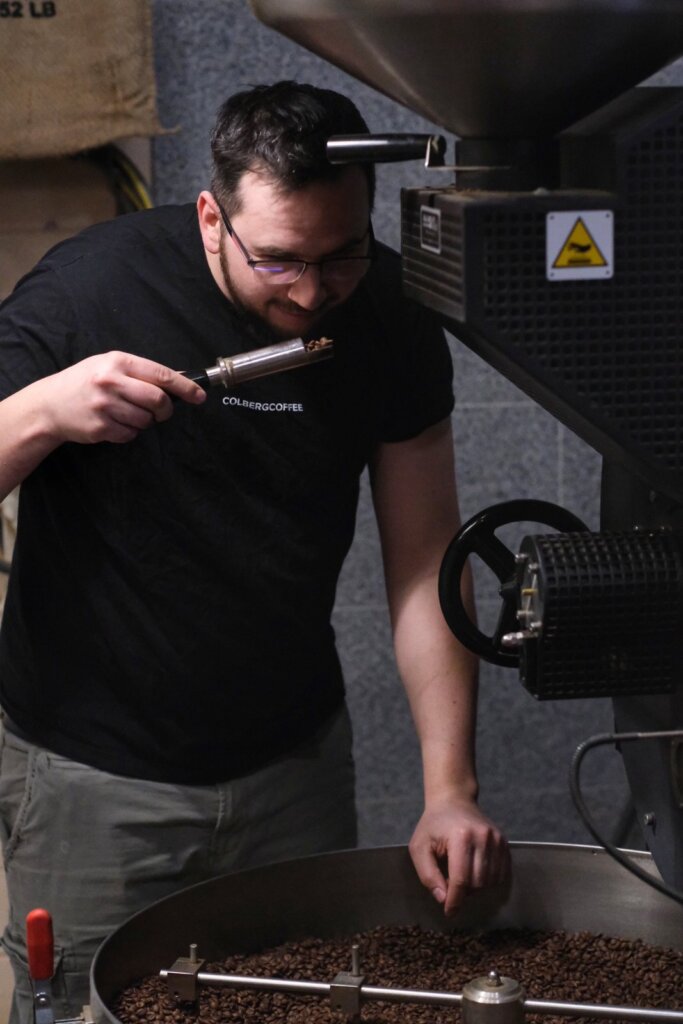
Calculating weight loss requires just two measurements. First, weigh the green coffee, then weigh the same batch after roasting. Divide the difference by the initial weight of the beans. For example, if 1000 g of green coffee yields 850 g of roasted coffee, the weight loss is 15%. All you need is a set of scales with a resolution of 0.005 kg or finer, and a routine of weighing every batch. The result provides additional insight into internal bean development, which cannot be assessed from surface colour alone. Rao recommends evaluating weight loss alongside the final bean temperature, bean colour and structure.
Same colour, different weight loss
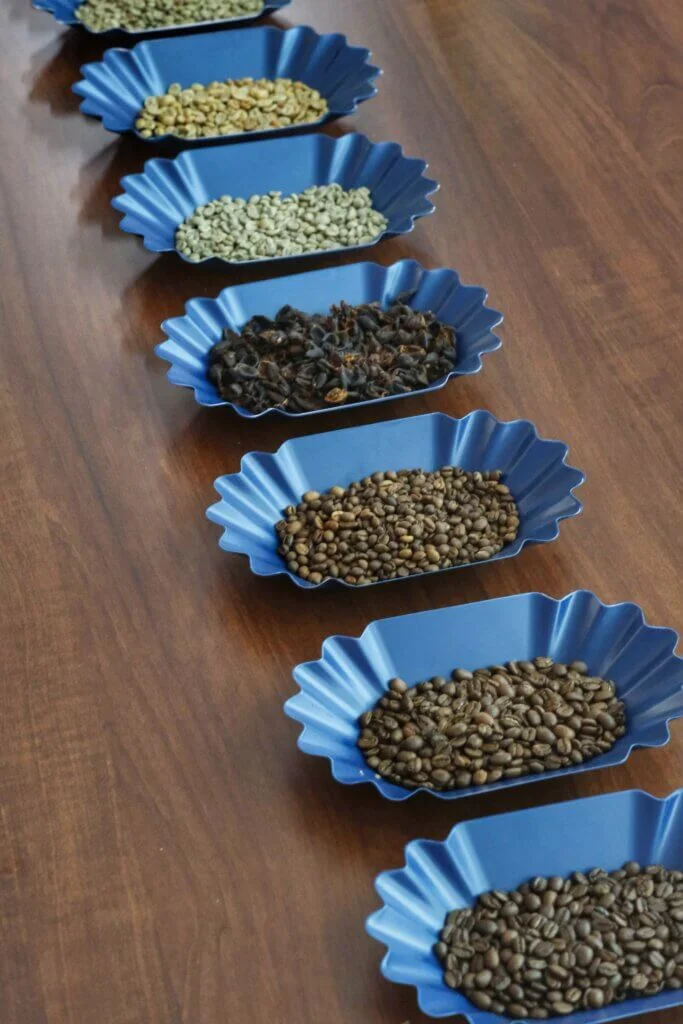
Two batches of the same coffee can have almost identical colour yet differ in their degree of internal bean development. Surface appearance alone is therefore not enough to assess a roast. Two examples from the book illustrate how these differences can be identified.
The first example focuses on weight loss. If two batches of the same coffee roasted to an identical colour lose 15.0% and 14.5% of their initial weight respectively, Rao considers the batch with a 15.0% weight loss to be more developed. In this case, greater weight loss may indicate better internal bean development. However, the comparison is only meaningful if the coffee has the same initial moisture content.
The second example focuses on espresso extraction. Suppose two batches of coffee with identical roast colours are brewed using the same parameters, including temperature, extraction time, coffee dose and beverage weight. The first achieves an extraction yield of approximately 19.0%, while the second averages 16.5%. If these results are consistent across repeated tests, the first batch is almost certainly better developed. The beans look similar but differ in how readily their soluble compounds can be extracted. This illustrates why roast quality should not be assessed solely by colour.
When lower weight loss does not indicate a roasting fault
Lower weight loss does not always mean something went wrong during roasting. The book gives the example of a Kenyan coffee that loses 14.8% of its weight during roasting in early November. After storage in jute sacks, the same coffee loses just 14.0% when roasted in mid-December using an identical roast profile. The difference is due to a change in the moisture content of the green beans. In the cool, dry winter air, the beans lost some of their moisture before roasting, resulting in lower weight loss during the roast.
For this reason, weight loss should not be compared directly across different coffees. Even for the same lot, comparisons are only meaningful if the initial moisture content of the green beans remains unchanged. Rao recommends purchasing green coffee with a moisture content of 10.5-11.5% and suggests that temperatures of 20-22°C and relative humidity of 45-50% are likely to help maintain consistent quality during storage. He also describes his experience during his first winter at the roastery. His green coffee lost too much moisture and roasted too quickly. To prevent similar problems, he installed a humidifier the following autumn.
What is the ideal weight loss during coffee roasting?
There is no single correct weight loss figure that applies to every coffee. Nor is there a universal threshold for determining whether a specialty coffee roast is good or bad. Measuring weight loss helps maintain roast consistency, but the results must be considered alongside other parameters and the flavour of the brewed coffee. Darker roasting can soften sour or harsh notes caused by underdevelopment, but it also reduces sweetness and aroma. Greater weight loss alone is therefore no indication of a better roast.
If you enjoy coffees with pronounced sweetness and a rich aroma, explore our light roast coffee category. For espresso and milk-based drinks, we also recommend our range of medium roast coffee. You can learn more about how heat transforms coffee beans in our article on coffee roasting.
Key takeaways
- Coffee typically loses 12% to 24% of its weight during roasting. This means that 1 kg of green beans yields 760 to 880 g of roasted coffee.
- Water accounts for most of the weight loss. The darker the roast, the greater the loss of organic matter.
- Weight loss helps assess how a roast has progressed, but it also depends on the initial moisture content of the green beans. Results for different coffees should therefore not be compared directly.
What percentage of its weight does coffee lose during roasting?
Typically 12% to 24%, depending on the moisture content of the green beans and the roast level. The light roasts popular in the specialty coffee industry in 2014 lost 14-16% of their weight on average. With dark roasts, where oils appear on the surface of the beans, weight loss is 22% or more.
How much roasted coffee does 1 kg of green coffee yield?
One kilogram of green coffee typically yields 760 to 880 g of roasted coffee. The exact amount depends on weight loss during roasting. For example, a weight loss of 15% leaves 850 g of roasted coffee.
What escapes from coffee beans during roasting?
Primarily water, which can account for up to 90% of the total weight loss in light roasts. The remainder consists mainly of carbon dioxide, along with small amounts of silverskin, other gases and volatile compounds.
Why are roasted coffee beans larger but lighter?
During roasting, pressure from water vapour and carbon dioxide stretches the bean structure, increasing its volume to 150-190% of its original volume. At the same time, the bean loses water and some organic matter, causing its density to fall by almost half.
How do you calculate coffee roasting weight loss?
Subtract the weight of the roasted coffee from the weight of the green coffee. Divide the difference by the initial weight of the green coffee. If 1000 g of green coffee yields 850 g of roasted coffee, the weight loss is 15%.
Does low weight loss indicate a poor roast?
Not necessarily. Weight loss is also influenced by the initial moisture content of the green beans. Lower weight loss does not necessarily indicate a roasting fault, and results for different coffees should not be compared without accounting for differences in moisture content.
Przeczytaj też
Kopi Luwak: The Coffee from Droppings I Don’t Recommend
Kopi Luwak costs a fortune, yet its supposedly exceptional quality remains questionable. Behind this famous
Nov
Paper, Metal or Cloth Coffee Filters: Which to Choose?
Paper retains most coffee oils and fine particles, metal lets more of them through, and
Nov

Christmas Coffee Recipes: 5 Ideas from a Barista
Five Christmas coffee recipes you can make at home, including drinks from our café's winter
Nov

Cyber Monday 2026: When Is It and How to Stock Up on Coffee
Cyber Monday 2026 falls on 30 November. Find out how it started, what we have
Nov
Jamaica Blue Mountain Coffee: Is the Legend Worth the Price?
For years, Jamaica Blue Mountain was regarded as one of the world's finest coffees, and
Nov
How much water do coffee grounds retain? Where does it go?
From 350 g of water, you get around 302 g of brewed coffee. We explain
Nov
V60 Pouring Height: What Does Physics Say?
Does pouring from higher up always improve coffee agitation? Physics shows that there is a
Nov
Why Does Coffee Taste Different as It Cools?
Coffee left on your desk can taste completely different from how it tasted just after
Nov

This site is protected by reCAPTCHA. The Google Privacy Policy and Terms of Service apply.