











You buy another bag of the same coffee. Neither the label nor the roast profile has changed, yet the coffee tastes a little different from last time. Your grinder or brewing method may not be responsible. Even with identical roaster settings, one batch can differ from the next. The temperature of the machine, the weather and the condition of the green beans all play a part. At our roastery, we work to minimise these differences, so I know how many variables need to be controlled during roasting. Drawing on Scott Rao’s 2014 book The Coffee Roaster’s Companion, I will explain why roasts can differ and what can be done to keep the flavour as consistent as possible from bag to bag.
In this article, you will learn:
- why the first roast of the day often differs from subsequent batches,
- how weather, chimney draught and batch size affect the roasting process,
- how a roastery identifies differences between roasts.
Why the same coffee tastes different between roasts
Four main factors affect roast consistency: the thermal energy stored in the roaster, the temperature and moisture content of the green beans, ambient conditions and the cleanliness of the exhaust ducts. A change in just one of these factors can affect how the beans heat up during the next roast. Even reproducing the previous day’s settings exactly does not guarantee an identical result.
Why the first roast of the day can be different
Before the first roast, the machine needs to be thoroughly warmed up. A probe reading at the charge temperature does not necessarily mean the roaster is ready. The air and the probe heat up relatively quickly, but the heavy metal components of the roaster take longer. If we charge the coffee too early, the cooler components will absorb heat and the beans will initially heat up more slowly. Only after a few batches does the roaster store enough thermal energy to produce consistent results in subsequent batches. There is no practical way to measure this energy precisely, so the warm-up procedure needs to be refined based on roasting results.
While cupping Cup of Excellence coffees, Rao noticed that two samples were less developed than the others. He correctly guessed that they came from the first and second roasts of the day. Why does this happen? Imagine charging two batches of coffee at an identical probe reading of 204°C. The drum surface might be at 260°C during the first charge and 271°C during the second. The displayed temperature is the same, but the drum transfers a different amount of heat to the beans.
How to warm up a roaster before the first batch
Many roasteries heat their machines to the charge temperature and hold it there for 15-30 minutes. According to Rao, this procedure is often insufficient because the metal components of the machine are still too cool. He recommends heating the roaster to a higher temperature and then gradually lowering it before the first charge. Here is the recommended procedure:
- Set the airflow to the average level you intend to use during roasting.
- With the gas at a medium or high setting, heat the roaster until the bean temperature probe reads 28°C above the intended charge temperature.
- Hold the elevated temperature for 20 minutes.
- Reduce the gas and allow the temperature to fall gradually to the charge temperature. Hold it there for 10 minutes.
- Charge the first batch of coffee and roast it using the same gas and airflow settings as for subsequent batches.
This procedure needs to be tailored to the individual roaster. If the first roast progresses too quickly, lower the peak temperature during the next warm-up. If the coffee roasts too slowly, hold the elevated temperature for longer. Over the following days, compare how the first roast progresses with subsequent roasts. After a few trials, you should have a good idea of which warm-up procedure works best for your machine.
What to do between roasts
After the first roast, the machine needs to be properly prepared for the next batch. Reaching the charge temperature alone is not enough, as the roaster may have more or less heat stored in it than before. A consistent routine helps, with each adjustment made at a predetermined time. It is best to use a timer and follow the same sequence every time:
- After dropping the coffee, reduce the airflow to the lowest setting used during roasting.
- Turn off the gas for 1 minute.
- Adjust the gas so that the probe reading reaches the charge temperature within 60-90 seconds.
- Hold the charge temperature for 1 minute, then charge the next batch of coffee.
Sometimes the procedure needs adjusting. After a darker roast, the machine retains more heat, so the gas can be left off a little longer. Adjustments may also be necessary after exceptionally light roasts. Once the between-batch procedure is well suited to the machine, differences in total roast time between successive batches can be as little as 5-10 seconds at most. This makes it easier to maintain a consistent roasting process throughout the day.
How batch size affects the roasting process
Consistent results are easiest to achieve when every batch of coffee weighs the same. If you need to roast different quantities, it is best to roast all the smaller batches first before moving on to the larger ones. Each change in batch size may require different settings. Smaller batches generally need less gas, lower airflow, slower drum rotation and a lower charge temperature. Very small batches also present a temperature measurement problem. If the beans do not fully cover the probe, its readings become less accurate. It is therefore best to develop a separate roast profile for each batch size. In Rao’s experience, many roasters perform best with batches weighing 50-70% of their rated capacity. Batches below 25% of capacity can be more difficult to roast properly.
Weather and chimney draught matter too
Weather conditions also affect roaster performance. On a cold, dry day, the chimney draught may be stronger, increasing airflow through the machine. Cooler air in the roastery also contains more oxygen per unit of volume. This affects gas combustion in the burner and, consequently, the amount of heat transferred to the beans. A roast profile that worked well in July may therefore need adjusting in January. Monitor the bean temperature throughout the roast and adjust the settings to suit the prevailing conditions.
Keeping the chimney and exhaust ducts clean is equally important. During roasting, deposits accumulate on their inner surfaces and restrict airflow. These deposits build up more quickly when roasting darker coffees, so the ducts require more frequent cleaning. Cleaning should take place every few hundred hours of operation, approximately every 200 roasting hours, depending on production volume and roast level. Regularly removing these deposits helps maintain proper airflow and reduces the risk of fire.
Green coffee changes during storage
Even when roaster settings remain unchanged, the properties of green coffee can change during storage. Suppose a lot of Kenyan coffee loses 14.8% of its weight during roasting in early November. By mid-December, using the same roast profile, the weight loss has fallen to just 14.0%. This is due to moisture loss while the beans are stored in jute sacks. Over several weeks, some of the moisture in the beans has escaped into the surrounding air, resulting in less weight loss during roasting. I discuss this in more detail in my article how much weight does coffee lose during roasting?. When coffee is stored in hermetic bags, controlling the storage temperature is sufficient. With jute sacks, ambient humidity also needs to be monitored.
Another challenge arises when a new shipment of green coffee arrives. Even if we intend to achieve the same roast level, the coffee may require a different profile. Finding the right settings through trial and error can take anywhere from a few days to several weeks. During this time, customers may receive coffee of inconsistent quality. It is therefore best to assess every new lot of green beans before the first roast. Measuring moisture content, density and bean size helps determine how best to apply heat and reduces the number of trial roasts needed.
How roasteries identify differences between roasts
Assessing a roast requires more than a single measurement. Roasters compare the temperature curve, percentage weight loss, final bean temperature, and the colour and structure of the beans. Knowing how to interpret these data is important. Probe readings during the first 2-3 minutes of roasting can be misleading, so avoid drawing premature conclusions from them. Colour alone is also insufficient. Two batches of coffee may look identical while the beans have developed differently on the inside. This can be further assessed by comparing extraction yields using a refractometer. For reliable results, the samples must be brewed under identical conditions.
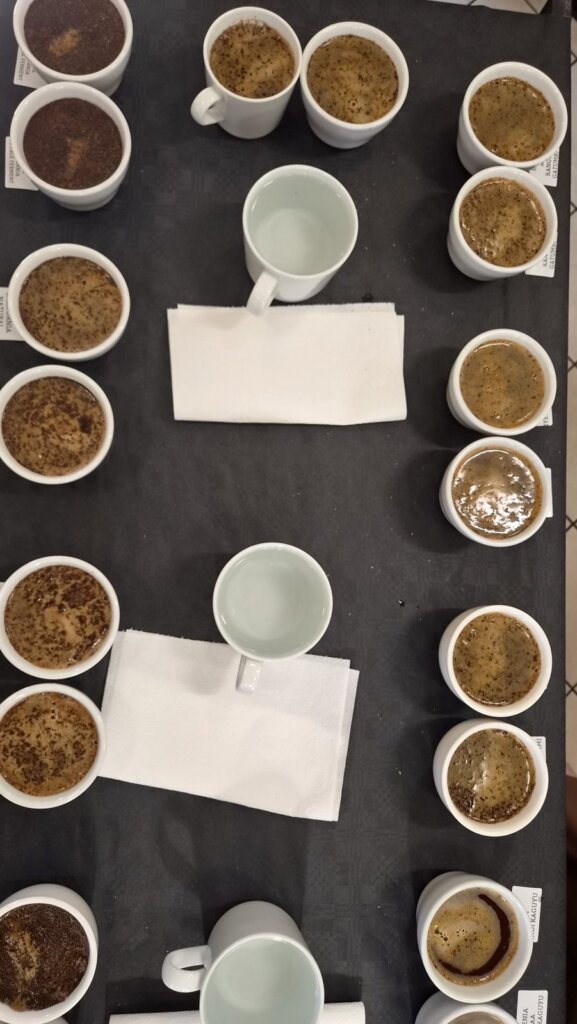
Measurements are useful, but ultimately, you need to taste the coffee. Cupping allows roasts to be compared by preparing every sample according to the same procedure. The amount of ground coffee, the amount of water, grind size and brewing time must all be identical. Even an extra 10 g of water can noticeably affect extraction and the flavour of the brew. Ideally, the tasting should be conducted blind, without knowing which samples are being evaluated. If possible, do this the day after roasting. I describe the entire procedure in my article coffee cupping: how a roastery evaluates coffee.
| What you taste in the cup | What it may indicate, according to Rao |
|---|---|
| umami or brothy flavour | severely underdeveloped coffee |
| grassy flavour | slight underdevelopment |
| sourness or flavours of unripe fruit | adequate internal development, but an excessively light roast |
| paper, cardboard, straw | baked coffee |
| smoky flavour in coffee that has not been dark-roasted | insufficient airflow towards the end of the roast |
| burnt flavour | beans scorched by an overheated drum |
| soggy cereal | insufficient airflow or an irregular rate of rise (ROR) |
Not every flavour we detect during cupping is a result of the roasting process. Raspberry or lavender notes may be natural characteristics of a particular coffee. Flavours reminiscent of grass, cardboard or burnt material, however, may indicate roasting defects. Rao’s table also identifies several degrees of over-roasting, assigning each a separate category. When assessing a roast, it is therefore important to consider both the characteristics of the green coffee and how it was roasted.
Can coffee always be roasted in exactly the same way?
In my view, a consistent roast profile is fundamental to good roasting practice, but it does not guarantee identical flavour. The 5-10 seconds mentioned earlier refers to the difference in total roast time between successive batches. However, the beans develop throughout the entire roast, including before first crack. The way the temperature changes from the beginning to the end of the roast is therefore important. Two batches with similar total roast times can produce different results in the cup. The book also does not specify how much variation in flavour is acceptable before a roast should be considered faulty.
At Colbergcoffee, we roast coffee 2-4 times a week, so maintaining consistency is an ongoing part of our work. If your next bag of the same coffee tastes slightly different, it may be due to a change in how the coffee was roasted or the arrival of a new shipment of green beans. You can learn more about the entire process in our article on coffee roasting.
Key takeaways
- Differences between roasts are influenced by the thermal energy stored in the roaster, the condition of the green coffee, weather conditions and the cleanliness of the chimney.
- Consistent warm-up and between-batch procedures can limit differences in total roast time between successive batches to 5-10 seconds.
- Bean colour alone is not sufficient to assess roast consistency. It is best to combine measurements with blind cupping.
Why does the same coffee taste different from one bag to the next?
Differences between roasts may be one reason. The roasting process is affected by the thermal energy stored in the roaster, the temperature and moisture content of the green beans, ambient conditions and the cleanliness of the exhaust ducts. The flavour of the coffee may also change when a new shipment of green beans arrives.
Does the first roast of the day differ from subsequent batches?
The first roast may progress differently if the roaster has not been warmed up sufficiently. The probe may already indicate the correct charge temperature while the metal components of the machine remain cooler. Under these conditions, the beans heat up more slowly than during subsequent roasts.
How long should you warm up a coffee roaster?
Scott Rao recommends holding the roaster at a temperature 28°C above the intended charge temperature for 20 minutes, followed by 10 minutes at the charge temperature itself. These 30 minutes do not include the time needed for initial heating and gradually lowering the temperature. The entire procedure should be tailored to the individual roaster.
What should you do between roasts?
After dropping the coffee, reduce the airflow and turn off the gas for 1 minute. Then adjust the gas so that the probe reading reaches the charge temperature within 60-90 seconds. Hold this temperature for 1 minute before charging the next batch of coffee.
What is the best batch size for roasting coffee?
Many roasters perform best with batches weighing 50-70% of their rated capacity. Each batch size should have its own roast profile, tailored to the quantity of beans and the capabilities of the machine.
Is it possible to achieve identical flavour across roasts?
You can improve roast profile consistency and minimise differences between batches, but guaranteeing identical flavour is difficult. The book does not specify an acceptable degree of flavour variation or a percentage of flavour similarity that would allow two roasts to be considered identical.
Przeczytaj też
Kopi Luwak: The Coffee from Droppings I Don’t Recommend
Kopi Luwak costs a fortune, yet its supposedly exceptional quality remains questionable. Behind this famous
Nov
Paper, Metal or Cloth Coffee Filters: Which to Choose?
Paper retains most coffee oils and fine particles, metal lets more of them through, and
Nov

Christmas Coffee Recipes: 5 Ideas from a Barista
Five Christmas coffee recipes you can make at home, including drinks from our café's winter
Nov

Cyber Monday 2026: When Is It and How to Stock Up on Coffee
Cyber Monday 2026 falls on 30 November. Find out how it started, what we have
Nov
Jamaica Blue Mountain Coffee: Is the Legend Worth the Price?
For years, Jamaica Blue Mountain was regarded as one of the world's finest coffees, and
Nov

How much water do coffee grounds retain? Where does it go?
From 350 g of water, you get around 302 g of brewed coffee. We explain
Nov
V60 Pouring Height: What Does Physics Say?
Does pouring from higher up always improve coffee agitation? Physics shows that there is a
Nov

Why Does Coffee Taste Different as It Cools?
Coffee left on your desk can taste completely different from how it tasted just after
Nov

This site is protected by reCAPTCHA. The Google Privacy Policy and Terms of Service apply.