

Caffè latte and latte macchiato are both made from espresso and milk, but they are two different drinks. What separates them is the order in which the ingredients go in and how well they are mixed.
Below you will find ratios in millilitres, milk temperature, step-by-step recipes and an explanation of where the layers in a latte macchiato come from. Contrary to common advice, it is not about pouring slowly.
Caffè latte vs latte macchiato: what really sets them apart
In a caffè latte the base is espresso, topped up with milk. In a latte macchiato the base is milk, and the espresso goes into the glass last.
| Feature | Caffè latte | Latte macchiato |
|---|---|---|
| Base | Espresso | Milk |
| Order | Espresso, then milk | Milk, then espresso |
| Vessel | Cup, 220-300 ml | Tall glass, 250-300 ml |
| Look | Uniform, often with latte art | Visible layers |
| Taste | Coffee and milk together, creamy | Milk first, then coffee |
| How much coffee you taste | Clearly | Subtly |
| Caffeine | The same, if both contain one espresso | |
The name gives it away. Macchiato is Italian for “stained”. A latte macchiato is literally milk stained with coffee, not coffee with milk. For the comparison with cappuccino, see our separate post on the differences between latte and cappuccino.
Caffè latte: espresso and milk in one structure
A caffè latte starts with espresso in a cup. Steamed milk with a smooth, glossy texture is poured over it, finished with a thin layer of microfoam. The key word is integration: coffee and milk should form one structure, not stay as separate layers.
A well-made latte is creamy, naturally sweet from the milk and clearly coffee-forward. The milk softens the espresso’s acidity but does not bury it. If after the first sip you cannot tell which coffee you are drinking, there is too much milk or the espresso was too weak.
You can pour latte art on a latte. The pattern forms when microfoam rises through the crema to the surface. It works the same way on a cappuccino and a flat white. In a latte macchiato there is no room for it, because the espresso goes into the glass last.

Latte macchiato: milk with espresso on top
A latte macchiato is made in the reverse order. Steamed milk goes into a tall glass first. You wait a moment until the foam clearly rises to the top, and only then add the espresso.
The difference is not only in appearance but also in taste. You experience the drink in stages: lots of milk first, then coffee, and finally the foam. Instead of one coherent flavour, you get a sequence. For some that is the appeal, for others a reason to order a latte.
You taste the coffee much less here. Not because there is less of it. In the standard version it is still one espresso. The proportion of milk is higher, though, and the ingredients are not integrated.
Where the layers in a latte macchiato come from
This is the most interesting part of the whole topic, and most guides explain it the wrong way round.
The mechanism behind the layers in a latte macchiato has been described scientifically. A Princeton University team, including Nan Xue and Howard Stone, published it in Nature Communications in 2017. The phenomenon is called double-diffusive convection, and it also occurs in the oceans.
The process has two stages. First, the espresso being poured mixes turbulently with part of the milk. Once the stream slows down, a gradient of concentration and temperature settles in the drink. The liquid then arranges itself into horizontal convection cells, which we see as bands.
The practical conclusion is counter-intuitive: pour the espresso fast, not slowly. In the study, layers only appeared once the pouring speed exceeded a critical value. With a stream that is too slow, the coffee does not penetrate the milk deeply enough to build the necessary gradient, so the bands do not form.
This arrangement is surprisingly stable. In the study, the layers lasted from several dozen minutes to a few hours, and even longer in the model system, until diffusion blurred them. Temperature equalising on its own does not remove them straight away.
Ratios: how much espresso, how much milk
These are our starting ratios, worked out in the café. Neither drink has a single codified recipe, so there are big differences between cafés. For comparison, Scott Rao describes a latte in a 180-240 ml cup, with 30-45 ml of espresso and foam about 6 mm thick. Our numbers fall within that range and are easy to repeat at home.
| Drink | Espresso | Milk | Vessel | Foam thickness |
|---|---|---|---|---|
| Caffè latte | Double, 18 g dose, 36-40 ml | 180-220 ml | Cup, 250-300 ml | About 0.5 cm |
| Latte macchiato | Single, 9 g dose, 25-30 ml | 150-180 ml | Tall glass, 250-300 ml | 2-3 cm |
The difference in the amount of foam is deliberate. A latte needs thin, dense microfoam that can be mixed in and used for a pattern. In a latte macchiato the foam is thicker because it forms the characteristic white top. It does not, however, hold the coffee in the middle layer. That is down to differences in density, the momentum of the stream and buoyancy, more on which shortly.
If the drink is too milky, you have two options. You can add a second espresso. The vessel stays full, but the caffeine and the cost per serving go up too. Or you can reduce the milk and stay with one espresso. Both corrections are valid. The choice depends on the volume and strength you want.
How to make a caffè latte step by step
- Pull a double espresso straight into a warm cup.
- Pour cold milk into the jug, roughly up to the base of the spout.
- Stretch the milk with the steam wand just below the surface until you hear a gentle hiss. Air has to go in right at the start, before the milk passes about 38°C, while the jug is still cool to the touch. How long this takes depends on the amount of milk, the steam pressure and the wand.
- Sink the wand deeper and build a whirlpool. The milk should spin, not bubble.
- Finish at 60-65°C. Without a thermometer: when you can no longer comfortably hold the jug in your hand.
- Tap the jug on the counter and swirl it until the surface is glossy and smooth, with no visible bubbles.
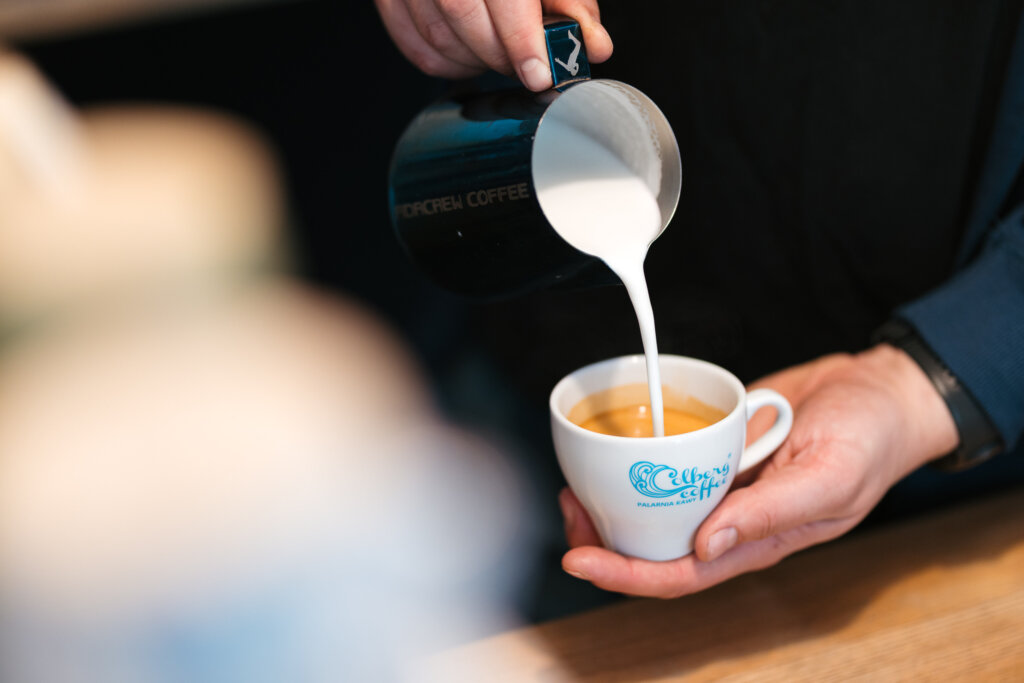
- Pour from a few centimetres up into the centre of the cup so the milk goes under the crema, then bring the jug down low at the end and draw the pattern.
The most common mistake at home is stretching the milk for too long. Instead of microfoam you get a stiff cap of froth that sits on the coffee and refuses to combine with it.
How to make a latte macchiato step by step
- Steam the milk as for a latte, but stretch it longer so there is more foam. Aim for the same 60-65°C.
- Pour the milk into a tall glass, to about two thirds of its height.
- Leave it for several dozen seconds until the foam rises to the top and forms a distinct, thick layer. This step is specific to this drink: with a latte it is the opposite, the milk is poured within the first 30 seconds because it loses texture over time.
- Pull a single espresso.
- Pour it quickly and decisively, in one stream, into the centre of the glass. The coffee will break through the foam and form a darker layer in the middle. This is not pure espresso but a mixture of coffee and milk at a different concentration, which sits above the denser milk.
If the layers do not form, the most common cause is pouring the espresso too slowly. The other causes are foam that is too thin and too small a temperature difference between the coffee and the milk.
Serve the drink straight away. The layers last a long time, but the milk cools, and then the drink loses sweetness.
Milk temperature: why 65 degrees is the limit
We finish steaming in the 60-65°C range, where the milk’s sweetness peaks. The workable range is 55-65°C.
More important than the number itself is the order of work. Air goes in at the start, before the milk passes about 38°C. After that you are only heating the milk and keeping it spinning. Stretching hot milk creates large bubbles that you cannot break down.
Overheating the milk above 70°C spoils the drink, but the reason is not as simple as is often claimed. Whey proteins, mainly beta-lactoglobulin, do denature at that point. Partial denaturation can, however, stabilise the foam. The problem lies elsewhere: the aroma of the milk changes, the texture gets worse and perceived sweetness drops. Lactose does not stop being sweet, but you stop perceiving it the same way.
That is why a barista finishes steaming earlier than many guests expect. The drink is not “too cold” then. It is at a temperature where you can taste the coffee.

Which milk to choose, including plant-based
We work with whole cow’s milk at 3.2 percent fat. Fat gives creaminess, protein holds the foam and lactose provides sweetness. Skimmed milk produces more abundant, drier foam. Some people like that, others do not. There is no single best choice. Differences can be clear even between suppliers of whole milk, so in a café it is worth comparing a few products in a blind test.
Of the plant-based drinks, the easiest to work with is oat in a barista version. Added fat improves the texture, while resistance to curdling comes mainly from stabilisers and acidity regulators. The properties depend on the recipe, so two drinks labelled “barista” can behave differently. Soya can be good but curdles more easily with more acidic coffees. Almond and rice usually foam less well, though there are exceptions. You will find more in our piece on how a plant-based drink changes the taste of coffee.
Plant-based drinks can be trickier in a latte macchiato, because the layers depend on density and temperature. Barista oat usually works. The others need testing.
Beyond the standard options, specialty cafés are also starting to use pea milk. It steams well and has no distinct flavour of its own.
Glass and cup: why the vessel matters
For a caffè latte, the shape of the bottom matters. A cup with a rounded, narrow bottom directs the milk under the crema and makes mixing easier. A wide, flat cup makes latte art easier because it gives you a larger surface. A capacity of 250-300 ml is a safe middle ground.
For a latte macchiato, choose a tall and narrow vessel. The espresso stream needs a path downwards, and the layers should be clearly visible from the side. A wide glass does not stop them forming, but the effect is much less legible. The drink also cools faster through the walls.
It is worth warming the vessel. Cold porcelain can lower the drink’s temperature by several degrees in a dozen or so seconds. When you start at 60°C, that is a noticeable difference.
Which coffee for a latte and a latte macchiato
For milk drinks we choose coffees with a medium or darker roast profile, with notes of chocolate, nuts, caramel and dried fruit. Milk weakens the more subtle characteristics of espresso, so the coffee needs enough strength relative to the milk’s volume. That does not mean every light-roast Ethiopia will disappear in milk. Dose, extraction, milk ratio and the specific profile decide that. Still, the more milk, the less sense it makes to pay for the most nuanced beans.
The more milk, the stronger the base has to be. In a latte macchiato, which has the most milk, espresso blends with a clear body work well, for example our Strong Storm or Jeremii Blend.
Freshness matters here just as much as in black coffee. We roast the coffee from our roastery continuously, twice a week.
Why latte macchiato is ordered less often in specialty cafés
Latte macchiato appears on specialty café menus less often than caffè latte. Not because it is worse. It simply does not show what such a café wants to put in the spotlight.
A roastery works for months so that you can recognise the origin of the beans, the process and the roast profile in the cup. A drink in which milk is the base and espresso an addition blurs those differences by definition. That is why specialty menus are shifting towards smaller milk drinks with a higher share of coffee.
It is not the only reason. The menu tradition, portion size and the expectations of a given venue’s guests also matter. Nor is it a reason to give up latte macchiato. It only explains why a barista may suggest a different drink if you say you want to taste a specific coffee.
Frequently asked questions about latte and latte macchiato
What is the difference between a latte and a latte macchiato?
Order and proportion. In a caffè latte the base is espresso, milk is poured onto it and the drink is uniform. In a latte macchiato the base is milk and the espresso goes on top at the end, which creates visible layers and makes the coffee much less noticeable.
How much espresso and milk goes into a latte macchiato?
We use one espresso from a 9 g dose, about 25-30 ml, and 150-180 ml of steamed milk in a tall 250-300 ml glass. The foam should be 2-3 cm. We make a caffè latte with a double espresso and 180-220 ml of milk. These are our recipes, not a binding standard: neither drink has a single codified definition.
Why does a latte macchiato have visible layers?
It is double-diffusive convection, described by a Princeton team in Nature Communications in 2017. The espresso first mixes turbulently with the milk, and once the stream slows down, a concentration gradient settles in the drink and the liquid arranges itself into horizontal convection cells, visible as bands. The condition is pouring the espresso above a certain critical speed: with a stream that is too slow, the coffee does not penetrate deeply enough and the bands do not form.
What temperature should you steam milk to?
Between 55 and 65°C. We finish at 60-65°C, where sweetness peaks. The order matters too: air goes in at the start, before the milk passes about 38°C. Overheating above 70°C changes the milk’s aroma, worsens the texture and lowers perceived sweetness.
Do a latte and a latte macchiato have the same caffeine?
If both contain one espresso, yes. The amount of milk does not change the caffeine content, only how strongly you taste the coffee. A caffè latte made with a double espresso will have twice as much caffeine as a latte macchiato made with a single.
Which plant-based milk works for a latte?
The easiest to work with is barista oat. Added fat improves the texture, while resistance to curdling comes mainly from stabilisers and acidity regulators. Properties depend on the specific recipe, though, so two drinks with the same description can behave differently. Soya curdles more easily with more acidic coffees, almond and rice usually foam less well.
