

Let me introduce the star of this article. The moka pot, also known as a caffettiera or a macchinetta, is a device that brews coffee under pressure. It is so simple that you will find one in homes all over the world, and in almost every Italian kitchen. Most are made of aluminium or steel, and I would take the classic aluminium one: it gives you more control over the brew. I still have my first moka pot and I have been brewing in it for years. It looks a little worn by now, but only on the outside. As a piece of equipment it is extremely durable, assuming you use it correctly and keep it clean. More on that in a moment. The simplicity of the moka pot is the best thing about it: look at the photo below and you will see three parts, the bottom chamber you fill with water, the funnel that holds the ground coffee, and the top chamber the finished coffee rises into.
Brewing in it is easy, but to get a good cup there are a few rules worth following.
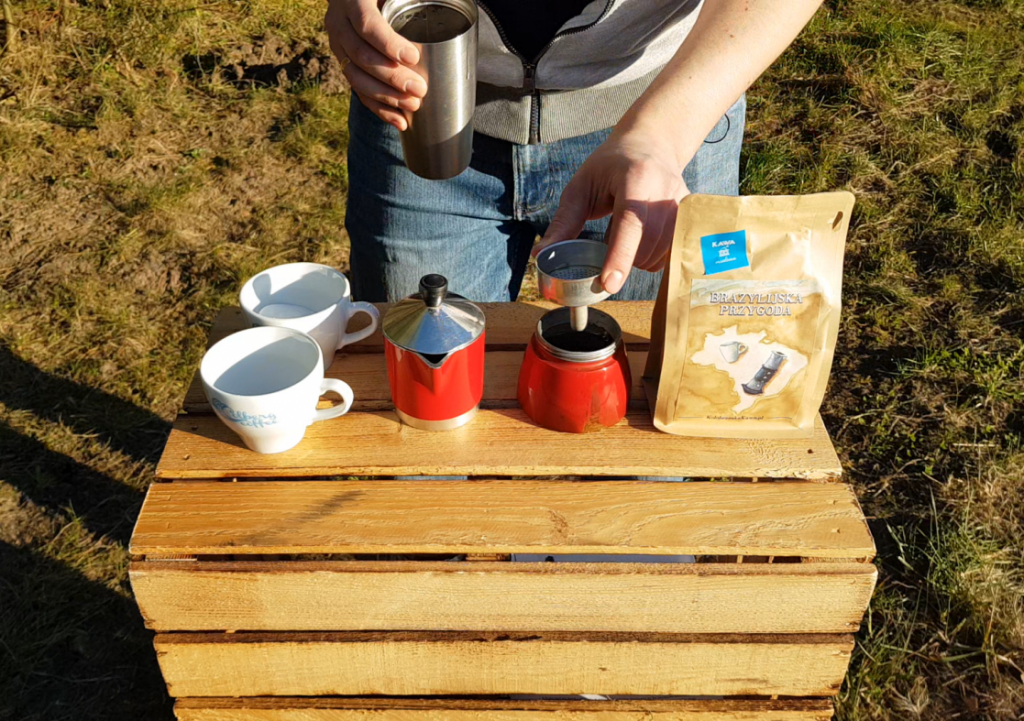
Video: how to brew good coffee in a moka pot
Water, and why it matters so much in a moka pot
Start with the water. It should be fresh and filtered. If your tap water still carries off-flavours such as chlorine, use a spring water with low mineral content, around 200 mg per litre. My reference is Żywiec Zdrój, a widely sold Polish spring water: coffee brewed on it comes out full in the cup. Still on water, heat it before you pour it into the bottom chamber. That stops the coffee scorching in the funnel. Here is why: if the water heats from cold inside the pot, the whole process takes longer, the pot gets hotter and so does the coffee bed, which can then scorch and leave you with a harsh, bitter cup. And fill the chamber to just below the safety valve, not above it.

Freshly roasted specialty coffee is half the job
The next thing is the coffee itself. Ideally it is freshly roasted, freshly ground specialty coffee, taken to a medium or dark roast. Refuse to compromise on quality and you get to enjoy a proper range of flavours and aromas. If you do not like acidity in coffee, pick beans from Brazil: they usually bring chocolate and nut aromas and a sweetness in the cup. Brazil is a good place to start with coffee in general. If you want to push further, look at Central America, say Honduras or Guatemala. You will still find chocolate there, along with fruit notes that give the cup a fantastic balance. And if you want fruity acidity front and centre, go to Africa. Today I am brewing with a blend of two excellent Brazilian arabicas, the sweet and chocolatey Brazylijska Przygoda.

How fine should you grind for a moka pot?
Grind size matters as much as bean quality. Broadly, a moka pot sits between espresso and pour-over, with particles about the size of fine sugar. Do not go finer than that, or the coffee turns bitter and over-extracted, because of how hot the water is during the brew. That heat is unavoidable: it is built into the design, since the water has to be pushed under pressure from the bottom chamber up through the coffee. So the only lever you have for softening its effect is a coarser grind. Supermarket pre-ground coffee will not work here, because it is ground too fine. If you do not own a burr grinder, find a roastery that will grind your beans for the moka pot. That is a far better option than a bag off the shelf or coffee ground in a blade grinder. We at Colbergcoffee will grind any of our coffees for you.

Filtering coffee in a moka pot
Which brings us neatly to filtration. As I said, the moka pot is a simple device, so the filtering is simple too. The metal screen inside has fairly wide holes, which lets coffee fines through into the finished brew. Fines in the cup mean particles that scratch at your throat and a loss of clarity in the flavour. The fix is a round paper filter of the kind used in the AeroPress. Wet it and stick it to the screen under the top section. Now the smallest particles stay on the filter and you get a better cup.
Brewing in a moka pot
- Pour hot water into the bottom chamber.
- Drop in the funnel and fill it with ground coffee, leaving 2 mm between the coffee and the rim.
- Level the coffee, but do not tamp it or press it down.
(the water is forced up from below, so tamping changes nothing)

- OPTIONAL rinse the paper filter with water and stick it to the screen under the top section.
- Screw the parts together, using something to protect your hands from the heat.
- Put the pot on the heat. Leave the lid open so you can watch the coffee come through, and when the colour starts turning straw-like, cool the base in a bowl of water or under the tap to stop the extraction.

- The coffee is ready. Pour it into a cup and drink it concentrated, like an espresso. If you want something less intense, top it up with hot water. And if you drink milk coffees, steam your milk and pour the coffee straight from the pot into it for a homemade latte macchiato. Enjoy.
Keep the moka pot clean
Look after the pot as well. Once it has cooled, wash it with water and dry it. Never put it in the dishwasher and never use cleaning chemicals on it: aluminium reacts with them and the surface can be ruined. Do not leave it in prolonged contact with water either, because aluminium oxidises and that damages the surface too. You will recognise the damage as dull blotches on the inside. If the surface does go, the pot belongs on a shelf as an ornament. Do not keep brewing in it, because it may be bad for your health.
Thanks for reading
Good of you to stay to the end. For more on coffee, have a look at the other posts on the site. You will find good specialty coffee in our roastery’s shop.
